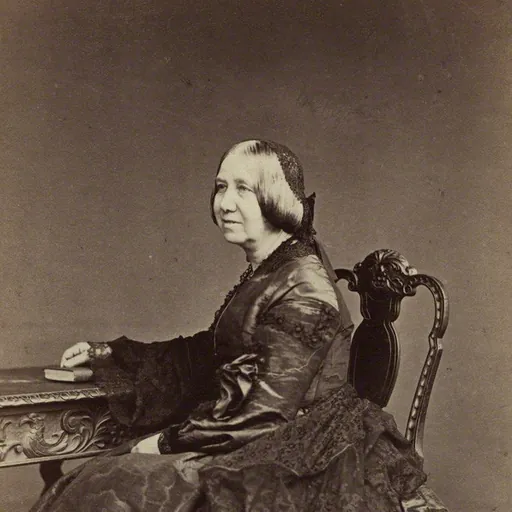
About Margaret Gillies
Lived 1803 – 1887 (aged 83). Margaret Gillies was a British painter.
Margaret Gillies (7 August 1803 – 20 July 1887) was a London-born Scottish miniaturist and watercolourist.
Biography Gillies was the second daughter of William Gillies, a Scottish merchant in Throgmorton Street, London, and his wife Charlotte Hester Bonnor (died 1811), daughter of Thomas Bonnor. Having lost their mother when Margaret was eight years old, and their father having met with business reverses, she and her older sister, Mary (1800–1870), were placed under the care of their uncle, Adam Gillies, Lord Gillies. They were educated by him, and then introduced to Edinburgh society.
Before she was twenty, Gillies decided to earn her own living, and returned with her sister to her father's home in London. Mary Gillies became an author, while Margaret took the direction of a professional artist. She received lessons in miniature-painting from Frederick Cruikshank, and gained a reputation for it. Cruikshank's style was based on that of Andrew Robertson. Margaret Gillies illustrated in 1842 Smith's first report as a mines inspector, on a tour in Leicestershire and West Yorkshire.
Around 1850 Gillies' studio was at 36 Percy Street, where she briefly gave a home to the "auto-icon" of Jeremy Bentham, on whose cadaver Southwood Smith had conducted a highly controversial public dissection in 1832. She went in 1851 to Paris for a year, where she worked in the studios of Hendrik and Ary Scheffer, and on her return to England she exhibited some portraits in oils. The Warren, Crockham Hill, where she died later that year, on 20 July, of pleurisy, after a few days' illness. and she gave early encouragement to Anna Mary Howitt and the portraitist Mary Field, wife of the architect Horace Field.
In 1866 Margaret bought a grave plot in the dissenters' section of the western side of Highgate Cemetery for a stillborn baby of Charles and Gertrude Lewes. Mary was later interred in this grave on 23 July 1870, as was Catherine, the widow of the poet and critic Richard Hengist Horne, on 6 September 1893. In the adjoining grave rests Caroline Southwood Hill (buried on 3 January 1903), Southwood Smith's daughter and mother of the social reformers Miranda Hill and Octavia Hill, the latter of whom jointly founded the National Trust. The ashes of Caroline's youngest daughter Florence was the last interment in December 1935. Although Margaret Gillies is memorialised on this grave she is buried elsewhere, presumably in Crockham Hill.
Works Before she was 24, Gillies was commissioned to paint a miniature of William Wordsworth, and stayed at Rydal Mount for several weeks. Pamela Gerrish Nunn wrote that she "combined an early-Victorian aesthetic with a mid-Victorian independence of mind".
Portrait artist During the 1830s and 1840s Gillies was a career portrait artist, and for many successive years contributed portraits to the exhibitions of the Royal Academy. Her subjects included feminist figures: Mary Leman Grimstone, Mary Howitt and her daughter Anna Mary Howitt, Harriet Martineau of the Monthly Repository group. She also painted the poet and critic Richard Hengist Horne and the novelist Anne Marsh-Caldwell. After viewing it there, Elizabeth Barrett Browning said that it showed Dickens with "the dust and mud of humanity about him, notwithstanding those eagle eyes". and acquired and restored by the art dealer Philip Mould in 2018.
Watercolourist In 1852 Gillies was elected an associate of the Old Society of Painters in Water Colours, and was a contributor to its exhibitions for the rest of her life. Her exhibited works included:
Past and Future, 1855, and The Heavens are telling, 1856, both of which were engraved Rosalind and Celia, 1857 Una and the Red Cross Knight in the Cavern of Despair, An Eastern Mother, and Vivia Perpetua in Prison, 1858 A Father and Daughter, 1859 Imogen after the Departure of Posthumus, 1860 Beyond, 1861 The Wanderer, 1868 Prospero and Miranda, 1874 Cercando Pace, a drawing in three compartments, 1875 The Pilgrimage, exhibited at the Royal Jubilee Exhibition at Manchester in 1887
Her last work was Christiana by the River of Life, exhibited in 1887.
Don’t just read it —
keep it.
Full-length biographies made to live with: read them, listen on the way to work, watch them tonight.
- E-book
- Audio
- Video
Instant download · yours to keep · every purchase keeps this site free
Important facts
Family & relationships
People in Margaret Gillies's life
Named in this biography and alive at the same time


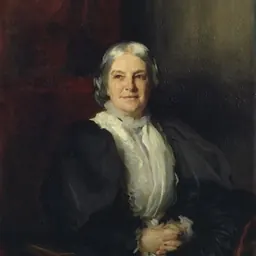
Related people
Same field, nearest in time


Contemporaries
People whose lives overlapped Margaret Gillies's





Frequently asked questions
Who was Margaret Gillies?
Scottish painter (1803-1887)
When was Margaret Gillies born?
Margaret Gillies was born on 7 August 1803 in London.
When did Margaret Gillies die?
Margaret Gillies died on 20 July 1887 in Crockham Hill.
What was Margaret Gillies's occupation?
Margaret Gillies was a painter.
What nationality was Margaret Gillies?
Margaret Gillies was British.
Sources & further reading
Cite this page
APA: Biography.guide. (2026). Margaret Gillies. https://biography.guide/margaret-gillies/
MLA: "Margaret Gillies." Biography.guide, https://biography.guide/margaret-gillies/.
Chicago: "Margaret Gillies." Biography.guide. https://biography.guide/margaret-gillies/.
Data last updated: 2026-09-23 · Spot an error? Report a correction.
Portrait: Wikimedia Commons · author & licence
Page generated 2026-09-27 05:06 UTC