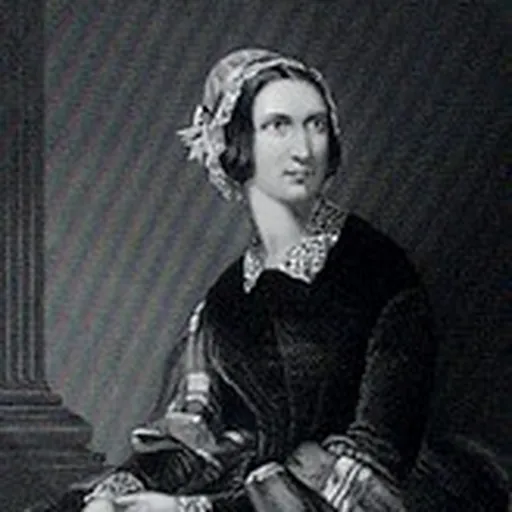
About Mary Howitt
Lived 1799 – 1888 (aged 88). Mary Howitt was a British linguist, poet, writer, translator and editor, known for Hans Christian Andersen bibliography.
Mary Howitt (12 March 1799 – 30 January 1888) was an English writer, editor, translator and a pioneer of the women's rights movement in the UK. She is most known as the author of the famous poem The Spider and the Fly. She translated several works by Hans Christian Andersen and Frederika Bremer. Some of her works were written in conjunction with her husband, William Howitt. Many, in verse and prose, were intended for young people.
Background and early life Mary Botham, daughter of Samuel Botham and Ann, was born at Coleford, Gloucestershire, where her parents lived temporarily, while her father, a prosperous Quaker surveyor and former farmer of Uttoxeter, Staffordshire, looked after some mining property. In 1796, aged 38, Samuel had married 32-year-old Ann, daughter of a Shrewsbury ribbon-weaver. They had four children: Anna, Mary, Emma and Charles. Their Queen Anne house is now called Howitt Place.
The Howitts lived initially in Heanor in Derbyshire, where William was a pharmacist. Not until 1823, when they were living in Nottingham, did William decide to give up his business with his brother Richard and concentrate with Mary on writing. Her Popular History of the United States, published in the United Kingdom in 1859 and the United States in 1860, was "quickly forgotten" in its time but has been praised in the 21st century as a "well-crafted work" that "surpassed all previous histories in its fluid literary style." Uniquely, she paid full attention to slavery, including its role in the north, and made "unprecedented criticisms" of slave codes in New York and South Carolina, compared the "so-called 1741 New York slave revolt" to the Salem witch trials, condemned the American Colonization Society, and pointed out the hypocrisy underlying the American Revolution, in which colonists contended for "their own liberty" while "depriving other people of theirs."
In 1853 they moved to West Hill in Highgate close to Hillside, the home of their friends, the physician and sanitary reformer Thomas Southwood Smith and his partner, the artist Margaret and her sister Mary Gillies. Mary Howitt had some years earlier arranged that the children's writer Hans Christian Andersen would visit Hillside to see the haymaking during his trip to England in 1847. After 1856 Mary, besides anonymous contributions to periodical literature of the day, edited with the assistance of her daughter A Treasury of Stories for the Young, in three volumes. Through her eldest daughter Anna Mary and her good friend Barbara Leigh Smith Bodichon, author of the pamphlet A Brief Summary of the Laws of England Concerning Women (1854), she became involved as secretary of the Married Women's Property Committee (MWPC). This committee included other eminent and established professional women writers and Leigh Smith's friends such as Anna Mary, Bessie Rayner Parkes and Eliza Bridell Fox. Leigh Smith drafted a petition, which was circulated nationally, with a request for signatures to support a Married Women's Property Bill. Of the 26.000 signatures which were gathered, Mary Howitt personally collected hundreds of signatures. At the head of the petition some respectable married women were placed such as Mary Howitt, Elizabeth Barrett Browning and Elizabeth Gaskell. She was also one of the 1500 women who signed the first mass petition for women's suffrage in 1866. Together with her married eldest daughter she continued the campaigns for votes for women and married women's property rights. They both contributed to a pamphlet Opinions of women on women's suffrage published by the Central Committee of the National Society for Women's Suffrage in 1879, pleading for votes for women.
Scandinavia "Ansitz Mair am Hof". The summer retreat in Dietenheim, near Brunico, 1871–1879 In the early 1840s Mary Howitt was residing in Heidelberg, where her literary friends included Shelley's biographer Thomas Medwin and the poet Caroline de Crespigny, and her attention was drawn to Scandinavian literature. She and a friend, Madame Schoultz, set about learning Swedish and Danish. She then translated into English and introduced Fredrika Bremer's novels (1842–1863, 18 vols). Howitt also translated many of Hans Christian Andersen's tales, such as
The men returned from Australia a number of years later. William wrote several books describing its flora and fauna. Margaret Howitt wrote the Life of Fredrika Bremer and a memoir of her own mother.
Mary Howitt's name was attached as author, translator or editor to at least 110 works. She received a silver medal from the Literary Academy of Stockholm, and on 21 April 1879 gained a civil list pension of £100 a year. In her declining years she joined the Roman Catholic Church, and was one of an English deputation received by Pope Leo XIII on 10 January 1888. Her Reminiscences of my Later Life were printed in Good Words in 1886. The Times wrote of her and her husband: Their friends used jokingly to call them William and Mary, and to maintain that they had been crowned together like their royal prototypes. Nothing that either of them wrote will live, but they were so industrious, so disinterested, so amiable, so devoted to the work of spreading good and innocent literature, that their names ought not to disappear unmourned.
Mary Howitt was away from her residence in Meran in Tirol, spending the winter in Rome, when she died of bronchitis on 30 January 1888.
Among those written independently of her husband were: Sketches of Natural History (1834) Wood Leighton, or a Year in the Country (1836) Birds and Flowers and other Country Things (1838) Hymns and Fireside Verses (1839) Hope on, Hope ever, a Tale (1840) Strive and Thrive (1840) Sowing and Reaping, or What will come of it (1841) Work and Wages, or Life in Service (1842) Which is the Wiser? or People Abroad (1842) Little Coin, Much Care (1842) No Sense like Common Sense (1843) Love and Money (1843) My Uncle the Clockmaker (1844) The Two Apprentices (1844) My own Story, or the Autobiography of a Child (1845) Fireside Verses (1845) Ballads and other Poems (1847) The Children's Year (1847) The Childhood of Mary Leeson (1848) Our Cousins in Ohio (1849) The Heir of Wast-Wayland (1851) The Dial of Love (1853) Birds and Flowers and other Country Things (1855) The Picture Book for the Young (1855) M. Howitt's Illustrated Library for the Young (1856; two series) Lillieslea, or Lost and Found (1861) Little Arthur's Letters to his Sister Mary (1861) The Poet's Children (1863) The Story of Little Cristal (1863) Mr. Rudd's Grandchildren (1864) Tales in Prose for Young People (1864) M. Howitt's Sketches of Natural History (1864) Tales in Verse for Young People (1865) Our Four-footed Friends (1867) John Oriel's Start in Life (1868) Pictures from Nature (1869) Vignettes of American History (1869) A Pleasant Life (1871) Birds and their Nests (1872) Natural History Stories (1875) Tales for all Seasons (1881) Tales of English Life, including Middleton and the Middletons (1881) with the "Lobster Quadrille", a parody of Mary's poem.
The poem became a Caldecott Honor Book in October 2003.
Don’t just read it —
keep it.
Full-length biographies made to live with: read them, listen on the way to work, watch them tonight.
- E-book
- Audio
- Video
Instant download · yours to keep · every purchase keeps this site free
Important facts
Family & relationships
People in Mary Howitt's life
Named in this biography and alive at the same time




Related people
Same field, nearest in time
Contemporaries
People whose lives overlapped Mary Howitt's






Frequently asked questions
Who was Mary Howitt?
English poet, and author, editor (1799-1888)
When was Mary Howitt born?
Mary Howitt was born on 12 March 1799 in Coleford.
When did Mary Howitt die?
Mary Howitt died on 30 January 1888 in Rome.
What was Mary Howitt's occupation?
Mary Howitt was a linguist, poet, writer, translator and editor.
What was Mary Howitt known for?
Mary Howitt was known for Hans Christian Andersen bibliography.
What nationality was Mary Howitt?
Mary Howitt was British.
Sources & further reading
Cite this page
APA: Biography.guide. (2026). Mary Howitt. https://biography.guide/mary-howitt/
MLA: "Mary Howitt." Biography.guide, https://biography.guide/mary-howitt/.
Chicago: "Mary Howitt." Biography.guide. https://biography.guide/mary-howitt/.
Data last updated: 2026-09-24 · Spot an error? Report a correction.
Portrait: Wikimedia Commons · author & licence
Page generated 2026-09-27 05:08 UTC