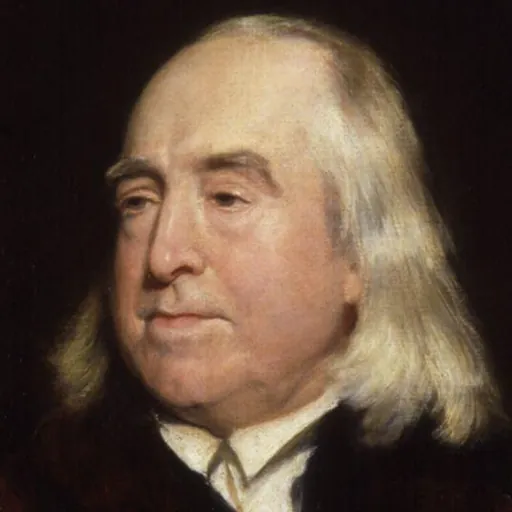
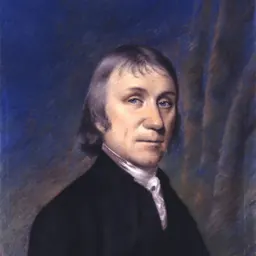
Jeremy Bentham
British philosopher, jurist, and social reformer
About Jeremy Bentham
Lived 1749 – 1832 (aged 83). Jeremy Bentham was a British and French philosopher, merchant, lawyer, political scientist, suffragist and human rights defender.
Jeremy Bentham (; 4 February 1747/8 O.S. [15 February 1748 N.S.] – 6 June 1832) was an English philosopher, jurist, and social reformer regarded as the founder of modern utilitarianism. He became a leading theorist in Anglo-American philosophy of law, and a political radical whose ideas influenced the development of welfarism. He advocated individual and economic freedoms, the separation of church and state, freedom of expression, equal rights for women, the right to divorce, and (in an unpublished essay) the decriminalizing of homosexual acts. He called for the abolition of slavery, and the abolition of capital punishment and physical punishment, including that of children. He has also become known as an early advocate of animal rights. Though strongly in favour of the extension of individual legal rights, he opposed the idea of natural law and natural rights (both of which are considered "divine" or "God-given" in origin), calling them "nonsense upon stilts". His wealthy family were supporters of the Tory party. He was reportedly a child prodigy: he was found as a toddler sitting at his father's desk reading a multi-volume history of England, and he began to study Latin at the age of three.
Bentham began to develop this model, particularly as applicable to prisons, and outlined his ideas in a series of letters sent home to his father in England. He supplemented the supervisory principle with the idea of contract management; that is, an administration by contract as opposed to trust, where the director would have a pecuniary interest in lowering the average rate of mortality.
The Panopticon was intended to be cheaper than the prisons of his time, as it required fewer staff; "Allow me to construct a prison on this model", Bentham requested to a Committee for the Reform of Criminal Law, "I will be the gaoler. You will see ... that the gaoler will have no salary—will cost nothing to the nation." As the watchmen cannot be seen, they need not be on duty at all times, effectively leaving the watching to the watched. According to Bentham's design, the prisoners would also be used as menial labour, walking on wheels to spin looms or run a water wheel. This would decrease the cost of the prison and give a possible source of income.
The ultimately abortive proposal for a panopticon prison to be built in England was one among his many proposals for legal and social reform. But Bentham spent some sixteen years of his life developing and refining his ideas for the building and hoped that the government would adopt the plan for a National Penitentiary appointing him as contractor-governor. Although the prison was never built, the concept had an important influence on later generations of thinkers. Twentieth-century French philosopher Michel Foucault argued that the panopticon was paradigmatic of several 19th-century "disciplinary" institutions. Bentham remained bitter throughout his later life about the rejection of the panopticon scheme, convinced that it had been thwarted by the King and an aristocratic elite. Philip Schofield argues that it was largely because of his sense of injustice and frustration that he developed his ideas of "sinister interest"—that is, of the vested interests of the powerful conspiring against a wider public interest—which underpinned many of his broader arguments for reform.
On his return to England from Russia, Bentham had commissioned drawings from an architect, Willey Reveley. In 1791, he published the material he had written as a book, although he continued to refine his proposals for many years to come. He had by now decided that he wanted to see the prison built: when finished, it would be managed by himself as contractor-governor, with the assistance of Samuel. After unsuccessful attempts to interest the authorities in Ireland and revolutionary France, he started trying to persuade the prime minister, William Pitt, to revive an earlier abandoned scheme for a National Penitentiary in England, this time to be built as a panopticon. He was eventually successful in winning over Pitt and his advisors, and in 1794 was paid £2,000 for preliminary work on the project.
The intended site was one that had been authorised, under the Appropriation Act 1799 (39 Geo. 3. c. 114) for the earlier penitentiary, at Battersea Rise; but the new proposals ran into technical legal problems and objections from the local landowner, the Earl Spencer. Other sites were considered, including one at Hanging Wood, near Woolwich, but all proved unsatisfactory. Eventually Bentham turned to a site at Tothill Fields, near Westminster. Although this was common land, with no landowner, there were a number of parties with interests in it, including Earl Grosvenor, who owned a house on an adjacent site and objected to the idea of a prison overlooking it. Again, therefore, the scheme ground to a halt At this point, however, it became clear that a nearby site at Millbank, adjoining the Thames, was available for sale, and this time things ran more smoothly. Using government money, Bentham bought the land on behalf of the Crown for £12,000 in November 1799.
From his point of view, the site was far from ideal, being marshy, unhealthy, and too small. When he asked the government for more land and more money, however, the response was that he should build only a small-scale experimental prison—which he interpreted as meaning that there was little real commitment to the concept of the panopticon as a cornerstone of penal reform. Negotiations continued, but in 1801 Pitt resigned from office, and in 1803 the new Addington administration decided not to proceed with the project. Bentham was devastated: "They have murdered my best days."
Nevertheless, a few years later the government revived the idea of a National Penitentiary, and in 1811 and 1812 returned specifically to the idea of a panopticon. Bentham, now aged 63, was still willing to be governor. However, as it became clear that there was still no real commitment to the proposal, he abandoned hope, and instead turned his attentions to extracting financial compensation for his years of fruitless effort. His initial claim was for the enormous sum of nearly £700,000, but he eventually settled for the more modest (but still considerable) sum of £23,000. The Penitentiary House, etc. Act 1812 (52 Geo. 3. c. 44) transferred his title in the site to the Crown.
More successful was his cooperation with Patrick Colquhoun in tackling the corruption in the Pool of London. This resulted in the Depredations on the Thames Act 1800 (39 & 40 Geo. 3. c. 87).
South Australian colony proposal On 3 August 1831 the Committee of the National Colonization Society approved the printing of its proposal to establish a free colony on the south coast of Australia, funded by the sale of appropriated colonial lands, overseen by a joint-stock company, and which would be granted powers of self-government as soon as was practicable. Contrary to assumptions, Bentham had no hand in the preparation of the 'Proposal to His Majesty's Government for founding a colony on the Southern Coast of Australia, which was prepared under the auspices of Robert Gouger, Charles Grey, 2nd Earl Grey, and Anthony Bacon. Bentham did, however, in August 1831, draft an unpublished work entitled 'Colonization Company Proposal', which constitutes his commentary upon the National Colonization Society's 'Proposal'.
The Westminster Review In 1823, he co-founded The Westminster Review with James Mill as a journal for the "Philosophical Radicals"—a group of younger disciples through whom Bentham exerted considerable influence in British public life. One was John Bowring, to whom Bentham became devoted, describing their relationship as "son and father": he appointed Bowring political editor of The Westminster Review and eventually his literary executor. Another was Edwin Chadwick, who wrote on hygiene, sanitation, and policing and was a major contributor to the Poor Law Amendment Act 1834: Bentham employed Chadwick as a secretary and bequeathed him a large legacy.
Bentham's wish to preserve his dead body was consistent with his philosophy of utilitarianism. In his essay Auto-Icon, or Farther Uses of the Dead to the Living, Bentham wrote, "If a country gentleman has rows of trees leading to his dwelling, the auto-icons of his family might alternate with the trees; copal varnish would protect the face from the effects of rain." On 8 June 1832, two days after his death, invitations were distributed to a select group of friends, and on the following day at 3 p.m., Southwood Smith delivered a lengthy oration over Bentham's remains in the Webb Street School of Anatomy & Medicine in Southwark, London. The printed oration contains a frontispiece with an engraving of Bentham's body partly covered by a sheet.
It is currently kept on public display at the main entrance of the UCL Student Centre. It was previously displayed at the end of the South Cloisters in the main building of the college until it was moved in 2020. Upon the retirement of Sir Malcolm Grant as provost of the college in 2013, however, the body was present at Grant's final council meeting. As of 2013, this was the only time that the body of Bentham has been taken to a UCL council meeting. (There is a persistent myth that the body of Bentham is present at all council meetings noted as "Present-but not voting".)
Philosophy
Racial views Bentham believed each race to be different, independent of climate or place of birth. He wrote in An Introduction to the Principles of Morals and Legislation:
In the 1782 essay Of the Influence of Time and Place in Matters of Legislation, Bentham wrote "The ascendancy of the English is an ascendancy of wisdom and understanding:—it is the same ascendancy that a Brahmin has over a Parias—a European over a Brahmin—and an Englishman over another European". Whilst opposing imperialism, Bentham wrote in Emancipate Your Colonies that "it was in the long-term interests of India to be governed by a civilized nation like Britain".
Bentham viewed the Aboriginal Australians as an uncivilised people. In an 1802 letter to Lord Pelham, Bentham described the Aboriginal people in New South Wales as "brutes in human shape", "the very dregs even of savage life—a species of society beyond comparison less favourable to colonisation than utter solitude", and "a set of living nuisances". Writing in Colonization Company Proposal (1831), Bentham described the "hostility of the uncivilized aborigines". Animal rights Bentham is widely regarded as one of the earliest proponents of animal rights. He argued and believed that the ability to suffer, not the ability to reason, should be the benchmark, or what he called the "insuperable line". If reason alone were the criterion by which we judge who ought to have rights, human infants and adults with certain forms of disability might fall short, too. In 1780, alluding to the limited degree of legal protection afforded to slaves in the French West Indies by the Code Noir, he wrote: In February 1825, Richard Martin, an Irish MP and prominent campaigner against cruelty to animals, denounced Magendie's demonstrations in the House of Commons, while acknowledging that some experiments on living animals could be justified.
Against the background of this controversy and Martin's parliamentary campaign, Bentham addressed the Morning Chronicle in March 1825. The newspaper had published attacks on animal-welfare legislation and had mocked Martin. Bentham did not object to medical experiments on animals as such when they had a determinate object beneficial to humanity and a reasonable prospect of achieving it. He wrote that otherwise he had a "decided and insuperable objection" to causing pain to animals, in part because of the harmful effects such practices might have on human beings. In his letter he wrote:
Don’t just read it —
keep it.
Full-length biographies made to live with: read them, listen on the way to work, watch them tonight.
- E-book
- Audio
- Video
Instant download · yours to keep · every purchase keeps this site free
Important facts
People in Jeremy Bentham's life
Named in this biography and alive at the same time





Related people
Same field, nearest in time


Contemporaries
People whose lives overlapped Jeremy Bentham's



Frequently asked questions
Who was Jeremy Bentham?
British philosopher, jurist, and social reformer (1748–1832)
When was Jeremy Bentham born?
Jeremy Bentham was born on 15 February 1749 in Houndsditch, London.
When did Jeremy Bentham die?
Jeremy Bentham died on 6 June 1832 in London.
What was Jeremy Bentham's occupation?
Jeremy Bentham was a philosopher, merchant, lawyer, political scientist, suffragist and human rights defender.
What nationality was Jeremy Bentham?
Jeremy Bentham was British and French.
Sources & further reading
Cite this page
APA: Biography.guide. (2026). Jeremy Bentham. https://biography.guide/jeremy-bentham/
MLA: "Jeremy Bentham." Biography.guide, https://biography.guide/jeremy-bentham/.
Chicago: "Jeremy Bentham." Biography.guide. https://biography.guide/jeremy-bentham/.
Data last updated: 2026-09-23 · Spot an error? Report a correction.
Portrait: Wikimedia Commons · author & licence
Page generated 2026-09-27 05:08 UTC