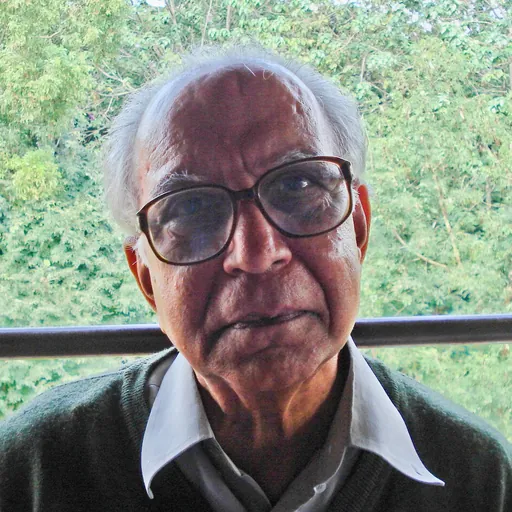
About M. S. Narasimhan
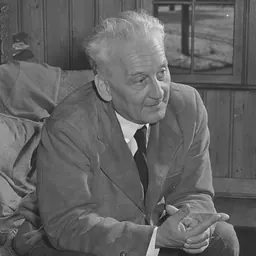
Lived 1932 – 2021 (aged 88). M. S. Narasimhan was an Indian mathematician.
Mudumbai Seshachalu Narasimhan (7 June 1932 – 15 May 2021) was an Indian mathematician. His focus areas included number theory, algebraic geometry, representation theory, and partial differential equations. He was a pioneer in the study of moduli spaces of holomorphic vector bundles on projective varieties. His work is considered the foundation for Kobayashi–Hitchin correspondence that links differential geometry and algebraic geometry of vector bundles over complex manifolds. He was also known for his collaboration with mathematician C. S. Seshadri, for their proof of the Narasimhan–Seshadri theorem which proved the necessary conditions for stable vector bundles on a Riemann surface.
He was a recipient of the Padma Bhushan, India's third highest civilian honor, in 1990, and the Ordre national du Mérite from France in 1989. He was an elected Fellow of the Royal Society, London. He was also the recipient of Shanti Swarup Bhatnagar Prize in 1975 and was the only Indian to receive the King Faisal International Prize in the field of science.
Early life Narasimhan was born on 7 June 1932 into a rural family in Tandarai in present day Tamil Nadu, as the eldest among five children. His family hailed from the North Arcot district. After his early education in rural part of the country, he joined Loyola College in Madras for his undergraduate education. Here he studied under Father Charles Racine, a French Jesuit professor, who in turn had studied under the French mathematician and geometer Élie Cartan. He joined the Tata Institute of Fundamental Research (TIFR), Bombay, for his graduate studies in 1953. He obtained his Ph.D. from the University of Mumbai in 1960 where his advisor was the mathematician K. S. Chandrasekharan, who was known for his work on number theory. His areas of focus while at TIFR included studying partial differential operators and elliptic operators.
He collaborated with Indian mathematician C. S. Seshadri for the ground-breaking Narasimhan–Seshadri theorem which has been at the core of algebraic geometry and number theory for over half a century. The theorem derived the relation between the purely algebraic notion of stable vector bundles on Riemann surfaces.
For his work, Narasimhan was considered a pioneer in the study of moduli spaces of holomorphic vector bundles on projective varieties. After retiring from ICTP, he settled in Bangalore. He was awarded the Padma Bhushan, India's third highest civilian honor, in 1990. He was also the recipient of the Shanti Swarup Bhatnagar Prize in 1975, Third World Academy of Sciences Prize for Mathematics in 1987, and the Srinivasa Ramanujan Medal in 1988. He was also the recipient of the King Faisal International Prize for Science in 2006, an award that he won jointly with mathematician Simon Donaldson, Imperial College. As of 2021, he was the only Indian to have won the King Faisal International Prize for Science. Also in 2021, he became a laureate of the Asian Scientist 100 by the Asian Scientist.
Personal life Narasimhan was married to Sakuntala Narasimhan, a classical musician, journalist and a consumer rights activist. The couple had a daughter, Shobhana Narasimhan, a scientist and professor at Jawaharlal Nehru Centre for Advanced Scientific Research, and a son.
Selected publications
Don’t just read it —
keep it.
Full-length biographies made to live with: read them, listen on the way to work, watch them tonight.
- E-book
- Audio
- Video
Instant download · yours to keep · every purchase keeps this site free
Important facts
Family & relationships
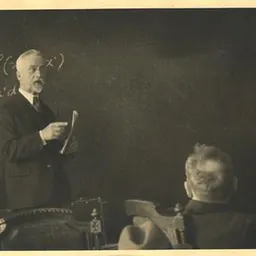
People in M. S. Narasimhan's life
Named in this biography and alive at the same time
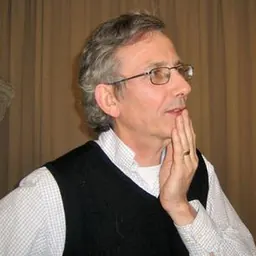

Related people
Same field, nearest in time


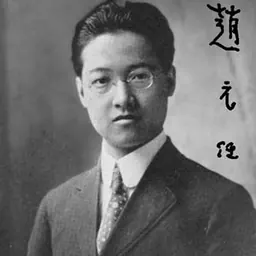
Contemporaries
People whose lives overlapped M. S. Narasimhan's


Frequently asked questions
Who was M. S. Narasimhan?
Indian mathematician (1932–2021)
When was M. S. Narasimhan born?
M. S. Narasimhan was born on 7 June 1932 in Tandarai.
When did M. S. Narasimhan die?
M. S. Narasimhan died on 16 May 2021 in Bangalore, India, Karnataka.
What was M. S. Narasimhan's occupation?
M. S. Narasimhan was a mathematician.
What nationality was M. S. Narasimhan?
M. S. Narasimhan was Indian.
Sources & further reading
Cite this page
APA: Biography.guide. (2026). M. S. Narasimhan. https://biography.guide/m-s-narasimhan/
MLA: "M. S. Narasimhan." Biography.guide, https://biography.guide/m-s-narasimhan/.
Chicago: "M. S. Narasimhan." Biography.guide. https://biography.guide/m-s-narasimhan/.
Data last updated: 2026-09-22 · Spot an error? Report a correction.
Portrait: Wikimedia Commons · author & licence
Page generated 2026-09-27 05:01 UTC