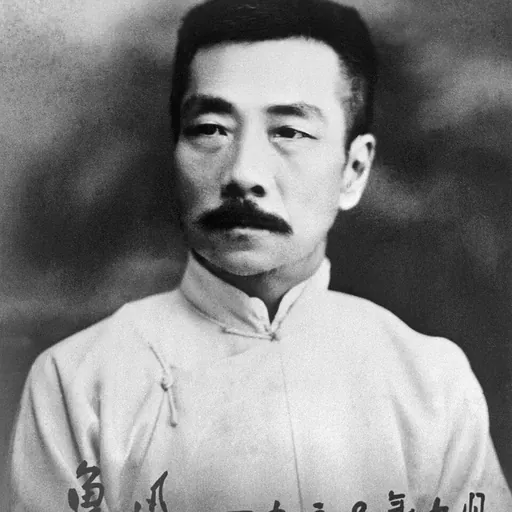
About Lu Xun
Lived 1881 – 1936 (aged 55). Lu Xun was a Chinese essayist, poet, literary critic, esperantist, translator and novelist.
Lu Xun (, ; 25 September 188119 October 1936), pen name of Zhou Shuren, born Zhou Zhangshou, was a Chinese writer. A leading figure of modern Chinese literature, he wrote in both vernacular and literary Chinese as a novelist, literary critic, essayist, poet, translator and political commentator, known for his sharp, satirical style and critical reflections on Chinese history and culture.
Lu Xun was born into a declining family of landlords and scholar-officials in Shaoxing, Zhejiang, and was the elder brother of Zhou Zuoren. Although he initially aspired to sit for the imperial examination, his family's declining fortunes led him to attend government-funded schools established under the Self-Strengthening Movement, where he was introduced to Western science and thought. In 1904, he enrolled at the Sendai Medical College in Japan, but left medicine to pursue literature. Financial difficulties forced his return to China, where he taught at various schools and colleges before taking a position at the Ministry of Education of the Beiyang government.
Lu Xun pioneered the New Culture Movement by publishing the first novel in vernacular Chinese, Diary of a Madman, in 1918. He gained prominence through his political writings in La Jeunesse following the May Fourth Movement in 1919. From the late 1920s onward, Lu Xun became increasingly engaged with Marxist thought and leftist politics. In the 1930s, he maintained a close but fraught relationship with the League of Left-Wing Writers. His works have been canonized in the People's Republic of China owing to Mao Zedong's high regard for him.
Biography Family background Lu Xun was born in Shaoxing, Zhejiang. His birth name was "Zhou Zhangshou" . His courtesy name was "Yushan" , which he later changed to "Yucai" . In 1898, before he went to the Jiangnan Naval Academy, he took the given name "Shuren" , which figuratively means "to be an educated man". The name "Lu Xun ", by which he is best known, was a pen name chosen upon the initial publishing of his story Diary of a Madman in 1918, with the surname Lu from his mother.
The Zhou family had been prosperous for centuries, and had become wealthy through landowning, pawnbroking, and by having several family members promoted to government positions. Lu Xun's paternal grandfather, Zhou Fuqing, was appointed to the Imperial Hanlin Academy in Beijing, the highest position possible for aspiring civil servants at that time. By the time Lu Xun was born, however, his family's prosperity had already been declining.
Lu Xun's father, Zhou Boyi, had been successful at passing the county-level imperial examinations, the route to wealth and social success in imperial China, but was unsuccessful in writing the more competitive provincial-level examinations. In 1893 he was discovered attempting to bribe an examination official. He was stripped of his position in the government and forbidden to ever again write the civil service examinations. Lu Xun's grandfather was also implicated, and was sentenced to beheading for his son's crime. The sentence was later commuted, and he was imprisoned in Hangzhou instead. The Zhou family only prevented Lu Xun's grandfather from being executed through regular, expensive bribes to authorities, until he was finally released in 1901.
After the family turmoil, Lu Xun's father engaged in heavy drinking and opium use and his health declined. Local doctors attempted to cure him through a series of expensive quack prescriptions, including monogamous crickets, sugar cane that had survived frost three times, ink, and the skin from a drum. He might have suffered from dropsy. but then abandoned pursuing a traditional Confucian education or career.
As a consequence of Lu Xun's decision to attend a military school specializing in Western education, his mother wept, he was instructed to change his name to avoid disgracing his family,
After leaving the school, Lu Xun sat for the lowest level of the civil service exams, and finished 137th of 500. He intended to sit for the next-highest level, but became upset when one of his younger brothers died, and abandoned his plans.
In 1904, Lu Xun enrolled at the Sendai Medical School (now Tohoku University School of Medicine), but remained there for less than two years. He generally found his studies at the school tedious and difficult, partially due to his imperfect Japanese. While at medical school, he met Fujino Genkurō, initially his anatomy professor, who showed particular kindness toward Lu Xun, then the school’s only Chinese student. Because of Fujino’s mentorship, Lu Xun was accused by some classmates of receiving unfair assistance in examinations, including advance access to examination questions.
While Lu Xun was attending medical school, the Russo-Japanese War (1904–1905) broke out. Part of the war was fought on disputed Chinese land. Lantern slides used in the classroom also featured news items. The girl, Zhu An, had little in common with Lu, was illiterate, and had been subject to foot binding. Lu Xun married her, but the two never developed a romantic relationship. Despite this, he continued to provide for her financially for the rest of his life. and in 1907 briefly took Russian lessons. He attempted to found a literary journal, New Life, with his brother, but before the first issue could be published, the project’s other contributors and financial backers withdrew, causing it to collapse. In 1909 Lu Xun and his brother published their translations of Western fiction, including Edgar Allan Poe, as Tales from Abroad, but the book sold only 41 copies of the 1,500 copies that were printed. The publication failed for a number of reasons: it was only sold in Tokyo, which did not have a large Chinese population, and in a single silk shop in Shanghai. Additionally, they wrote in literary Chinese, which was difficult for ordinary people to read.
Lu Xun spent these years in traditional Chinese literary pursuits: collecting old books, researching classical Chinese novels, reconstructing ancient tombstone inscriptions, and compiling the history of his native Shaoxing. He explained to a friend that his activities were not "scholarship", but "a substitute for 'wine and women'". In his personal letters he expressed disappointment about his own failure, China's political situation, and his family's continuing impoverishment.
In 1911 he returned to Japan to retrieve his brother, Zuoren, so that Zuoren could help with the family finances. Zuoren wanted to remain in Japan to study French, but Lu Xun wrote that "French... does not fill stomachs". He encouraged another one of his brothers, Jianren, to become a botanist. Together with Qian Daosun and Xu Shoushang, he designed the Twelve Symbols national emblem in 1912.
Between 1912 and 1917 he was a member of an ineffectual censorship committee of the Beiyang government, informally studied Buddhist sutras, lectured on fine arts, wrote and self-published a book on the history of Shaoxing, and edited and self-published a collection of folk stories from the Tang and Song dynasties. Qian replied, "But if a few awake, you can't say that there is no hope of destroying the iron house." Lu Xun recounted the conversation in his short story collection, Call to Arms. Lu Xun continued writing for the magazine, where he produced some of his most famous stories between 1917 and 1921. These stories were collected and re-published in Nahan ("Outcry") in 1923.
In 1919, Lu Xun moved his family from Shaoxing to a large compound in Beijing, Some writers have speculated that their relationship may have worsened as a result of issues related to money, that Lu Xun walked in on Zuoren's wife bathing, or that Lu Xun had an inappropriate "relationship" with Zuoren's wife in Japan that Zuoren later discovered. After the falling out with Zuoren, Lu Xun became depressed. In the March 18 Massacre of 1926, two of Lu Xun's students from Beijing Women's College were killed, prompting Lu Xun's article, “In Memory of Miss Liu Hezhen.” Later in 1926, when the warlord troops of Zhang Zuolin and Wu Peifu took over Beijing, Lu Xun left northern China and fled to Xiamen,
In September 1927, Lu Xun received a letter from his student Tai Jingnong informing him that the Swedish explorer and writer Sven Hedin wished, through Liu Bannong, to nominate Lu Xun for the Nobel Prize in Literature. Lu Xun declined the proposal, stating that neither he nor any contemporary Chinese writer was yet deserving of the honor. Per Wästberg Espmark stated that the Swedish Academy in the mid-1930s had sounded out Lu Xun about a possible nomination, but that he declined. Göran Malmqvist, who disputed the authenticity of the correspondence between Lu Xun and Tai Jingnong, clarified that the Swedish Academy had never offered Lu Xun the prize itself, making it inaccurate to claim that Lu Xun had declined to receive it.
In late 1927, Lu Xun decided to renounce fiction and poetry in response to China’s deteriorating political situation and his own emotional turmoil, thereafter writing primarily political and polemical essays.
Later career
Lu Xun (right) sat in the front, and Xu Guangping sat behind him, their son (Zhou Haiying) in Lu Xun's arms. In 1929, Lu Xun visited his mother, and reported that she was pleased at the news of Xu's pregnancy.
After moving to Shanghai, Lu Xun rejected all regular teaching positions (though he sometimes gave guest lectures at different campuses), and for the first time was able to make a living solely as a professional writer, with a monthly income of roughly 500 yuan. He was also appointed by the government as a "specially appointed writer" by the national Ministry of Higher Education, which secured him an additional 300 yuan per month.
Lu Xun began to study and identify with Marxist politics, made contact with local CCP members, and became involved in literary disputes with other leftist writers in the city. In 1930 Lu Xun became one of the co-founders of the League of Left-Wing Writers, but shortly after he moved to Shanghai other leftist writers accused him of being "an evil feudal remnant", the "best spokesman of the bourgeoisie", and "a counterrevolutionary split personality". The League continued in various forms until 1936, when the constant disputes among its members led the CCP to dissolve it. Lu Xun's political views became distinctly anti-KMT. In 1933 Lu Xun met Edgar Snow. Snow asked Lu Xun whether there were any Ah Q's left in China. Lu Xun responded, "It's worse now. Now it's Ah Q's who are running the country."
Despite the unfavorable political climate, Lu Xun contributed regularly to a variety of periodicals in the 1930s, including Lin Yutang's humor magazine The Analects Fortnightly, and corresponded with writers in Japan as well as China.
Although he had renounced writing fiction years before, in 1934 he published his last collection of short stories, Old Tales Retold. thumb The remains of Lu Xun in Shanghai on October 19, 1936. Photograph by Sha Fei.
In 1936, Lu Xun would meet Kaji Wataru. A Japanese dissident who had fled to Shanghai before the war. And would even employ Kaji as a Japanese translator of his work. After Lu Xun death in 1936, Kaji Wataru would be the only foreigner who served as pallbearer at Lu Xun's funeral.
Lu Xun was a heavy smoker, which may have contributed to the deterioration of his health throughout his last year. By 1936 he had developed chronic tuberculosis, and in March of that year he was stricken with bronchial asthma and a fever. The treatment for this involved draining 300 grams of fluid in the lungs through a puncture.
From June to August, he was again sick, and his weight dropped to only . He recovered somewhat, and wrote two essays in the fall reflecting on mortality. These included "Death", and "This Too Is Life". A month before his death, he wrote: "Hold the funeral quickly... do not stage any memorial services. Forget about me, and care about your own life – you're a fool if you don't." Regarding his son, he wrote: "On no account let him become a good-for-nothing writer or artist."
Death At 3:30 am on the morning of 18 October 1936, the author woke having great difficulty breathing. Dr. Sudo, his physician, was summoned, and Lu Xun was given injections to relieve the pain. His wife was with him throughout that night. Lu Xun died at 5:11 am the next morning, 19 October. In 1986, Fredric Jameson cited Diary of a Madman as the "supreme example" of the "national allegory" form that all Third World literature takes. Gloria Davies compares Lu Xun to Nietzsche, saying that both were "trapped in the construction of a modernity which is fundamentally problematic". According to Leonardo Vittorio Arena, Lu Xun cultivated an ambiguous standpoint towards Nietzsche, a mixture of attraction and repulsion, the latter because of Nietzsche's excesses in style and content.
In China, Lu Xun’s legacy has been extensively interpreted and appropriated by the Chinese Communist Party. In his lifetime, even though left-leaning, Lu Xun kept a distance with any political organization as well as the CCP. In a letter to Cao Juren dated 30 April 1934, Lu Xun wrote that “if the old society collapses one day, I will probably end up wearing a red vest and sweeping the streets of Shanghai.” In a letter dated 15 July 1936, three months before his death, Lu Xun wrote that many readers assumed that The True Story of Ah Q was about the Xinhai Revolution, but that he had written not about events twenty years earlier, but about China “twenty or thirty years in the future.” After Lu Xun’s death in 1936, Li Ji, a close friend, recalled that Lu Xun had told Feng Xuefeng, his student and liaison with the CCP: “When the revolution succeeds, I will be the first to flee. Because you people will be the first to kill me.”
Shortly after Lu Xun's death, Mao Zedong called him "the saint of modern China". In 1940, Mao wrote in On New Democracy that “Lu Xun was not only a great writer, but also a great thinker and a great revolutionary,” a formulation that subsequently became the orthodox CCP assessment of Lu Xun. In 1942, at the Yan'an Forum on Literature and Art, Mao quoted Lu Xun to urge his audience to be "a willing ox", but told writers and artists who believed in freedom of expression that, because CCP areas were already liberated, they did not need to be as sharp as Lu Xun. After the establishment of the People’s Republic of China in 1949, Lu Xun was firmly settled as a center in the communist literary canon and became widely taught in schools , even as many of his associates were persecuted, including his brother Zhou Zuoren. According to Lu Xun's son Zhou Haiying, Mao Zedong told Luo Jinan in 1957 that, had Lu Xun lived, he would have “either remained silent or been imprisoned.” During the Cultural Revolution, Lu Xun’s works were among the very few books still permitted to be published in China.
Since the 2000s, periodic revisions to Chinese school textbooks involving the addition or removal of Lu Xun’s works have attracted public attention and been speculated as reflecting shifts in the CCP’s ideological direction. Julia Lovell, who has translated Lu Xun's writing, commented on one of the removals that it might be "an attempt to discourage the youth of today from Lu Xun's inconveniently fault-finding habits."
In the Xi Jinping era, Lu Xun has increasingly been presented as a patriotic cultural symbol rather than as an anti-establishment critic. Mao admired Lu’s attacks on what both saw as the cruelty, backwardness, and hypocrisy of old China. Xi’s emphasis on cultural confidence and the rehabilitation of traditional Chinese culture, however, sits uneasily with Lu Xun’s relentless critiques.
Because of his leftist political involvement and the his status in the PRC, Lu Xun's works were banned in Taiwan until the late 1980s.
Lu Xun completed volumes of translations, notably from Russian. He particularly admired Nikolai Gogol and made a translation of Dead Souls. His own first story's title, Diary of a Madman, was inspired by Gogol's story of the same name. As a left-wing writer, Lu Xun played an important role in the development of modern Chinese literature. His books were and remain highly influential and popular today, both in China and internationally. Lu Xun's works appear in high school textbooks in both China and Japan. He is known to Japanese by the name Rojin (; ).
Lu Xun had relationship to Esperanto movement in China. He published the translated work in Japanese of Esperantist Vasilij Erošenko in Shanghai after Erosenko had been expelled for "Bolshevism" from Japan.
Lu Xun was also a leader of the Woodcut Movement in China (1930–1950) and widely recognized as a pioneer of the rise of the woodcut print in China. After encountering new printmaking techniques in Japan, Lu Xun embraced the art form, envisioning it as a medium to promote social change and "an alternative socialist road to art." Through writings, lectures, and woodcut print publications, Lu Xun was instrumental in inspiring a generation in China towards the black-and-white woodcut.
Various things are named after him. These include the Lu Xun Literary Prize; Asteroid (233547) 2007 JR27 Luxun; and the Lu Hsun crater on Mercury. The artist Shi Lu Xun chose the second half of his pen name to reflect his admiration for Lu Xun.
Style and thought Lu Xun was a versatile writer. He wrote using both traditional Chinese conventions and 19th century European literary forms. His style has been described in equally broad terms, conveying both "sympathetic engagement" and "ironic detachment" at different moments. Particularly in his early novellas, Lu Xun wrote about characters who were weak, indecisive, frustrated, and largely the victims of oppressive Chinese culture.
His essays are often incisive in his societal commentary, and in his stories his mastery of the vernacular language and tone make some of his literary works (like "The True Story of Ah Q") hard to convey through translation. In them, he frequently treads a fine line between criticizing the follies of his characters and sympathizing with those very follies. Lu Xun was a master of irony and satire (as can be seen in "The True Story of Ah Q") and yet could also write impressively direct prose ("My Old Home", "A Little Incident").
Lu Xun is typically regarded by Mao Zedong as the most influential Chinese writer who was associated with the May Fourth Movement. He produced harsh criticism of social problems in China, particularly in his analysis of the "Chinese national character". He was sometimes called a "champion of common humanity".
Lu Xun felt that the Xinhai Revolution of 1911 had been a failure. In 1925 he opined, "I feel the so-called Republic of China has ceased to exist. I feel that, before the revolution, I was a slave, but shortly after the revolution, I have been cheated by slaves and have become their slave." He even recommended that his readers heed the critique of Chinese culture in Chinese Characteristics by the missionary writer Arthur Smith. His disillusionment with politics led him to conclude in 1927 that "revolutionary literature" alone could not bring about radical change. Rather, "revolutionary men" needed to lead a revolution using force. In the end, he experienced profound disappointment with the new Nationalist government, which he viewed as ineffective and even harmful to China.
Lu Xun contended that "f Chinese characters are not exterminated, there can be no doubt that China will perish."
Don’t just read it —
keep it.
Full-length biographies made to live with: read them, listen on the way to work, watch them tonight.
- E-book
- Audio
- Video
Instant download · yours to keep · every purchase keeps this site free
Important facts
more
Xun Lu, Shuren Zhou, Jin Ro, Hsün Lu, Zhou Shuren, Yü-tsʻai Chou, Lu-hsün, Zhangshou Zhou, Lu Sün, Shun Lu, Śuna Lū, Tấn Lỗ, Lu Siy$08un, Sin No, Shiun Lu, Shun Lo, Chang-shou Chou, Shu-jen Chou, Lu Hsün, Sin Lou, Sjoe-Yen Tsjoo, Shoo-jin Chow, Yü-shan Chou, Yushan Zhou, Chou Jen Tcheou, Siun Lou, Sin Lū, Lu Sinʹ, Ju-jin Shū, Yucai, Loo-sin, Lusin, Luxun, Yucai ZhouFamily & relationships
People in Lu Xun's life
Named in this biography and alive at the same time




Related people
Same field, nearest in time




Contemporaries
People whose lives overlapped Lu Xun's




Frequently asked questions
Who was Lu Xun?
Chinese novelist and essayist (1881–1936)
When was Lu Xun born?
Lu Xun was born on 25 September 1881 in Shaoxing.
When did Lu Xun die?
Lu Xun died on 19 October 1936 in Shanghai.
What was Lu Xun's occupation?
Lu Xun was an essayist, poet, literary critic, esperantist, translator and novelist.
What nationality was Lu Xun?
Lu Xun was Chinese.
Sources & further reading
Cite this page
APA: Biography.guide. (2026). Lu Xun. https://biography.guide/lu-xun-essayist/
MLA: "Lu Xun." Biography.guide, https://biography.guide/lu-xun-essayist/.
Chicago: "Lu Xun." Biography.guide. https://biography.guide/lu-xun-essayist/.
Data last updated: 2026-09-22 · Spot an error? Report a correction.
Portrait: Wikimedia Commons · author & licence
Page generated 2026-09-27 05:04 UTC