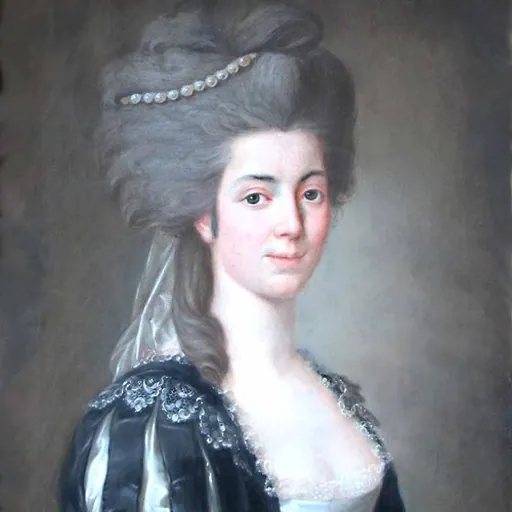
About Leonor de Almeida Portugal, 4th Marquise of Alorna
Lived 1750 – 1839 (aged 88). Leonor de Almeida Portugal, 4th Marquise of Alorna was a poet, salonnière, painter, translator and writer.
D. Leonor de Almeida Portugal, 4th Marquise of Alorna, 7th Countess of Assumar (31 October 1750 – 11 October 1839) was a Portuguese noblewoman, painter, and poet. Commonly known by her penname, Alcipe, the Marquise was a prime figure in the Portuguese Neoclassic a proto-Romantic literary scene, while still a follower of Neoclassicism when it came to painting.
Leonor was born into one of the many branches of the House of Távora, Portugal's most illustrious and powerful noble family at the time. This being said, the time of her birth and the subsequent years were a time of great trouble for the House of Távora, as they had been accused of treason against King José I of Portugal, in a series of events known as the Távora affair. Because of the unfortunate events in her early childhood, Leonor spent nineteen years forcibly imprisoned in a convent, where she spent most of her time reading and writing poetry. Her early success as a poet at the convent started her lifelong career which would lead her to becoming one of Europe's most noteworthy literary figures at the time.
The occupation of Leonor's husband, Count Carlos Pedro of Oyenhausen-Groewenbourg, as a diplomat in the service of Queen Maria I of Portugal, meant that Leonor and her family spent much of their lives traveling the courts of Europe, most notably the Austrian Imperial Court at Vienna. Her travels allowed Leonor to acquaint herself with many of Europe's great minds of the time, thus spreading her literary and artistic influence throughout the continent and expanding Leonor's views and perceptions, both in poetry and in painting.
Early life Leonor's grandmother, Leonor Tomásia de Távora, 3rd Marquise of Távora. D. Leonor de Almeida Portugal was born in Lisbon, on 31 October 1750, to João de Almeida Portugal, 2nd Marquis of Alorna and 5th Count of Assumar, and Leonor de Lorena e Távora, daughter of Leonor Tomásia de Távora, 3rd Marchioness of Távora. She was born into the House of Távora, one of the most illustrious noble families in Portugal. Her family's wealth and power, however, achieved them suspicion from King José I's Prime Minister Sebastião José de Carvalho e Melo, 1st Marquis of Pombal. These tensions between the Távoras and the Marquis of Pombal accumulated in 1758, when Leonor was eight years old, in the Távora affair. The affair saw the execution of her maternal grandparents and Leonor and her mother's forced placement in the Convent of São Félix of Chelas, until 1777. Likewise, her father and brother were imprisoned in the Tower of Belém.
While in the convent at Chelas, Leonor lived with her mother and sister. She devoted her time to studying the works of Rousseau, Voltaire, Montesquieu, Pierre Bayle, and the Encyclopedia of Diderot. As there was not much for a young girl to do at a convent, Leonor spent most of her time composing poems and other lyrical pieces. It is during her childhood at the convent when Leonor began her career as a poet, publishing her first work, the Poems of Chelas. It was also in the convent where she came in contact with famed poets and members of the Portuguese literary scene, convents and monasteries having been a traditional place for refuge by writers and artists in Portugal.
The convent was often a location of retreat to the members of the Arcadia, a literary society, and to distinguished poets like Francisco Manuel do Nascimento, best known by his pen-name, Filinto Elísio. Nascimento, having read the Poems of Chelas, sought out Leonor, to listen her works and discuss poetry with her, and eventually became her tutor in literature, poetry, and Latin. Nascimento's pen-name was, in fact, given to him by Leonor, while he was her tutor at the convent. It was also during her time at the convent when Leonor started being called Alcipe, as the nuns often gave nicknames to the young girls at the convent, as they also gave Leonor's sister, Maria de Almeida Portugal, the nickname Dafne.
Leonor finally left the convent in 1777, when she was twenty-seven years old, at the orders of the newly acclaimed Queen Maria I, who sought to reverse all the policies and actions of the Marquis of Pombal, whom she despised. Similarly, her father and brother were released from Belém Tower and the two branches of the family reunited. The family's former palaces, the envy of the Portuguese nobility, had been destroyed by order of the Marquis of Pombal, and thus the family moved to the Quinta of Vale de Nabais, outside of Lisbon, which they renamed Quinta of Alorna. Though reduced from their previous standing, the family quickly rose in the Portuguese court and nobility. Leonor rapidly became a personality of the aristocracy, her intelligence and charm having captivated the nobles who expected a girl ruined by a forced convent life.
Marriage Carlos Pedro Maria José Augusto, Count of Oyenhausen-Groewenbourg. Two years after her release from her imprisoned life at the convent, Leonor already had numerous suitors for her hand in marriage. Her prime suitor was Carlos Pedro Maria José Augusto, Count of Oyenhausen-Grevenburg, a nobleman and military-man from the Holy Roman Empire. The Count served in the Seven Years' War, as an aide-de-camp to General Frederick Charles Ferdinand, Duke of Brunswick-Lüneburg. In 1762, Carlos Pedro came to Portugal with his cousin, William, Count of Schaumburg-Lippe, who was invited by the Marquis of Pombal to train the Portuguese army.
Carlos Pedro went into the service of Queen Maria I, where he distinguished himself as a notable military-man and honourable statesman. His position and reputation made him the prime candidate for Leonor's hand and thus the two married on 15 February 1779. Present were Queen Maria I and King Pedro III, Leonor's godparents, alongside many of the most important nobles at the Portuguese Royal Court. As a gift to the couple, Queen Maria I invested Carlos Pedro as a knight of the Order of Christ, Portugal's highest and noblest order.
Vienna In 1779, Count Carlos Pedro moved the couple to Porto, as he was made commander of the VI Royal Infantry Regiment, which was based in that city. While in Porto, Leonor bore the couple's first child, Leonor Benedita de Almeida e Oyenhausen. His post in Porto would only be temporary, for in 1780, Queen Maria I appointed Count Carlos Pedro as her minister plenipotentiary to the Imperial Court of Vienna and the couple moved thereafter. On the way to Vienna, Leonor and Count Carlos Pedro were received by the courts of King Carlos III of Spain and Louis XVI of France. While in Vienna, Leonor became a prominent member of the local poetry scene and distinguished herself as a notable painter. Though she was often sick, due to the difference of the Austrian climate to the Portuguese one, Leonor bore two children: Juliana de Almeida e Oyenhausen, Juliana de Almeida e Oyenhausen, to Aires José Maria de Saldanha Albuquerque Coutinho Matos e Noronha, 2nd Count of Ega.
In 1802, Obras poeticas; Lisbon, 1844. Estudo Biographico- Critico, a Respeito da Litteratura Portugueza; Madrid, 1869.
Genealogy
Ancestry
Issue Name Portrait Lifespan Notes By Carlos Pedro Maria José Augusto, Count of Oyenhausen-Grevenburg (3 January 1739 – 3 March 1793; married on 15 February 1779) Leonor Benedita de Almeida e Oyenhausen 100px 30 November 1780 – 18 October 1850 5th Marquise of Alorna, 9th Countess of Assumar, in Portuguese nobility, as the heir and successor of both her mother and brother, and Countess of Oyenhausen-Groewenbourg, in Austrian nobility, as successor of her brother. Secretary of the Household of Maria Francisca Benedita, Dowager Princess of Brazil. Married João José Luís de Mascarenhas Barreto, 6th Marquis of Fronteira, 7th Count of Torre, and 7th Count of Coculim, in 1799. Juliana Maria Luisa Carolina de Almeida e Oyenhausen 100px 20 August 1782 – 2 November 1864 Married Aires José Maria de Saldanha Albuquerque Coutinho Matos e Noronha, 2nd Count of Ega, in 1800, and later married Count Grigory Alexandrovich Stroganoff, a high-ranking member of Russian nobility. The Countess was famous for her affair with Napoleonic General Jean-Andoche Junot, which granted her power and prestige. Frederica de Almeida e Oyenhausen 1 September 1784 – 2 October 1847 Never married. Henriqueta de Almeida e Oyenhausen 100px 3 January 1787 – 20 March 1860 Lady-in-Waiting to Queen Maria II of Portugal. Never married. Luísa de Almeida e Oyenhausen 1789 – 1817 Married Heliodoro Jacinto Carneiro de Araújo Alvelos, 1st Viscount of Condeixa. João Carlos Ulrico de Almeida e Oyenhausen 100px 31 October 1791 – 14 August 1822 8th Count of Assumar, in Portuguese nobility, as heir to his mother, and Count of Oyenhausen-Groewenbourg, in Austrian nobility, as the successor of his father. Lieutenant-Colonel of the 4th Royal Cavalry. Commander of the Order of Christ. Never married.
Don’t just read it —
keep it.
Full-length biographies made to live with: read them, listen on the way to work, watch them tonight.
- E-book
- Audio
- Video
Instant download · yours to keep · every purchase keeps this site free
Important facts
People in Leonor de Almeida Portugal, 4th Marquise of Alorna's life
Named in this biography and alive at the same time
Related people
Same field, nearest in time
Contemporaries
People whose lives overlapped Leonor de Almeida Portugal, 4th Marquise of Alorna's



Frequently asked questions
Who was Leonor de Almeida Portugal, 4th Marquise of Alorna?
Portuguese poet, salon-holder, author and painter (1750-1839)
When was Leonor de Almeida Portugal, 4th Marquise of Alorna born?
Leonor de Almeida Portugal, 4th Marquise of Alorna was born on 31 October 1750 in Lisbon.
When did Leonor de Almeida Portugal, 4th Marquise of Alorna die?
Leonor de Almeida Portugal, 4th Marquise of Alorna died on 11 October 1839 in Lisbon.
What was Leonor de Almeida Portugal, 4th Marquise of Alorna's occupation?
Leonor de Almeida Portugal, 4th Marquise of Alorna was a poet, salonnière, painter, translator and writer.
What nationality was Leonor de Almeida Portugal, 4th Marquise of Alorna?
Leonor de Almeida Portugal, 4th Marquise of Alorna's recorded nationality: Kingdom of Portugal.
Sources & further reading
· Wikipedia: Leonor de Almeida Portugal, 4th Marquise of Alorna
· DBpedia: Leonor de Almeida Portugal, Marquise of Alorna
Cite this page
APA: Biography.guide. (2026). Leonor de Almeida Portugal, 4th Marquise of Alorna. https://biography.guide/leonor-de-almeida-portugal-4th-marquise-of-alorna/
MLA: "Leonor de Almeida Portugal, 4th Marquise of Alorna." Biography.guide, https://biography.guide/leonor-de-almeida-portugal-4th-marquise-of-alorna/.
Chicago: "Leonor de Almeida Portugal, 4th Marquise of Alorna." Biography.guide. https://biography.guide/leonor-de-almeida-portugal-4th-marquise-of-alorna/.
Data last updated: 2026-09-27 · Spot an error? Report a correction.
Portrait: Wikimedia Commons · author & licence
Page generated 2026-10-05 02:15 UTC