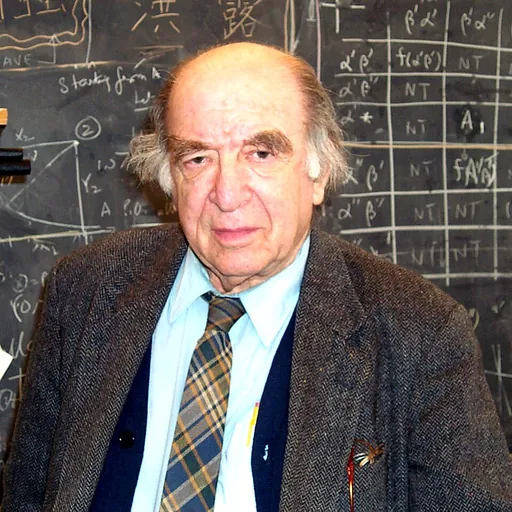
Leonid Hurwicz
Polish-American economist and mathematician
About Leonid Hurwicz
Lived 1917 – 2008 (aged 90). Leonid Hurwicz was an American and Polish mathematician, economist and university teacher.
Leonid Hurwicz (; August 21, 1917 – June 24, 2008) was a Polish–American economist and mathematician, known for his work in game theory and mechanism design. He originated the concept of incentive compatibility, and showed how desired outcomes can be achieved by using incentive compatible mechanism design. Hurwicz shared the 2007 Nobel Memorial Prize in Economic Sciences (with Eric Maskin and Roger Myerson) for his seminal work on mechanism design. Hurwicz was one of the oldest Nobel Laureates, having received the prize at the age of 90.
Hurwicz was educated and grew up in Poland, and became a refugee in the United States after Hitler invaded Poland in 1939. In 1941, Hurwicz worked as a research assistant for Paul Samuelson at the Massachusetts Institute of Technology and Oskar Lange at the University of Chicago. He was a research associate for the Cowles Commission between 1942 and 1946. In 1946 he became an associate professor of economics at Iowa State College. Hurwicz joined the University of Minnesota in 1951, becoming Regents' Professor of Economics in 1969, and Curtis L. Carlson Professor of Economics in 1989. He was Regents' Professor of Economics (Emeritus) at the University of Minnesota when he died in 2008.
Hurwicz was among the first economists to recognize the value of game theory and was a pioneer in its application. Interactions of individuals and institutions, markets and trade are analyzed and understood today using the models Hurwicz developed.
Personal life Hurwicz was born in Moscow, Russia, to a family of Polish Jews a few months before the October Revolution. Soon after Leonid's birth, the family returned to Warsaw. and later lived at a number of locations in Minneapolis. They had four children: Sarah, Michael, Ruth and Maxim.
His interests included linguistics, archaeology, biochemistry and music.
He was hospitalized in mid-June 2008, suffering from renal failure. He died a week later in Minneapolis.
Education and early academic career Encouraged by his father to study law, After moving to the United States he continued his studies at Harvard University and the University of Chicago. Hurwicz had no degree in economics. In 2007 he said, "Whatever economics I learned I learned by listening and learning."
In 1941 Hurwicz was a research assistant to Paul Samuelson at the Massachusetts Institute of Technology and to Oskar Lange at the University of Chicago. From 1942 to 1944, at the University of Chicago, he was a member of the faculty of the Institute of Meteorology and taught statistics in the Department of Economics. About 1942 his advisors were Jacob Marschak and Tjalling Koopmans at the Cowles Commission for Research in Economics at the University of Chicago, now the Cowles Foundation at Yale University.
Teaching and research
Hurwicz received a Guggenheim Fellowship in 1945–1946. Hurwicz continued to be a consultant to the Cowles Commission until about 1961.
Hurwicz was recruited by Walter Heller to the University of Minnesota in 1951, where he became a professor of economics and mathematics in the School of Business Administration. at Northwestern University twice in 1988 and 1989, at the University of California, Santa Barbara (1998), the California Institute of Technology (1999) and the University of Michigan in (2002). He was a visiting distinguished professor at the University of Illinois in 2001. In 2007 his ongoing research was described by the University of Minnesota as "comparison and analysis of systems and techniques of economic organization, welfare economics, game-theoretic implementation of social choice goals, and modeling economic institutions."
Hurwicz's interests included mathematical economics and modeling and the theory of the firm. He is internationally renowned for his pioneering research on economic theory, particularly in the areas of mechanism and institutional design and mathematical economics. In the 1950s, he worked with Kenneth Arrow on non-linear programming. Hurwicz was the graduate advisor to Daniel McFadden,
Earlier economists often avoided analytic modeling of economic institutions. Hurwicz's work was instrumental in showing how economic models can provide a framework for the analysis of systems, such as capitalism and socialism, and how the incentives in such systems affect members of society. The theory of incentive compatibility that Hurwicz developed changed the way many economists thought about outcomes, explaining why centrally planned economies may fail and how incentives for individuals make a difference in decision making.
Hurwicz served on the editorial board of several journals. He co-edited and contributed to two collections for Cambridge University Press: Studies in Resource Allocation Processes (1978, with Kenneth Arrow) and Social Goals and Social Organization (1987, with David Schmeidler and Hugo Sonnenschein). His most recent articles were published in the journals "Economic Theory" (2003, with Thomas Marschak), "Review of Economic Design" (2001, with Stanley Reiter) and "Advances in Mathematical Economics" (2003, with Marcel K. Richter). Hurwicz presented the Fisher-Schultz (1963), Richard T. Ely (1972), David Kinley (1989) and Colin Clark (1997) lectures.
Awards and honors
Memberships and honorary degrees Hurwicz was elected a fellow of the Econometric Society in 1947 and in 1969 was the society's president. Hurwicz was elected a Fellow of the American Academy of Arts and Sciences in 1965. In 1974 he was inducted into the National Academy of Sciences and in 1977 was named a Distinguished Fellow of the American Economic Association.
Named for Hurwicz First presented in 1950, the Hurwicz criterion is thought about to this day in the area of decision making called "under uncertainty." Abraham Wald published decision functions that year. Hurwicz combined Wald's ideas with work done in 1812 by Pierre-Simon Laplace. Hurwicz's criterion gives each decision a value which is "a weighted sum of its worst and best possible outcomes" represented as α and known as an index of pessimism or optimism. R. Duncan Luce and Howard Raiffa, in a field some date back to Jacob Bernoulli.
In 2010, the College of Liberal Arts at the University of Minnesota launched the Heller-Hurwicz Economics Institute, a global initiative created to inform public policy by supporting and promoting frontier economic research and by communicating findings to leading academics, policymakers, and business executives around the world. Funds raised by the Institute are used to attract and retain preeminent faculty and, in part, to support graduate student research.
The University of Michigan has an endowed chair named for Hurwicz, the Leonid Hurwicz Collegiate Professor of Complex Systems, Political Science, and Economics, currently held by Scott E. Page.
The Leonid Hurwicz Distinguished Lecture is given to the Minnesota Economic Association (as is the Heller lecture). John Ledyard (2007), Robert Lucas, Roger Myerson, Edward C. Prescott, James Quirk, Nancy Stokey and Neil Wallace are among those who have delivered the lecture since it was inaugurated in 1992.
Nobel Prize in Economics In October 2007, Hurwicz shared the Nobel Memorial Prize in Economic Sciences with Eric Maskin of the Institute for Advanced Study and Roger Myerson of the University of Chicago "for having laid the foundations of mechanism design theory." During a telephone interview, a representative of the Nobel Foundation told Hurwicz and his wife that Hurwicz was the oldest person to win the Nobel Prize. Hurwicz said, "I hope that others who deserve it also got it." When asked which of all the applications of mechanism design he was most pleased to see he said welfare economics. The winners applied game theory, a field advanced by mathematician John Forbes Nash, to discover the best and most efficient means to reach a desired outcome, taking into account individuals' knowledge and self-interest, which may be hidden or private. Mechanism design has been used to model negotiations and taxation, voting and elections,
Unable to attend the Nobel Prize ceremony in Stockholm because of his poor health, Hurwicz received the prize in Minneapolis. Accompanied by Evelyn, his spouse of six decades, and his family, he was the guest of honor at a convocation held on the campus of the University of Minnesota presided over by university president Robert Bruininks. Immediately following a live broadcast of the Nobel Prize awards ceremony, Jonas Hafström, Swedish ambassador to the United States, personally awarded the Economics Prize to Professor Hurwicz. His wife died in 2016 aged 93.
Publications Exposition on game theory classic.
Also available as: and as:
Cowles Commission Discussion Paper: Economics No. 2112, (pdf).
Don’t just read it —
keep it.
Full-length biographies made to live with: read them, listen on the way to work, watch them tonight.
- E-book
- Audio
- Video
Instant download · yours to keep · every purchase keeps this site free
Important facts
People in Leonid Hurwicz's life
Named in this biography and alive at the same time





Related people
Same field, nearest in time


Contemporaries
People whose lives overlapped Leonid Hurwicz's

Frequently asked questions
Who was Leonid Hurwicz?
Polish-American economist and mathematician (1917–2008)
When was Leonid Hurwicz born?
Leonid Hurwicz was born on 21 August 1917 in Moscow.
When did Leonid Hurwicz die?
Leonid Hurwicz died on 24 June 2008 in Minneapolis.
What was Leonid Hurwicz's occupation?
Leonid Hurwicz was a mathematician, economist and university teacher.
What nationality was Leonid Hurwicz?
Leonid Hurwicz was American and Polish.
Sources & further reading
Cite this page
APA: Biography.guide. (2026). Leonid Hurwicz. https://biography.guide/leonid-hurwicz/
MLA: "Leonid Hurwicz." Biography.guide, https://biography.guide/leonid-hurwicz/.
Chicago: "Leonid Hurwicz." Biography.guide. https://biography.guide/leonid-hurwicz/.
Data last updated: 2026-09-21 · Spot an error? Report a correction.
Portrait: Wikimedia Commons · author & licence
Page generated 2026-09-27 05:01 UTC