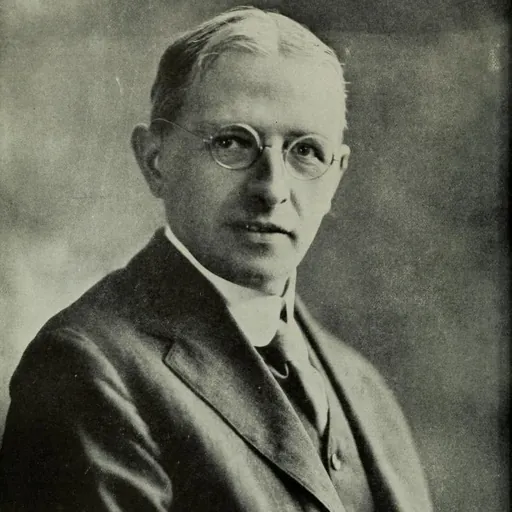
About Henry Norris Russell
Lived 1877 – 1957 (aged 79). Henry Norris Russell was an American astronomer and astrophysicist, known for Hertzsprung–Russell diagram, Term symbol and Vogt–Russell theorem.
known_for = awards = * Gold Medal of the Royal Astronomical Society (1921) Henry Draper Medal (1922) Bruce Medal (1925) Janssen Medal (French Academy of Sciences) (1936) ForMemRS (1937)
Life Russell was born on 25 October 1877, at Oyster Bay, New York, the son of Rev Alexander Gatherer Russell (1845-1911) and his wife, Eliza Hoxie Norris.
After graduating from Princeton Preparatory School in 1893, he studied astronomy at Princeton University, obtaining his B.A. in 1897 and his doctorate in 1900, studying under Charles Augustus Young. He is buried in Princeton Cemetery.
Family
In November 1908 Russell married Lucy May Cole (1881-1968). They had four children. Their youngest daughter, Margaret Russell (1914-1999), married the astronomer Frank K. Edmondson in the 1930s.
Published work Russell co-wrote an influential two-volume textbook in 1927 with Raymond Smith Dugan and John Quincy Stewart: Astronomy: A Revision of Young’s Manual of Astronomy (Ginn & Co., Boston, 1926–27, 1938, 1945). This became the standard astronomy textbook for about two decades. There were two volumes: the first was The Solar System and the second was Astrophysics and Stellar Astronomy. The textbook popularized the idea that a star's properties (radius, surface temperature, luminosity, etc.) were largely determined by the star's mass and chemical composition, which became known as the Vogt–Russell theorem (including Heinrich Vogt who independently discovered the result). Since a star's chemical composition gradually changes with age (usually in a non-homogeneous fashion), stellar evolution results.
Russell dissuaded Cecilia Payne-Gaposchkin from concluding that the composition of the Sun is different from that of the Earth in her thesis, as it contradicted the accepted wisdom at the time. He realized she was correct four years later after deriving the same result by different means. In his paper Russell credited Payne with discovering that the Sun had a different chemical composition from Earth but never shared the rewards of the fame he readily accepted for her work which he’d failed to recognize until years later.
Awards and honors Member of the American Philosophical Society (1913) Member of the United States National Academy of Sciences (1918) Fellow of the American Academy of Arts and Sciences (1921) Gold Medal of the Royal Astronomical Society (1921) Lalande Prize (1922) Henry Draper Medal from the National Academy of Sciences (1922) Bruce Medal (1925) Rumford Prize (1925) Franklin Medal (1934) Janssen Medal from the French Academy of Sciences (1936) Foreign Member of the Royal Society (1937) Honorary Fellow of the Royal Society of Edinburgh (1938) Henry Norris Russell Lectureship (1946) Asteroid 1762 Russell
Don’t just read it —
keep it.
Full-length biographies made to live with: read them, listen on the way to work, watch them tonight.
- E-book
- Audio
- Video
Instant download · yours to keep · every purchase keeps this site free
Important facts
People in Henry Norris Russell's life
Named in this biography and alive at the same time






Related people
Same field, nearest in time


Contemporaries
People whose lives overlapped Henry Norris Russell's



Frequently asked questions
Who was Henry Norris Russell?
American astronomer (1877–1957)
When was Henry Norris Russell born?
Henry Norris Russell was born on 25 October 1877 in Oyster Bay.
When did Henry Norris Russell die?
Henry Norris Russell died on 18 February 1957 in Princeton.
What was Henry Norris Russell's occupation?
Henry Norris Russell was an astronomer and astrophysicist.
What was Henry Norris Russell known for?
Henry Norris Russell was known for Hertzsprung–Russell diagram, Term symbol and Vogt–Russell theorem.
What nationality was Henry Norris Russell?
Henry Norris Russell was American.
Sources & further reading
· Wikipedia: Henry Norris Russell
· DBpedia: Henry Norris Russell
Cite this page
APA: Biography.guide. (2026). Henry Norris Russell. https://biography.guide/henry-norris-russell/
MLA: "Henry Norris Russell." Biography.guide, https://biography.guide/henry-norris-russell/.
Chicago: "Henry Norris Russell." Biography.guide. https://biography.guide/henry-norris-russell/.
Data last updated: 2026-09-21 · Spot an error? Report a correction.
Portrait: Wikimedia Commons · author & licence
Page generated 2026-09-27 05:01 UTC