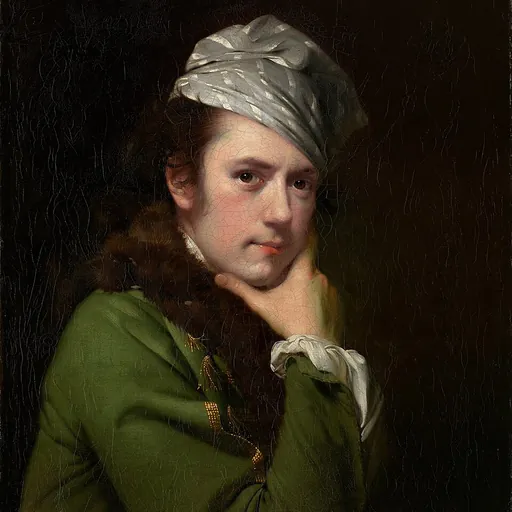
About Joseph Wright of Derby
Lived 1734 – 1797 (aged 62). Joseph Wright of Derby was a British painter, artist, landscape painter, portraitist and architectural drafter.
Joseph Wright (3 September 1734 – 29 August 1797), styled Joseph Wright of Derby, was an English painter who specialised in portrait painting and landscape art. He has been acclaimed as "the first professional painter to express the spirit of the Industrial Revolution".
Wright is notable for his use of tenebrism, an exaggerated form of the better known chiaroscuro effect, which emphasises the contrast of light and dark, and for his paintings of candle-lit subjects. His paintings of the birth of science out of alchemy, often based on the meetings of the Lunar Society of Birmingham, a group of scientists and industrialists living in the English Midlands, are a significant record of the struggle of science against religious values in the period known as the Age of Enlightenment.
Many of Wright's paintings and drawings are owned by Derby City Council, and are on display at the Derby Museum and Art Gallery.
Life
Joseph Wright was born in Irongate, Derby, to a respectable family of lawyers. He was the third of five children of Hannah Brookes (1700–1764) and John Wright (1697–1767), an attorney and the town clerk of Derby. Joseph had two elder brothers, John and Richard Wright.
Deciding to become a painter, as a seventeen-year old youth Wright went to London in 1751 and for two years studied under Thomas Hudson, the master of Joshua Reynolds. Wright acknowledged that he was also influenced by Alexander Cozens and applied his composition ideas to paintings.
After painting portraits for a while in Derby, the young Wright again worked as an assistant to Hudson for fifteen months. In 1753 he returned to, and settled in Derby. He varied his work in portraiture by the production of subjects with strong tenebrism under artificial light, with which his name is chiefly associated, and by landscape painting.
Wright set off in 1773 with John Downman, a newly pregnant Ann Wright, and Richard Hurleston for Italy. Their ship took shelter for three weeks in Nice before they completed their outward voyage in Livorno in Italy in February 1774. Downman returned to Britain in 1775. Although he spent a great deal of productive time in Naples, Wright never witnessed any major eruption of Mount Vesuvius. However, it is possible that he witnessed smaller, less impressive eruptions, which may have inspired many of his subsequent paintings of the volcano.
On his return from his working sojourn in Italy he again established himself in England as a portrait-painter, this time at the fashionable spa resort of Bath. But he met with little encouragement there, and in 1777 returned to Derby where he spent the rest of his life. Its companion piece, Dovedale by Sunlight captures the colours of day.
Moonlight Landscape, held in the John and Mable Ringling Museum of Art in Sarasota, Florida, is another of his nighttime landscape paintings. The painting is very dramatic, an apparently full moon is obscured by an arched bridge over water, but illuminates the scene, making the water sparkle in contrast to the dusky landscape.
Cave at Evening is painted with the same dramatic chiaroscuro for which Wright is noted. The painting was executed during 1774, while he was staying in Italy. There are similarities to the Museum of Fine Arts, Boston's holding, Grotto by the Seaside in the Kingdom of Naples with Banditti, Sunset (1778).
Painting the British Enlightenment
Wright had close contact with the pioneering industrialists of the English Midlands. Two of his most important patrons were Josiah Wedgwood, credited with the industrialization of the manufacture of pottery, and Richard Arkwright, regarded as the creator of the factory system in the cotton industry. One of Wright's students, William Tate, was uncle to the eccentric gentleman tunneller, Joseph Williamson, and completed some of Wright's works after his death. Wright also had connections with Erasmus Darwin and other members of the Lunar Society, which brought together leading industrialists, scientists, and philosophers. Although meetings were held in or near Birmingham, Darwin, grandfather of Charles Darwin, lived in Derby, and some of the paintings by Wright, which are notable for their use of brilliant light on shade, are of, or were inspired by, Lunar Society gatherings.
A Philosopher Lecturing on the Orrery (1766) shows an early mechanism for demonstrating the movement of the planets around the Sun. The Scottish scientist James Ferguson (1710–1776) undertook a series of lectures in Derby in July 1762 based on his book Lectures on Select Subjects in Mechanics, Hydrostatics, Pneumatics, Optics &c. (1760). To illustrate his lectures, Ferguson used various machines, models, and instruments. Wright may have attended these talks, especially as tickets were available from John Whitehurst, Wright's close neighbour, a clockmaker and a scientist. Wright could have drawn on Whitehurst's practical knowledge to learn more about the orrery and its operation.
An Experiment on a Bird in the Air Pump (1768) shows people gathered to observe an early experiment into the nature of air and its ability to support life.
The Alchemist in Search of the Philosopher's Stone (1771) depicts the discovery of the element phosphorus by German alchemist Hennig Brand in 1669. A flask in which a large quantity of urine has been boiled down is seen bursting into light as the phosphorus, which is abundant in urine, ignites spontaneously in air.
These factual paintings are considered to also have metaphorical meaning, the bursting into light of the phosphorus in front of a praying figure signifying the problematic transition from faith to scientific understanding and enlightenment, and the various expressions on the figures around the bird in the air pump indicating concern over the possible inhumanity of the coming age of science. In light of this comment, Wright's painting of the bird in the air pump, completed more than twenty years earlier, seems particularly prescient. It was against this background that Charles Darwin, grandson of Erasmus Darwin, would add to the conflict between science and religious belief, half a century later, with the publication of his book The Origin of Species in 1859.
Memorials
Wright's birthplace at 28 Irongate, Derby, is commemorated with a representation of an armillary sphere on the pavement nearby.
Joseph Wright was buried in the grounds of St Alkmund's Church, Derby. The church was demolished in 1968 to make way for a major new section of the inner ring road cutting through the town centre, and its site now lies beneath the road. Wright's remains were removed to Nottingham Road Cemetery. In 1997, his tombstone was placed at the side of Derby Cathedral, and in 2002, it was brought inside and wall-mounted in a prominent place near the well-visited memorial to Bess of Hardwick.
Wright's name has been given to the sixth-form centre situated on Cathedral Row, Derby (not far from Iron Gate). The Joseph Wright Centre was opened in 2005 as the new flagship site for Derby College. The building is named after the eighteenth-century painter because his "artwork captured the many scientific and technological advances of the Industrial Revolution."
In early 2013 Derby City Council and Derby Civic Society announced they would erect a blue plaque on his home at 27 Queen Street in Derby.
Other works Peter Perez Burdett and His First Wife Hannah (1765) An Academy by Lamplight (1769) Vesuvius from Posillipo by Moonlight (1774) Grotto by the Seaside in the Kingdom of Naples with Banditti, Sunset (1778) Museum of Fine Arts, Boston Peter Labilliere (1780) Dorking Museum, UK Indian Widow (1784) Miss Mary Tunaley (1790–93) Museum of Fine Arts, Boston Romeo and Juliet: the Tomb Scene (1790) Derby Museum and Art Gallery Virgil's Tomb (three versions, 1779 to 1785) The Lady in Milton's Comus (1785) Walker Art Gallery Moonlight, Coast of Tuscany (1790) Tate Britain Portrait of Jedediah Strutt (1790) Derby Museum and Art Gallery
Gallery
Don’t just read it —
keep it.
Full-length biographies made to live with: read them, listen on the way to work, watch them tonight.
- E-book
- Audio
- Video
Instant download · yours to keep · every purchase keeps this site free
Important facts
more
Thomas Wright, Joseph (Wright Of Derby) Wright, james, Jos. Wright of derby, Wright de Derby, of Derby Joseph Wright, J. Wright, Wright, Wright of DarbyPeople in Joseph Wright of Derby's life
Named in this biography and alive at the same time



Related people
Same field, nearest in time


Contemporaries
People whose lives overlapped Joseph Wright of Derby's






Frequently asked questions
Who was Joseph Wright of Derby?
18th-century British painter (1734–1797)
When was Joseph Wright of Derby born?
Joseph Wright of Derby was born on 3 September 1734 in Derby.
When did Joseph Wright of Derby die?
Joseph Wright of Derby died on 29 August 1797 in Derby.
What was Joseph Wright of Derby's occupation?
Joseph Wright of Derby was a painter, artist, landscape painter, portraitist and architectural drafter.
What nationality was Joseph Wright of Derby?
Joseph Wright of Derby was British.
Sources & further reading
· Wikipedia: Joseph Wright of Derby
· DBpedia: Joseph Wright of Derby
Cite this page
APA: Biography.guide. (2026). Joseph Wright of Derby. https://biography.guide/joseph-wright-of-derby/
MLA: "Joseph Wright of Derby." Biography.guide, https://biography.guide/joseph-wright-of-derby/.
Chicago: "Joseph Wright of Derby." Biography.guide. https://biography.guide/joseph-wright-of-derby/.
Data last updated: 2026-09-22 · Spot an error? Report a correction.
Portrait: Wikimedia Commons · author & licence
Page generated 2026-09-27 05:01 UTC