
About Joseph Parry
Lived 1744 – 1826 (aged 82). Joseph Parry was a painter.
Joseph Parry (1756–1826) was a British painter and engraver. He was popularly known by his contemporaries as Old Parry to distinguish him from his sons James Parry and David Henry Parry, also artists.
Though a native of Liverpool, his most significant legacy was as "the Father of Art in Manchester," a title he was given by his contemporaries for his influence on the city's early artistic community.
Early life Joseph Parry was born on 6 May 1756 in Liverpool, England. In 1990, historian John C. P. Burleigh verified Parry's birthday using parish birth records in Liverpool, and discovered that the 1744 date originated with an error in the catalogue for an exhibition in 1893—this was repeated in Parry's entry in the Dictionary of National Biography in 1895 and propagated from there.
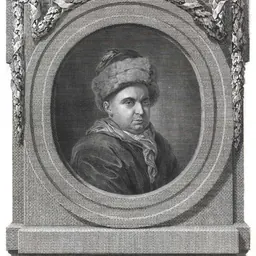
Regardless, all sources agree that Parry was the son of a master ship pilot, Benjamin Parry, working in the Liverpool harbour. He apprenticed as a ship and house painter, then later transitioned to fine art and began producing painted portraits, landscapes, and marine and historical scenes, as well as engravings. A Liverpool Privateer Returning with a Prize, dated 1781, is the earliest known ship portrait painted in the city. He engraved his only self-portrait while in Liverpool, sometime around 1780. He was influenced by David Teniers the Younger. thumb Mellor Mill (1802)In 1790 he moved with his family to Manchester, a rapidly industrialising mill town that would soon become known as "Cottonopolis"—however, like much of the rest of northwest England at the time the city had no artistic institutions nor any kind of homegrown community of artists, making the move a financially risky one. In the town directories of the period, published every four years, Parry is consistently one of only three to six different artists listed through into the 1800s; at the time there was an expectation that painters in the British provinces would never stay in one place for too long because it would negatively affect their work.
His figure drawing in particular was noted as exceptional by contemporaries—he would venture out into the city and countryside, sketch particular people who caught his eye, and then incorporate them into his later paintings. Parry produced a series of highly stylised paintings of the Wakes over a span of several years, depicting crowds of raucous partygoers in an Eccles that was more antiquated and idealised than in reality. His final depiction, Eccles Wakes Fair (1822)—commissioned by Thomas Kaye, editor of the Liverpool Courier—contained more than 200 individual figures, each drawn from life.
Parry continued to maintain links with Liverpool after his move to Manchester, being elected a member of the Liverpool Academy of Arts sometime after its founding in 1810. Due to Manchester's lack of gallery space and regular exhibitions (bar those arranged by commercial art dealers), Liverpool was also the nearest major institution where his works could be exhibited for the public.
His success at settling in Manchester was unusual among his peers—other notable artists who moved to Manchester in the late 18th century included Charles Towne, William Tate, Richard Parkes Bonnington, and William Marshall Craig, but they all moved away again eventually.
The only other artist to be considered synonymous with Manchester by the 1800s was John Rathbone, known in his day as "the Manchester Wilson." While both men taught members of the next generation of younger artists who came to the city in the 1800s and 1810s—such as John Ralston—Rathbone's death in 1807 prevented him from having as significant an influence on them as Parry.
By the 1820s, Manchester's art market had matured enough that dealers were bringing significant works from London and abroad to sell, and a generation of Manchester-based artists had emerged who felt that the city needed its own counterpart to London's Royal Academy and the Liverpool Academy of Art which could arrange regular exhibitions of new works as well as offer financial and fraternal support to artists in need. Parry's two youngest sons—James Parry and David Henry Parry—were both instrumental in the foundation of what would become the Royal Manchester Institution as part of the initial founding committee; the nickname "Old Parry" first appears around this time in response to his sons' emergence as artists in their own right, and the description of Parry as the "father of art" in the city is likely intended semi-literally. This includes the selection of several works by Parry for the Peel Park Local Art Exhibition of 1857; he was described in the visitor's guide as "the father of the Lancashire school of art."
Museums which today hold pieces by Parry in their collections include the Manchester Art Gallery, the British Museum, the Merseyside Maritime Museum, the Whitworth, the Lady Lever Art Gallery, the Salford Museum & Art Gallery, and the Shipley Art Gallery.
Personal life Parry married Esther Dunbovand at St. Paul's Church, Liverpool, on 26 January 1777. His obituary, syndicated in a number of national newspapers, stated that "as an artist his powers were extensive; he painted portraits, landscapes, histories, and domestic scenes—in the latter his pictures possess extraordinary merit."
Don’t just read it —
keep it.
Full-length biographies made to live with: read them, listen on the way to work, watch them tonight.
- E-book
- Audio
- Video
Instant download · yours to keep · every purchase keeps this site free
Important facts
People in Joseph Parry's life
Named in this biography and alive at the same time



Related people
Same field, nearest in time



Contemporaries
People whose lives overlapped Joseph Parry's




Frequently asked questions
Who was Joseph Parry?
English painter (1744–1826)
When was Joseph Parry born?
Joseph Parry was born on 17 January 1744 in Liverpool.
When did Joseph Parry die?
Joseph Parry died on 17 January 1826 in Manchester.
What was Joseph Parry's occupation?
Joseph Parry was a painter.
Sources & further reading
· DBpedia: Joseph Parry (artist)
Cite this page
APA: Biography.guide. (2026). Joseph Parry. https://biography.guide/joseph-parry-painter/
MLA: "Joseph Parry." Biography.guide, https://biography.guide/joseph-parry-painter/.
Chicago: "Joseph Parry." Biography.guide. https://biography.guide/joseph-parry-painter/.
Data last updated: 2026-09-20 · Spot an error? Report a correction.
Page generated 2026-09-27 05:15 UTC