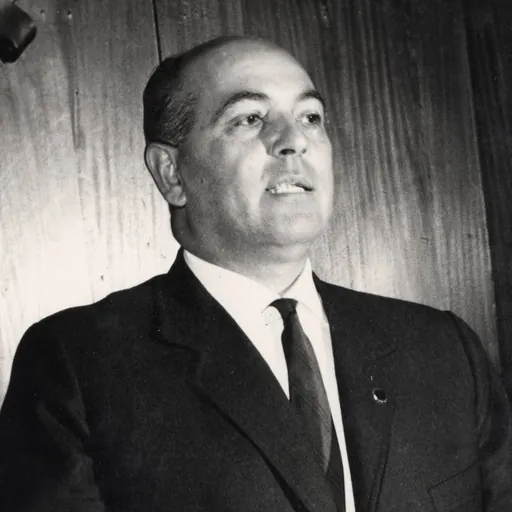
About José Solís
Lived 1913 – 1990 (aged 76). José Solís was a Spanish politician, military personnel and lawyer.
José Solís Ruiz (27 September 1913 – 30 May 1990) was a Spanish politician, known for his role in Francoist Spain, during which he occupied a number of important posts.
As a member of the Military Legal Corps, during Franco's regime he became civil government of several provinces, national representative of Trade Unions and the Secretary General of the FET y de las JONS party, a primary component of the "National movement". As such, he had a prominent role in the regime's policies during their developmental stage. Among the adopted measures was the enactment of the National Movement Principles Act, one of the regime's fundamental laws. An easy-going and jovial person, he quickly became one of the most popular figures of the dictatorship and was known as "the smile of the regime".
Biography
Youth and Training He was born on 27 September 1913 in the town of Cabra in Cordoba, into a family of small agricultural land owners in Andalusia. He was the son of Felipe Solís Villechenous – the Mayor of Cabra during the dictatorship of Primo de Rivera – and Eduarda Ruiz Luna. He studied law at the University of Deusto and the University of Valladolid.
As part of the "old guard" of the Falange Española de las Juntas de Ofensiva Nacional Sindicalista(FE de las JONS), a part of the national trade union center. He was part of the Military Legal Corps, In 1944 he was enlisted as secretary to the General Vice-Secretary of Social Ordinance, a position he held for almost all the years of the dictatorship until December 1975. During 1946, as part of his job as the Vice-secretary General of Social Ordinance, he organised the first Trade Union elections and also the first National Congress of Workers. Later he served as Civil Governor of the provinces of Pontevedra and Guipúzcoa. A jovial, polite and easy-going person, Solís soon became one of the most popular leaders of the regime and would become known as the "smile of the regime". During the following years he maintained a great presence in Spanish public and political life. It should be taken into account that his time as national trade union representative also coincided with the Spanish economic boom of the 1960s, known as the Spanish miracle. Under Solís, the labor institutions achieved maximum impact; he contributed to both expanding and modernizing them.The union work "Educacion y Descanso" (EyD) became one of the most popular instruments of trade unions among the working class, owing either to its network of recreational facilities or to its wide range of cultural activities.
Before the rise of the "technocrats" within the government and the administration, the Falange Española party were "entrenched" in the Trade Union Organization, promoting a kind of "openness" from the organization towards workers until this advocacy group became the core of Francoism. For example, after 1954 it was no longer necessary to possess a FET y de las JONS card to be able to participate in the trade union elections and even was even an attempt from the Francoist apparatus to attract former anarcho-syndicalist leaders to its core/bosom. Through this openness, Solís also sought to obtain the approval of the International Labour Organization (ILO). This process culminated in the 1966 union elections of "liaisons" and "jurors" who enjoyed relative freedom. But these elections did not reinforce the nationalist position, but quite the opposite, as Left-wing opposition were elected to many of the posts through the clandestine movement of the "workers’ commissions". By 1967–1968, the liberalizing experiment could not be terminated. In fact Solís had no objection to supporting the repression of the workers’ commissions during the state of emergency period decreed in 1968.
Secretary General of the Movement Solís in April 1962 delivering a speech on occasion of the 50th anniversary of the creation of the Cabildo of Gran Canaria. In February 1957, he was appointed Secretary-General of the "Movement"; a position that he would juggle with his role as the national trade union representative for more than a decade. He was known for being the least dogmatic member of the Falangist sector. Solís embarked on the task of modernizing the "movement".Within the party he collaborated closely with Fernando Herrero Tejedor, who was the Deputy Secretary General of the Movement during the 1960s. His appointment as chief of the FET y de las JONS came shortly after the so-called "Crisis of February 1956". Solís encountered an antiquated party, a victim of the separation between the generation that made the civil war and the younger generations. In a short time, he drew up the draft law of principles of the national movement, which sought to provide a legal basis for the single party of the regime and would end up being approved in 1958. However, some historians have considered that this law actually meant the beginning of the end of the FET y de las JONS as a party, diluting the nationalism within the "movement".
Solís tried to assemble a nationalist project of an alternative regime to that of the Opus Dei technocrats. This project, which had already been partially employed in Labour Unions through an internal opening, was complemented by the creation of "associations" within the movement to equip the Franco regime with a certain level of popular participation in the so-called contrast of views. By October 1958 Solís had already created the National Delegation of Associations with the mission of "widening the bases of accession to the movement to collective groups" and to whose front he had appointed Manuel Fraga Iribarne. As Minister-Secretary General of the Movement, it was essential that the institutions of the Franco regime adapt to the social changes that were occurring in Spain, promoting a "political development" that complements economic growth. Solís continued to battle in this regard, and in the middle of 1969 he promoted a preliminary draft of the bases of the right of association, although again Franco did not want to promulgate it.
The great power that Solís held – single party, unions, "movement" press and radio – earned him the suspicions of many leaders in the regime. During these years, his work at the forefront of the single party was not without criticism from the most extreme sectors of Francoism, which accused Solís of keeping the party in a state of "total abandonment". He was also highly criticized for his management of the "movement" press, the set of newspapers and publications controlled by the regime. The “old guard” José Antonio Girón de Velasco came to say that Solís used the newspaper Pueblo, which in theory was the newspaper of the labour trade unions, as a means of communication in his personal service. However, Solís's main enemy among the Francoist hierarchy was Vice President Carrero Blanco.
In October 1969, he was ousted from office. public. After the outbreak of the scandal there was a change of government. Paradoxically, Solís and Fraga were among the ministers who were fired. which led to the so-called "one-party government". According to Bartolomé Bennassar, Solís was taken aback by his dismissal, as he believed he would have Franco's reassurances that he would remain in the cabinet. After this event, the importance of the Spanish trade union organization within the Government was diminished.
Return to Government From June 1975, he once again occupied the position of Secretary General of the Movement in Franco's final government, after the accidental death of his predecessor Fernando Herrero Tejedor. However, by this time Solís had already left behind his previous liberal proposals. In October 1975 he was a prominent participant in the Sahara Crisis. With Franco seriously ill, on 21 October Solís travelled to Morocco to meet King Hassan II, to try and negotiate an exit and avoid direct conflict between the two countries. They would end up signing the Madrid Accords by which Spain left the territories of the Spanish Sahara, which were to be occupied by Morocco and Mauritania.
He formed part of the first government after the death of Franco as Minister of Labour, a position he held from 11 December 1975 to 7 July 1976. In this context, the Vitoria massacre occurred, during which several workers were killed by police repression. Solís retired from his post following the end of the Arias government in July 1976. He has since abandoned political life to focus on business activity. He died at his home in Madrid on 20 May 1990 and was buried in his hometown.
Personal life He married Ana María Rodríguez Sedano-Bosch, with whom he had fourteen children.
Solís collaborated with his friend Colonel Enrique Herrera Marín – Spain's military attaché in Buenos Aires – on the steps of the transfer of exiled Argentine President Juan Domingo Perón. In 1961 Perón finally settled on Spanish soil with the assistance of the Francoist government.
During the years of dictatorship, Solís became president of the International Committee for the Defense of Christian Civilization.
Works
—— (1955). Nuestro sindicalismo. Madrid. —— (1959). Nueva convivencia española. Madrid. Gran Cruz de la Orden de Cisneros (1953) Gran Cruz de la Orden Civil de Alfonso X el Sabio (1956) Gran Cruz de la Orden del Mérito Militar (1959)Gran Cruz de la Orden Imperial del Yugo y las Flechas (1961) Gran Cruz (con blanco) del Mérito Naval (1962) Gran Cruz de la Orden de Isabel la Católica (1962) Gran Cruz de la Orden Civil del Mérito Agrícola (1962) Gran Cruz de la Orden de San Raimundo de Peñafort (1963) Gran Cruz (con blanco) de la Orden del Mérito Aeronáutico (1967) Gran Cruz de la Orden de Carlos III (1969) Medalla de Oro al Mérito en el Trabajo (1973) Gran Cruz de la Orden de San Hermenegildo (1975) Collar de la Orden de Isabel la Católica (1976)
Don’t just read it —
keep it.
Full-length biographies made to live with: read them, listen on the way to work, watch them tonight.
- E-book
- Audio
- Video
Instant download · yours to keep · every purchase keeps this site free
Important facts
People in José Solís's life
Named in this biography and alive at the same time





Related people
Same field, nearest in time





Contemporaries
People whose lives overlapped José Solís's

Frequently asked questions
Who was José Solís?
Spanish politician (1913-1990)
When was José Solís born?
José Solís was born on 27 September 1913 in Cabra.
When did José Solís die?
José Solís died on 30 May 1990 in Madrid.
What was José Solís's occupation?
José Solís was a politician, military personnel and lawyer.
What nationality was José Solís?
José Solís was Spanish.
Sources & further reading
Cite this page
APA: Biography.guide. (2026). José Solís. https://biography.guide/jose-solis/
MLA: "José Solís." Biography.guide, https://biography.guide/jose-solis/.
Chicago: "José Solís." Biography.guide. https://biography.guide/jose-solis/.
Data last updated: 2026-09-21 · Spot an error? Report a correction.
Portrait: Wikimedia Commons · author & licence
Page generated 2026-09-27 05:00 UTC