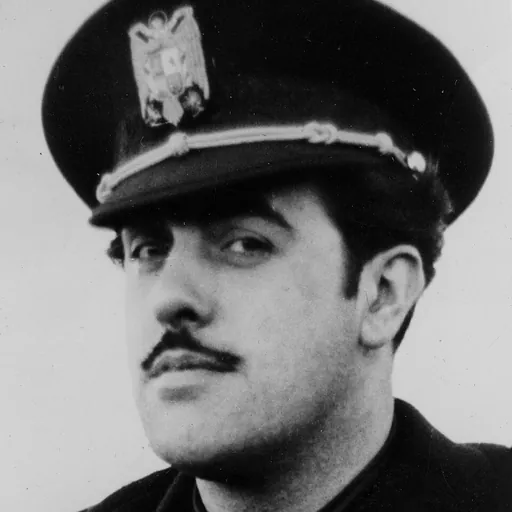
About José Antonio Girón de Velasco
Lived 1911 – 1995 (aged 83). José Antonio Girón de Velasco was a Spanish politician, trade unionist and lawyer.
José Antonio Girón de Velasco (28 August 1911, Herrera de Pisuerga, Palencia – 22 August 1995, Fuengirola, Málaga) was a prominent Spanish Falangist politician. He was minister of Labor (1941–57), counselor of the Council of the Realm and member of the Cortes Españolas. He was one of the most heard voices against any kind of changes during the last years of Francoist regime, taking part in the political group known as "the Bunker", for their reluctance to the Spanish transition to democracy after Franco's death.
He began his political activities during his university studies in Valladolid. In 1931 he joined Juventudes Castellanas de Acción Hispánica (Castilian Youth for Spanish Action), a small political group founded in Valladolid by Onésimo Redondo, that would merge with Ramiro Ledesma's Juntas de Ofensiva Nacional-Sindicalista (Unions of the National-Syndicalist Offensive) and José Antonio Primo de Rivera's Falange Española de las JONS. He fought in the Civil War on the Nationalist side and commanded units of Falangist militias. After the war, he was appointed national delegate of Veterans and in 1941 minister of Labor, when he was only 30. He deployed an intense activity, like the labor institutes for training workers and the development of the social security system . He was removed from the Ministry in 1957 according to the liberalizing shift that Franco wished for the Spanish economy (Stabilization Plan). The previous year, Girón had decreed a salary increase that the Spanish economy could not afford.
Throughout Francoism, Girón was one of the leaders of Falange and he increasingly showed his dissent, according to the Falangist principles, to many policies of the regime. Notably, he was strongly opposed to opportunism. He yearned for the Falangist 'pending revolution', as Primo de Rivera's ideas just inspired a few policies but Francoism was not really an actual Falangist regime, but a consensus of rightist and authoritarian tendencies. After Franco's death, both he and Blas Piñar were the natural leaders of the "Bunker" in the Cortes Españolas, and voted against the Political Reform Act of 1976 that allowed the transition to democracy.
Girón died on 22 August 1995.
Don’t just read it —
keep it.
Full-length biographies made to live with: read them, listen on the way to work, watch them tonight.
- E-book
- Audio
- Video
Instant download · yours to keep · every purchase keeps this site free
Important facts
People in José Antonio Girón de Velasco's life
Named in this biography and alive at the same time


Related people
Same field, nearest in time





Contemporaries
People whose lives overlapped José Antonio Girón de Velasco's





Frequently asked questions
Who was José Antonio Girón de Velasco?
Spanish politician (1911–1995)
When was José Antonio Girón de Velasco born?
José Antonio Girón de Velasco was born on 28 August 1911 in Herrera de Pisuerga.
When did José Antonio Girón de Velasco die?
José Antonio Girón de Velasco died on 22 August 1995 in Fuengirola.
What was José Antonio Girón de Velasco's occupation?
José Antonio Girón de Velasco was a politician, trade unionist and lawyer.
What nationality was José Antonio Girón de Velasco?
José Antonio Girón de Velasco was Spanish.
Sources & further reading
· Wikipedia: José Antonio Girón de Velasco
Cite this page
APA: Biography.guide. (2026). José Antonio Girón de Velasco. https://biography.guide/jose-antonio-giron-de-velasco/
MLA: "José Antonio Girón de Velasco." Biography.guide, https://biography.guide/jose-antonio-giron-de-velasco/.
Chicago: "José Antonio Girón de Velasco." Biography.guide. https://biography.guide/jose-antonio-giron-de-velasco/.
Data last updated: 2026-09-20 · Spot an error? Report a correction.
Portrait: Wikimedia Commons · author & licence
Page generated 2026-09-27 04:58 UTC