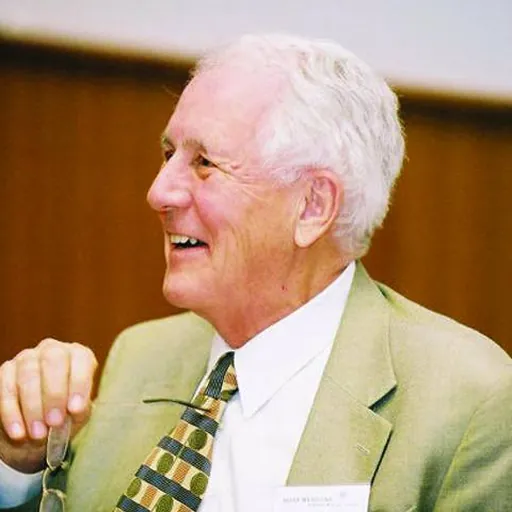
About John Woodland Hastings
Lived 1927 – 2014 (aged 87). John Woodland Hastings was an American biochemist and university teacher.
Early life Hastings lived in Seaford, Delaware, during his early childhood; in 1937, he joined the choir at the Cathedral of St. John the Divine and attended the choir's in-house boarding school, visiting his family during vacations. Hastings moved to Lenox School in Lenox, Massachusetts, in 1941 to complete his secondary education and was interested in literature, physics, mathematics, ice hockey and basketball.
Awards and honors
Throughout his career Hastings received numerous awards and honors: Guggenheim Fellow, 1965; Elected to the Johns Hopkins Society of Scholars, 1969; Elected to the American Academy of Arts and Sciences, 1972; NATO Senior Fellow in Science, Foundation Curie, Orsay, France, 1977; Alexander von Humboldt Fellow, Bonn, Germany 1979-80 and 1993; Yamada Foundation Fellow, Osaka, Japan, 1986; NIMH Merit Award, 1990 and 1994; Fellow of the American Academy of Microbiology, 2003; American Society for Photobiology Lifetime Achievement Award, 2003; Elected to the National Academy of Sciences, 2003; Recipient of the Farrell Prize in Sleep Medicine for his contributions to and for founding the field of circadian rhythms, 2006.
Career Hastings began his graduate studies at Princeton University in 1948 in the laboratory of E. Newton Harvey, the world leader of luminescence studies at the time, and focused on the role of oxygen in the luminescence of bacteria, fireflies, ostracod crustaceans and fungi. He received his PhD in 1951. He then joined the lab of William D. McElroy, another student of Harvey’s, at Johns Hopkins University where he discovered both the stimulatory effects of coenzyme A and gating control by oxygen of firefly luminescence, and that flavin is a substrate in bacterial luminescence.
In 1953 he joined the faculty in the Department of Biological Sciences at Northwestern University. In 1954 he began a long collaboration with Beatrice M. Sweeney, who was then at the Scripps Institution of Oceanography, in elucidating the cellular and biochemical mechanisms of luminescence in the unicellular dinoflagellate Lingulodinium polyedrum (formerly known as Gonyaulax polyedra). A byproduct of this initial research was their discovery of circadian control of the luminescence.
In 1957, Hastings next took a faculty position in the Biochemistry Division of the Chemistry Department at the University of Illinois at Urbana–Champaign where he continued his focus on dinoflagellate and bacterial luminescence and dinoflagellate circadian rhythms. Hastings joined the faculty of Harvard University as Professor of Biology in 1966. During this period he continued and expanded his studies of circadian rhythms in dinoflagellates and luminescence in bacteria, dinoflagellates and other organisms. He was elected to the National Academy of Sciences in 2003
For over 50 years he also had an affiliation with the Marine Biological Laboratory in Woods Hole, Massachusetts. He was the director of the Physiology Course there from 1962 to 1966, and served as a trustee from 1966 to 1970.
Research Interests Source: the discovery of a flavin to be a substrate in its luciferase reaction, the determination of gene regulation of the luciferases, and the first evidence for quorum sensing, a form of bacterial communication. In quorum sensing (initially termed autoinduction), the bacteria release a substance into the medium, the autoinducer. Once the concentration of this substance reaches a critical level (a measure of the number of bacteria in a limited area), transcription of specific other genes that had been repressed are turned on. Once the sequenced autoinducer gene was found to occur widely in gram-negative bacteria quorum sensing became accepted in the early 1990s. It is now known that in many pathogenic bacteria, there is delayed production of toxins, which serve to greatly augment their pathogenicity, this is similar to what happens for luciferase proteins. By curtailing their toxin output until the bacterial populations are substantial, these bacteria can generate massive quantities of toxin quickly and thereby swamp the defences of the host.
Luminescent Dinoflagellates: In early 1954 at Northwestern University, Hastings, his students and colleagues studied cellular and molecular aspects of bioluminescence in dinoflagellates [especially Lingulodinium polyedrum (formerly Gonyaulax polyedra)]. They elucidated the structures of the luciferins and luciferases, the organization and regulation of their associated genes, temporal control mechanisms, and the actual sub-cellular identity and location of the light emitting elements, which they termed scintillons. They demonstrated that the reaction is controlled by a drop in pH when an action potential leads to the entry of protons via voltage-activated membrane channels in the scintillons. Through immunolocalization studies the Hastings lab showed that scintillons are small peripheral vesicles (0.4 μm) that contain both the luciferase and the luciferin-binding protein. More recently, the lab found that the luciferase gene in Lingulodinium polyedrum and other closely related species contains three homologous and contiguous repeated sequences in a kind of "three-ring circus with the same act in all three." However, another luminescent, but heterotrophic, dinoflagellate, Noctiluca scintillans, has but a single protein, which appears to possess both catalytic and substrate binding properties in a single, rather than separate proteins.
Dinoflagellate Circadian Rhythms: Using Lingulodinium polyedrum as a model, Hastings spearheaded our understanding of the molecular mechanisms involved in control of circadian rhythms, which in humans are involved in sleep, jet-lag and other daily activities. His lab has shown that the rhythm of bioluminescence involves a daily synthesis and destruction of proteins. Because the mRNAs that code for these proteins remain unchanged from day to night, the synthesis of these proteins is controlled at the translational level. This work has now been expanded to other proteins in the cell. On the other hand, short pulses of inhibitors of synthesis of these proteins results in phase shifts of the circadian rhythm, either delays or advances, depending when the pulse is administered. At still another level, protein phosphorylation inhibitors also influence the period of the rhythm.
Other luminescent systems: Early in his career Hastings developed techniques to quantify the level of oxygen required in a luminescent reaction for several different species including bacteria, fungi, fireflies and ostracod crustaceans. This work showed that oxygen gating is the mechanism for firefly flashing. In other work when he was in the McElroy lab he examined the basic biochemical mechanism of firefly luciferase and demonstrated that coenzyme A stimulates light emission. His lab first demonstrated that the green in vivo coelenterate bioluminescence occurs because of energy transfer from the luminescent molecule (aequorin), which alone emits blue light, to a secondary green emitter which they termed green fluorescent protein (GFP).
Publications Publications by J.W. Hastings
Selected publications:
Hastings, J.W. and Wood, K.V. (2001) Luciferases did not all evolve from precursors having similar enzymatic properties. pp. 199–210, In, Photobiology 2000 (D. Valenzeno and T. Coohill, eds.) Valdenmar Publ. Co., Overland Park, KS.
Wilson, T. and Hastings, J.W. (1970) Chemical and biological aspects of singlet excited molecular oxygen. Photophysiology (A.C. Giese, ed.), Vol. V, pp. 49–95, Acad. Press, NY.
Hastings, J.W. Bioluminescence. (1968) Annu. Rev. Biochem. 37: 597-630.
Don’t just read it —
keep it.
Full-length biographies made to live with: read them, listen on the way to work, watch them tonight.
- E-book
- Audio
- Video
Instant download · yours to keep · every purchase keeps this site free
Important facts
People in John Woodland Hastings's life
Named in this biography and alive at the same time


Related people
Same field, nearest in time





Contemporaries
People whose lives overlapped John Woodland Hastings's

Frequently asked questions
Who was John Woodland Hastings?
American biologist
When was John Woodland Hastings born?
John Woodland Hastings was born on 24 March 1927 in Salisbury.
When did John Woodland Hastings die?
John Woodland Hastings died on 6 August 2014 in Lexington.
What was John Woodland Hastings's occupation?
John Woodland Hastings was a biochemist and university teacher.
What nationality was John Woodland Hastings?
John Woodland Hastings was American.
Sources & further reading
· Wikipedia: John Woodland Hastings
· DBpedia: John Woodland Hastings
Cite this page
APA: Biography.guide. (2026). John Woodland Hastings. https://biography.guide/john-woodland-hastings/
MLA: "John Woodland Hastings." Biography.guide, https://biography.guide/john-woodland-hastings/.
Chicago: "John Woodland Hastings." Biography.guide. https://biography.guide/john-woodland-hastings/.
Data last updated: 2026-09-24 · Spot an error? Report a correction.
Portrait: Wikimedia Commons · author & licence
Page generated 2026-09-27 05:08 UTC