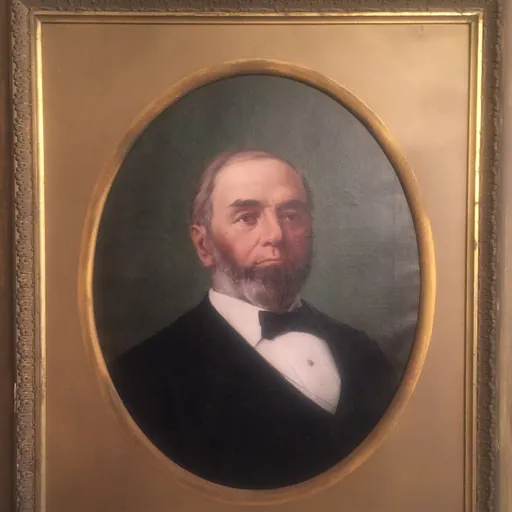
About John W. Griffiths
Lived 1809 – 1882 (aged 72). John W. Griffiths was an engineer and naval architect, known for Clipper ship and Rainbow (clipper).
John Willis Griffiths (October 6, 1809 – March 30, 1882) was an American naval architect who was influential in his design of clipper ships and his books on ship design and construction. He also designed steamships and war vessels and patented many inventions. Maritime historian William H. Thiesen wrote, "Of all the nineteenth-century American shipbuilders, John W. Griffiths did more than any other builder to champion American shipbuilding methods. An experimenter, an advocate for formal ship-design education, and a working intellectual, Griffiths proved to be most remarkable of America’s nineteenth-century shipbuilders.”
Ship designer
In 1845 Griffiths was employed for the shipbuilding firm of Smith & Dimon in lower Manhattan and designed the clipper ship Rainbow. Historian Dr. Larrie Ferreiro considered the Rainbow “the first of a line of ‘extreme’ clippers, with a fine, raked bow, high deadrise, and hollow waterlines.” His fourth and last clipper, Universe, was built by Smith and Dimon in 1850.
In March 1849 the Sea Witch set a record when it sailed from Hong Kong to New York in 74 days 14 hours. It was noted on October 25, 2013, that no single-hulled sailing vessel ever broke the record. Griffiths wrote in 1855, “It will be entirely proper to add, that the model of the Sea Witch had more influence upon the subsequent configuration of fast vessels, than any other ship ever built in the United States.”
Griffiths had received considerable praise for his clipper designs. Smith & Dimon stated, “We have no hesitation recommending him as a ‘Marine and Naval Architect’ of the first order. A gentleman who has reached an eminence in the line of his profession rarely attained, and whose skills in this branch of Mechanism we believe to be unsurpassed.” Fellow ship designer Donald McKay wrote Griffiths, “You are a master of your profession, have no Superior in it – a Scientific and practical Ship Builder – & an illustrious Citizen . . .”
After Griffiths left Smith & Dimon, his interest shifted from sailing vessels to steamships. He designed the sloop-of-war Pawnee for the US Navy and the radical shallow-draft merchant steamer Ocean Bird. Earlier in his career, Griffiths had cut frames for the Russian steam frigate Kamchatka. One year later it was renamed The US Nautical Magazine and Naval Journal. Griffiths wrote numerous essays on maritime topics, including why wood was preferable to iron as a shipbuilding material. Wrote Dr. Ferreiro, “Griffiths was also a popularizer of new developments in hull design and resistance calculations . . . “ The magazine kept shipbuilders informed about the latest developments in the industry. Thiesen wrote, “the timber-bending machine never became popular…because wooden-ship construction had become less profitable by the time Griffiths perfected the machine, and the cost of the apparatus proved too high for most wood shipbuilders.” In 1875 Griffiths created and patented the Universal Wood-Bending Machine for boats, carriages, and other vehicles. He earned a prize at the Philadelphia Centennial Exhibition in 1876 although carriage-maker Samuel R. Bailey always claimed that Griffiths had copied his invention.
Griffiths died of anthrax in Brooklyn, New York, on March 30, 1882, and was interred at the Linden Hill United Methodist Cemetery in Queens, New York. Historian William Brown Meloney dedicated his 1916 book The Heritage of Tyre “to the memory of John Willis Griffiths, whose genius revolutionized the science of merchant shipbuilding and naval architecture and enthroned the United States as Mistress of the Seas.” Marion H. Virnelson, Griffiths’ granddaughter, donated his belongings to the Smithsonian Institution in 1937. Griffiths' obituary did not appear in any major New York City newspapers, and his grave in Queens had been unmarked for 134 years. A headstone was unveiled on July 23, 2016, under the sponsorship of the National Maritime Historical Society.
Don’t just read it —
keep it.
Full-length biographies made to live with: read them, listen on the way to work, watch them tonight.
- E-book
- Audio
- Video
Instant download · yours to keep · every purchase keeps this site free
Important facts
People in John W. Griffiths's life
Named in this biography and alive at the same time



Related people
Same field, nearest in time


Contemporaries
People whose lives overlapped John W. Griffiths's





Frequently asked questions
Who was John W. Griffiths?
American naval architect (1809–1882)
When was John W. Griffiths born?
John W. Griffiths was born on 6 October 1809.
When did John W. Griffiths die?
John W. Griffiths died on 29 April 1882 in Brooklyn, New York.
What was John W. Griffiths's occupation?
John W. Griffiths was an engineer and naval architect.
What was John W. Griffiths known for?
John W. Griffiths was known for Clipper ship and Rainbow (clipper).
Sources & further reading
· Wikipedia: John W. Griffiths
Cite this page
APA: Biography.guide. (2026). John W. Griffiths. https://biography.guide/john-w-griffiths/
MLA: "John W. Griffiths." Biography.guide, https://biography.guide/john-w-griffiths/.
Chicago: "John W. Griffiths." Biography.guide. https://biography.guide/john-w-griffiths/.
Data last updated: 2026-09-22 · Spot an error? Report a correction.
Portrait: Wikimedia Commons · author & licence
Page generated 2026-09-27 05:00 UTC