
About John R. Hodge
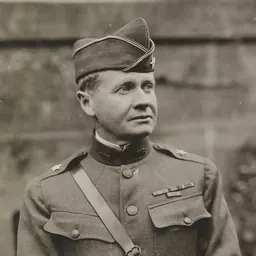
Lived 1893 – 1963 (aged 70). John R. Hodge was an American military leader and army officer.
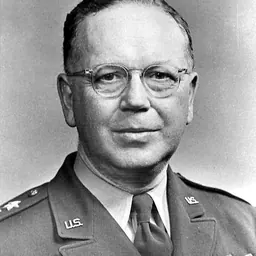
General John Reed Hodge (12 June 1893 – 12 November 1963) was an American military officer of the United States Army. Hodge commanded Operation Blacklist Forty in 1945. He served as the governor of the American military government in Korea from 1945 to 1948.
Early life and career Born in Golconda, Illinois, Hodge attended Southern Illinois Teachers College and the University of Illinois. After completing an officer indoctrination program at the U.S. Army Officer Candidate School at Fort Sheridan, he received a direct commission in the Army as an infantry second lieutenant in 1917. He served in World War I in France and Luxembourg.
Remaining in the Army following the end of the war, he taught military science at Mississippi State University from 1921 to 1925 and graduated from the Infantry School in 1926. After a posting to Hawaii, he graduated from the Command and General Staff School, from where he graduated in 1934, the Army War College, and the Air Corps Tactical School.
World War II At the beginning of World War II, Hodge served as chief of staff of the VII Corps under the command of Major General Robert C. Richardson Jr., located in California as a part of the Western Defense Command. He was promoted to the temporary rank of brigadier general in June 1942 and transferred to the 25th Infantry Division in Hawaii, where he succeeded Gilbert R. Cook as the assistant division commander (ADC) and deputy of Major General J. Lawton Collins.
The 25th Division was sent overseas to Guadalcanal in November 1942. Hodge stayed with 25th Division until April 1943, when he was promoted to the rank of major general and transferred to the temporary command of the 43rd Infantry Division, where he relieved Major General John H. Hester, who was exhausted from combat. Hodge commanded the 43rd Division during the combats in Northern Solomons and was decorated with the Army Distinguished Service Medal for his service.
After three months of service with the 43rd Division, Hodge was given command of the "Americal" Infantry Division on the Fiji Islands. He subsequently commanded the division during the Bougainville campaign.
Hodge was appointed commanding officer of the newly activated XXIV Corps in Hawaii and participated in the Battle of Leyte within Philippines Campaign and later in Battle of Okinawa. He received the Army Distinguished Service Medals for each of these campaigns. Hodge was promoted to the temporary rank of lieutenant general in June 1945.
Later career Army commanders in the United States and certain overseas commanders meet with Secretary of the Army Frank Pace and General J. Lawton Collins, Army Chief of Staff, in the Pentagon in routine sessions, 5 June 1952. Lieutenant General John R. Hodge is sat fourth from the right, between Secretary Pace (left) and Lieutenant General Henry Aurand (right)
The grave of General John R. Hodge at Arlington National Cemetery
From 1945 to 1948, Hodge was the commanding general of United States Army Forces in Korea (USAFIK). He took his corps to Korea under orders of Douglas MacArthur, landing at Incheon on 9 September 1945. He was the commanding officer receiving the surrender of all Japanese forces in Korea south of the 38th parallel. Hodge refused to recognize the People's Republic of Korea and its People's Committees, and outlawed it on 12 December 1945.
Hodge then returned to Fort Bragg, North Carolina, to command V US Corps from 1948 to 1950. After the retirement of Lieutenant General Alvan C. Gillem, Hodge was named the commanding general of the US Third Army.
Hodge was promoted to general on 5 July 1952. His final assignment was as Chief of Army Field Forces from 8 May 1952 until he retired from military service on 30 June 1953.
General Hodge died in Washington, D.C., in 1963, at the age of 70.
Decorations
Dates of rank
Don’t just read it —
keep it.
Full-length biographies made to live with: read them, listen on the way to work, watch them tonight.
- E-book
- Audio
- Video
Instant download · yours to keep · every purchase keeps this site free
Important facts
People in John R. Hodge's life
Named in this biography and alive at the same time




Related people
Same field, nearest in time


Contemporaries
People whose lives overlapped John R. Hodge's



Frequently asked questions
Who was John R. Hodge?
United States Army general (1893-1963)
When was John R. Hodge born?
John R. Hodge was born on 12 June 1893 in Golconda.
When did John R. Hodge die?
John R. Hodge died on 12 November 1963 in Washington, D.C..
What was John R. Hodge's occupation?
John R. Hodge was a military leader and army officer.
What nationality was John R. Hodge?
John R. Hodge was American.
Sources & further reading
Cite this page
APA: Biography.guide. (2026). John R. Hodge. https://biography.guide/john-r-hodge/
MLA: "John R. Hodge." Biography.guide, https://biography.guide/john-r-hodge/.
Chicago: "John R. Hodge." Biography.guide. https://biography.guide/john-r-hodge/.
Data last updated: 2026-09-20 · Spot an error? Report a correction.
Page generated 2026-09-27 05:31 UTC