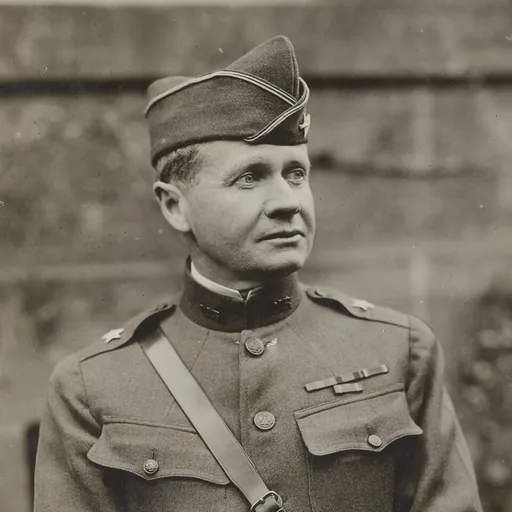
About Paul Bernard Malone
Lived 1872 – 1960 (aged 88). Paul Bernard Malone was a military leader.
Paul Bernard Malone (May 8, 1872 – October 16, 1960) was a highly decorated officer in the United States Army with the rank of major general. Following his graduation from the United States Military Academy (USMA), he participated in the Spanish–American and Philippine–American Wars and commanded an infantry brigade in the last year of the World War I. Malone reached the rank of brigadier general during that conflict and distinguished himself during the Battle of Soissons.
He received the Distinguished Service Cross and the Distinguished Service Medal and several foreign decorations. Malone remained in the Army following the war and completed his service as commanding general, Fourth United States Army in 1936.
Among his classmates who also became general officers were Butler Ames, John W. Barker, Oliver Edwards, George H. Estes, Hamilton S. Hawkins III, Samuel Hof, Ora E. Hunt, Frank Parker, Briant H. Wells, and Clarence C. Williams.
In mid-1913, Malone was transferred to Honolulu, Hawaiian Islands and served with 2nd Infantry Regiment until June 1916. He was promoted to major on July 12, 1916, and appointed chief of staff, Eagle Pass District, Texas. Malone served in this capacity on the Mexican Border during the Pancho Villa Expedition until January 1917, when he was appointed Officer-in-charge of Training Camps in the Central Department. He also served for brief period at the Citizens' Military Training Camp, the first businessmen's training camp at Plattsburgh, New York, and also as chief instructor at the Presidio training camp.
Malone then led the 23rd Infantry in the Battle of Soissons and particularly distinguished himself on July 19. During the two days which his regiment was engaged with the enemy, Malone frequently visited the advanced troops. On the evening of July 18, after the regiment had suffered severe losses, he assisted in the reorganization of a battalion for the attack on Vierzy. On the morning of July 19 he made a personal reconnaissance of the front lines, under heavy fire, in order to ascertain the enemy position, which was of vital importance. Malone then directed his regiment in attack and defeated the German forces. For his service during the Soissons operation, Malone was decorated with the Distinguished Service Cross (DSC), the second highest decoration of the United States Armed Forces.
He then briefly commanded the 12th Infantry Brigade at Fort Sheridan, Illinois, between March–June 1928, when he was promoted to major general and assumed command of Sixth Corps Area with headquarters in Chicago. Malone left United States in April 1929 and embarked for the Philippines, where he assumed command of Philippine Division at Fort William McKinley. While in this capacity, Malone served under Major General Douglas MacArthur, who commanded Philippine Department and Governor Henry L. Stimson. He was transferred to San Francisco in March 1935 and assumed command of Ninth Corps Area. During his tenure there, Malone's units participated in the California Pacific International Exposition.
In May 1935, he was given additional duty as commanding general, Fourth United States Army in San Francisco. The Fourth Army mission was to develop defense and operational plans for contingencies in the vicinity of the Pacific Coast and the western United States, review the mobilization plans of the Seventh and Ninth Corps Areas, and oversee the training of units in the army area. Malone served in that capacities until April 30, 1936, when he retired from active duty following a 42 years of service.
Following the United States entry into World War II, Malone's skills were requested again. Due to his military background, he was nominated to the capacity of defense coordinator of the Marin County, California, at the end of February 1942. However power struggle inside the Civil Defense office of Marin County did not allow his nomination and Malone was not appointed.
Malone then served as head of the statewide organization of the Madera County Minute Men of '42, which served to train and organize a force of hunters and others who are owners of firearms and ammunition suitable for armed resistance in case of invasion or sabotage. Statewide plans specify that the organization must be on a military basis, with in charge of each unit, and must be drilled and trained in simple military drills.
He later served on the State Guard committee with general Charles S. Farnsworth and proposed an increase in the guards' strength. He also broadcast a tribute as an encouragement to his former pupil, General Douglas MacArthur, who was struggling in the combat against the Japanese in the Philippines in January 1942. Malone also gained reputation as prominent military analyst and regularly attended the Marin junior chamber of commerce's meetings as guest speaker.
Death
Malone retired to Sarasota, Florida, following World War II and died there on October 16, 1960, at the age of 88. He was buried with full military honors at Arlington National Cemetery, Virginia, together with his wife, Gertrude Kerwin (1872–1954). They had together four children: two daughters, Gertrude and Mildred and two sons, Paul Jr. and Andrew, both United States Military Academy alumni and Army Colonels.
His works
Decorations
Here is Major general Malone's ribbon bar:
Legacy In the late 1970s, a series of several weapons qualification ranges, at the United States Army Infantry Center at Fort Benning, Georgia, were named after him.
Don’t just read it —
keep it.
Full-length biographies made to live with: read them, listen on the way to work, watch them tonight.
- E-book
- Audio
- Video
Instant download · yours to keep · every purchase keeps this site free
Important facts
People in Paul Bernard Malone's life
Named in this biography and alive at the same time



Related people
Same field, nearest in time



Contemporaries
People whose lives overlapped Paul Bernard Malone's


Frequently asked questions
Who was Paul Bernard Malone?
U.S. Army Major General
When was Paul Bernard Malone born?
Paul Bernard Malone was born on 8 May 1872 in Middletown.
When did Paul Bernard Malone die?
Paul Bernard Malone died on 16 October 1960 in Sarasota.
What was Paul Bernard Malone's occupation?
Paul Bernard Malone was a military leader.
Sources & further reading
· Wikipedia: Paul Bernard Malone
· DBpedia: Paul Bernard Malone
Cite this page
APA: Biography.guide. (2026). Paul Bernard Malone. https://biography.guide/paul-bernard-malone/
MLA: "Paul Bernard Malone." Biography.guide, https://biography.guide/paul-bernard-malone/.
Chicago: "Paul Bernard Malone." Biography.guide. https://biography.guide/paul-bernard-malone/.
Data last updated: 2026-09-23 · Spot an error? Report a correction.
Portrait: Wikimedia Commons · author & licence
Page generated 2026-09-27 05:04 UTC