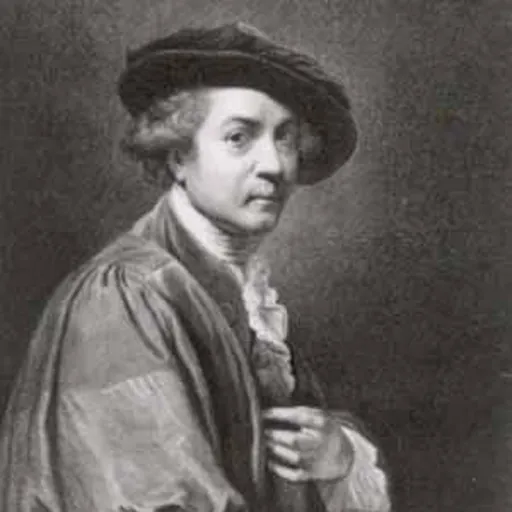
About John Keyse Sherwin
Lived 1751 – 1790 (aged 38–39). John Keyse Sherwin was a British painter, visual artist, copper engraver, draftsperson, exlibrist and engraver.
John Keyse Sherwin (175124 September 1790) was an English engraver and history-painter.
Biography Sherwin was born at East Dean in Sussex. His father was a wood-cutter employed in shaping bolts for shipbuilders, and the son followed the same occupation till his seventeenth year, when, having shown an aptitude for art by copying some miniatures, he was adopted by his father's landlord, William Mitford. Sherwin was sent to study in London, first under John Astley, and then for three years under Francesco Bartolozzi – for whom he is believed to have executed a large portion of the plate of Clytie, after Annibale Carracci, published as the work of his master.
Sherwin entered as a student of the Royal Academy, and gained a silver medal, and in 1772 a gold medal for his painting of "Coriolanus taking Leave of his Family". From 1774 till 1780 he was an exhibitor of chalk drawings and of engravings in the Royal Academy. Establishing himself in St James's Street as a painter, designer and engraver, he attained popularity and began to mix in fashionable society. His drawing of the "Finding of Moses", a work of but slight artistic merit, which introduced portraits of the princess royal of England and other leading ladies of the aristocracy, hit the public taste, and, as reproduced by his burin, sold largely. Sherwin died in extreme penury on 24 September 1790according to George Steevens, the editor of Shakespeare, at The Hog in the Pound, an obscure alehouse in Swallow Street, or, as stated by his pupil J.T. Smith, in the house of Robert Wilkinson, a printseller in Cornhill.
It is as an engraver that Sherwin is most esteemed; and it may be noted that he was ambidextrous, working indifferently with either hand upon his plates. His drawing is correct, his line excellent and his textures are varied and intelligent in expression. Such of his plates as the "Holy Family" after Nicolas Poussin, "Christ Bearing the Cross" after Murillo, the portrait of the marquis of Buckingham after Thomas Gainsborough and that of Pitt occupy a high place among the productions of the English school of line-engravers. He also worked after Pine, Dance and Kauffman.
Don’t just read it —
keep it.
Full-length biographies made to live with: read them, listen on the way to work, watch them tonight.
- E-book
- Audio
- Video
Instant download · yours to keep · every purchase keeps this site free
Important facts
People in John Keyse Sherwin's life
Named in this biography and alive at the same time



Related people
Same field, nearest in time



Contemporaries
People whose lives overlapped John Keyse Sherwin's




Frequently asked questions
Who was John Keyse Sherwin?
British artist (1751-1790)
When was John Keyse Sherwin born?
John Keyse Sherwin was born in 1751 in East Dean.
When did John Keyse Sherwin die?
John Keyse Sherwin died on 24 September 1790 in London.
What was John Keyse Sherwin's occupation?
John Keyse Sherwin was a painter, visual artist, copper engraver, draftsperson, exlibrist and engraver.
What nationality was John Keyse Sherwin?
John Keyse Sherwin was British.
Sources & further reading
· Wikipedia: John Keyse Sherwin
Cite this page
APA: Biography.guide. (2026). John Keyse Sherwin. https://biography.guide/john-keyse-sherwin/
MLA: "John Keyse Sherwin." Biography.guide, https://biography.guide/john-keyse-sherwin/.
Chicago: "John Keyse Sherwin." Biography.guide. https://biography.guide/john-keyse-sherwin/.
Data last updated: 2026-09-24 · Spot an error? Report a correction.
Portrait: Wikimedia Commons · author & licence
Page generated 2026-09-27 05:09 UTC