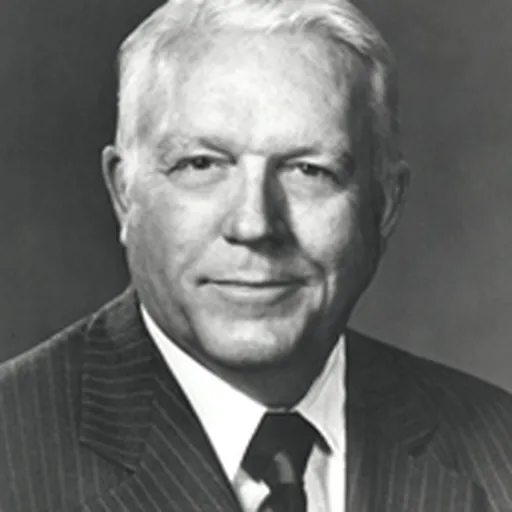
About John James Flynt, Jr.
Lived 1914 – 2007 (aged 92). John James Flynt, Jr. was an American politician and lawyer.
John James Flynt Jr. (November 8, 1914 – June 24, 2007) was an American Democratic Party politician who served in the United States House of Representatives for two congressional districts in Georgia from 1954 to 1979. Upon his retirement from the House, he was succeeded by future House Speaker Newt Gingrich, whom Flynt had narrowly defeated in the two previous elections.
Early life and education John James Walker Flynt Jr. was born on November 8, 1914, in Griffin, Georgia, the only son of John James Flynt and Susan Winn Banks Flynt. He attended Spalding County public schools, before enrolling in Georgia Military Academy. He then attended the University of Georgia at Athens where he was a member of the Phi Kappa Literary Society. After graduating with an A.B. degree in 1936. In 1936, he received his commission in the United States Army Reserves. Lt. Flynt was assigned to the 6th Horse Cavalry Regiment at Fort Oglethorpe, Georgia. He served from 1936 to 1937. In World War II, Flynt served as Aide-de-Camp for Brigadier General Robert W. Grow in the 3rd Armored Division in France and was awarded the Bronze Star Medal in 1944. In 1945, Flynt joined the U.S. Army Reserve, where he later retired a Colonel.
Early political career Flynt was a member of the Georgia House of Representatives 1947–1948, and was solicitor general for Griffin Judicial Circuit from 1949 to 1954. In 1952–1954, he was president of the Georgia Bar Association. Flynt was a delegate to the Georgia State Democratic conventions in 1946, 1950, 1954, 1958, 1962, and 1966, and was a delegate to the Democratic National Conventions of 1960 and 1968.
Tenure in Congress
Flynt was elected as a Democrat to the Eighty-third Congress by special election to fill the vacancy caused by the death of Representative A. Sidney Camp, and at the same time was elected to the Eighty-fourth Congress. He was reelected to the eleven succeeding Congresses, serving from November 2, 1954, to January 3, 1979. While in Congress, he was chair of the Committee on Standards of Official Conduct (Ninety-fourth and Ninety-fifth Congresses).
Jack Flynt was the focus of two books by the political scientist, Richard Fenno: Home Style and Congress at the Grassroots. He was one of the most conservative Democrats in the House. Flynt cast votes against abortion, gun control, the Equal Rights Amendment, Medicare, and public housing. Flynt opposed reciprocal trade agreements fearing that they would hurt the textile industry in his district, and supported price support for agriculture. A staunch segregationist, in 1956, Flynt signed the Southern Manifesto. Flynt voted against the Civil Rights Acts of 1957, the Civil Rights Acts of 1960, the Civil Rights Acts of 1964, and the Civil Rights Acts of 1968 as well as the 24th Amendment to the U.S. Constitution and the Voting Rights Act of 1965.
Flynt was reelected nine times without serious difficulty, eight of those times unopposed. He faced a Republican only once during this time, in 1966. The Republican Party was more or less nonexistent in most of Georgia well into the 1970s.
However, in 1974, he was nearly defeated by political newcomer Newt Gingrich, a professor at the University of West Georgia. This came as a considerable surprise, as 1974 was a very bad year for Republicans nationally due to fallout from Watergate. After an equally close rematch against Gingrich in 1976 (despite former governor Jimmy Carter's bid for president), Flynt opted not to run for reelection in 1978, when his district was finally won by Gingrich. Gingrich's eventual success was largely due to changing demographics. By the early 1970s, the southern and western suburbs of Atlanta had begun spilling into the district, and gradually swamped the native-born farming and small-town population in the voting booth.
Later years After leaving Congress, Flynt resumed the practice of law and farming operations. He engaged in banking and real estate, and lived in Griffin, Georgia, until his death in 2007.
Don’t just read it —
keep it.
Full-length biographies made to live with: read them, listen on the way to work, watch them tonight.
- E-book
- Audio
- Video
Instant download · yours to keep · every purchase keeps this site free
Important facts
People in John James Flynt, Jr.'s life
Named in this biography and alive at the same time





Related people
Same field, nearest in time





Contemporaries
People whose lives overlapped John James Flynt, Jr.'s

Frequently asked questions
Who was John James Flynt, Jr.?
American politician (1914-2007)
When was John James Flynt, Jr. born?
John James Flynt, Jr. was born on 8 November 1914 in Griffin.
When did John James Flynt, Jr. die?
John James Flynt, Jr. died on 24 June 2007 in Griffin.
What was John James Flynt, Jr.'s occupation?
John James Flynt, Jr. was a politician and lawyer.
What nationality was John James Flynt, Jr.?
John James Flynt, Jr. was American.
Sources & further reading
· Wikipedia: John James Flynt, Jr.
Cite this page
APA: Biography.guide. (2026). John James Flynt, Jr.. https://biography.guide/john-james-flynt-jr/
MLA: "John James Flynt, Jr.." Biography.guide, https://biography.guide/john-james-flynt-jr/.
Chicago: "John James Flynt, Jr.." Biography.guide. https://biography.guide/john-james-flynt-jr/.
Data last updated: 2026-09-20 · Spot an error? Report a correction.
Page generated 2026-09-27 05:10 UTC