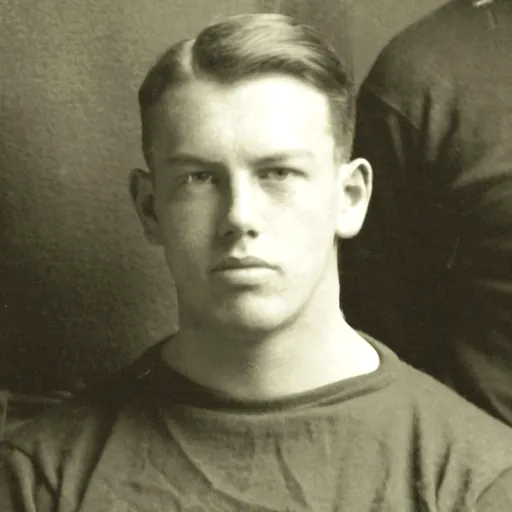
About James B. Craig
Lived 1893 – 1990 (aged 96–97). James B. Craig was an American athletics competitor and american football player.
James Blodgett Craig (March 11, 1893 – January 1990) was an All-American football halfback and quarterback who played with the University of Michigan Wolverines from 1911 to 1913. He was named an All-American in 1913. He also served as the athletic director and head football coach at the University of Arkansas from 1919 to 1920.
Early years Craig was born on March 11, 1893, in Detroit, Michigan. He was the son of William Craig, born in 1856, and Alice Craig, born in 1867. At the time of the 1900 U.S. Census, the Craig family was living at 136 Charlotte Avenue in Detroit. The family at that time consisted of William, identified as a capitalist, Alice, and sons Ralph (born 1889), James (born 1893), and William (born 1896).
The Craig brothers: track champions Before Craig ever played a down for the Wolverines, he established himself as one of the top hurdlers in the country. In a meet against Cornell in March 1911, Craig broke the world indoor record by running the high hurdles in 5 1–5 seconds. In 1912, Craig won the low hurdles competition in the 1912 Eastern Inter-Collegiate Athletic Association. Craig's older brother, Ralph Craig, was also a track star at the University of Michigan who went on to win the gold medals in the 100 and 200-meter events at the 1912 Olympics in Stockholm, Sweden.
The Wolverines finished the 1911 season with a 5–1–2 record. They started the season with convincing wins against and Case Institute of Technology, 24–0, Michigan Agricultural College, and Ohio State, 19–0, and narrowly beat Vanderbilt, 9–8. After starting the season 4–0, the Wolverines went 1–1–2 in their final four games, including a loss to Cornell and ties with Syracuse and Nebraska.
In the Syracuse game, Craig suffered an injury to his ribs (believed to be torn cartilage) after being "fiercely tackled" and was expected to be unable to play "for an indefinite period."
Despite the rib injury, Craig came back to lead the Wolverines to an 11–9 win over Pennsylvania two weeks later. News accounts at the time reported that the "craftiness of Coach Yost and the speed of 'Jimmy' Craig" led Michigan to the win in an icy blizzard at Ferry Field. Late in the game, Craig scored the winning touchdown on a "double pass." In one of Yost's "trick plays," Michigan's "interference started to the right," and the ball was then shot to Craig, waiting far to the left. Craig dodged two tacklers and sprinted for a touchdown.
After the strong start, Michigan lost two of three games to Syracuse (18–7) and Pennsylvania (27–21). In the final game of the season, Michigan beat Cornell, 13–7, with the help of "speed merchant" Jimmy Craig.
At the end of the season, Craig won numerous accolades for his strong performance: Craig was reputed to be "the best football player 'Hurry Up' Yost has had at Michigan since Willie Heston." "If it wasn’t for Jimmie Craig it is doubtful if Yost would know he had a football team this year. The fleet halfback has been Michigan’s only hero." A second reason given for the decision was a bad knee. A third reason discussed in the press was that Craig decided not to play because he was not selected as captain of the 1913 team. "Craig has never admitted that that was the reason he was out but it is the generally accepted belief here that it was so. Craig said he was staying out until the Syracuse game due to a bad knee and too much work in the university."
Whatever the reason, Craig's decision was the subject of extensive attention. A wire service report in August 1913 suggested that as long as Craig stuck to his decision to give up football, every conversation would turn to his "holdout stunt."
Craig's All-American performance in 1913 Craig's first game back in the lineup was a 43–8 win against Syracuse. Craig scored a touchdown soon after the game started and added three more in the second period. "Jimmy Craig, playing his first game of the season, was the mighty power behind Michigan’s offense. Time after time, for two periods, he dashed around the ends or battered between the tackles." At a "smoker" in the team's honor, Coach Yost presented Craig with the prized Heston-Schulz Cup given to the team's most valuable player as selected by Yost, Germany Schulz, and the team trainer.
In 1929, former Michigan head coach and then University of Wisconsin–Madison athletic director, George Little spoke of Craig as an example of a team player. Little told how, at the end of the 1913 football season, after Craig had been named by Walter Camp as an All-American, Craig went to the room of one of his teammates and thanked this player for helping him make the All-American team. Craig said: "I couldn’t have carried the ball if you hadn’t done the blocking." Little said Craig "had the ability, was clean in body, possessed an appreciation of the work of others and was not cocky. When you find one man with all these qualities, you may be sure he has everything necessary for success."
Even 20 years after his graduation, Craig was "often mentioned as the last great running back at Ann Arbor."
Later life Though not on the varsity football coaching staff, Craig was a coach at Michigan in 1914, and in 1915 he coached at Mercersburg Academy an independent, boarding school in Pennsylvania.
Service in World War I In March 1917, Craig was hired to succeed T. T. McConnell as the athletic director of the University of Arkansas. However, on account of Craig's desire to go into the Army during World War I, the university released him from the contract. Craig served for two years as a first lieutenant in the 315th F.A., 80th Division, of the American Expeditionary Force, including 13 months of service in Europe.
University of Arkansas athletic director Craig returned from France in August 1919 and was promptly re-hired by the University of Arkansas as director of athletics and coach of the football and baseball teams. The football team was 3–4 in Craig's first season as head coach – the first losing season since 1914. Craig served only one year at Arkansas, announcing his resignation in March 1920, effective at the end of the college year.
Later years At the time of the 1930 Census, James B. Craig and his wife Ruth J. Craig were living in Scio Township, Michigan, west of Ann Arbor. The couple had two children, John (age 9) and Mary (age 7). Craig listed his occupation as farmer.
Head coaching record
Don’t just read it —
keep it.
Full-length biographies made to live with: read them, listen on the way to work, watch them tonight.
- E-book
- Audio
- Video
Instant download · yours to keep · every purchase keeps this site free
Important facts
People in James B. Craig's life
Named in this biography and alive at the same time



Related people
Same field, nearest in time


Contemporaries
People whose lives overlapped James B. Craig's

Frequently asked questions
Who was James B. Craig?
American football player (1893-1990)
When was James B. Craig born?
James B. Craig was born on 1 March 1893 in Detroit.
When did James B. Craig die?
James B. Craig died in 1990.
What was James B. Craig's occupation?
James B. Craig was an athletics competitor and american football player.
What nationality was James B. Craig?
James B. Craig was American.
Sources & further reading
Cite this page
APA: Biography.guide. (2026). James B. Craig. https://biography.guide/james-b-craig/
MLA: "James B. Craig." Biography.guide, https://biography.guide/james-b-craig/.
Chicago: "James B. Craig." Biography.guide. https://biography.guide/james-b-craig/.
Data last updated: 2026-09-23 · Spot an error? Report a correction.
Portrait: Wikimedia Commons · author & licence
Page generated 2026-09-27 05:07 UTC