
Willie Heston
American football player and coach, lawyer, judge
About Willie Heston
Lived 1878 – 1963 (aged 85). Willie Heston was an American lawyer, american football player and judge.
William Martin Heston (September 9, 1878 – September 9, 1963) was an American football player and coach. He played halfback at San Jose State University and the University of Michigan. Heston was the head football coach for Drake University in 1905 and North Carolina College of Agriculture and Mechanic Arts, now North Carolina State University, in 1906. After he retired from coaching, he practiced law and served as a state court judge in Michigan. Heston was elected to the College Football Hall of Fame in 1954. He was selected by the Football Writers Association of America as the halfback for its all-time team for the first 50 years of the sport. University of Michigan coach Fielding H. Yost rated him as the greatest player of all-time.
Early years Heston was born in Galesburg, Illinois in 1878. His father, John William Heston, was a tenant farmer near Galesburg. At age four, Heston moved with his family to a river-bottom farm in Rippey, Iowa. Heston reportedly had two near-death experiences while living in Iowa, the first after contracting "whooping cough" and the second when he fell into the Raccoon River and had to be rescued by his sister.
At age nine, Heston moved with his family to a ranch in southwestern Kansas, where Heston was taken out of school to help the family raise money herding cattle.
San Jose's 1899 football team, with Heston as the captain, lost only one game, that being against the University of California. During the 1900 season, San Jose was undefeated and played Chico State Normal School to a 6-6 tie in the championship game. The teams agreed to a rematch three weeks later, and Stanford's coach Fielding H. Yost agreed to coach the San Jose State team in the two weeks leading up to the rematch. With Yost's guidance, San Jose State beat Chico State 46–0 in the rematch. Heston received his teaching degree from San Jose State and accepted a teaching job in Oregon in 1901. In Heston's four years as the starting left halfback, Michigan compiled an overall record of 43-0-1 and outscored its opponents 2,326–40. Noting the frequency with which Heston carried the ball, Ring Lardner wrote, "Michigan called Heston's signal. Maybe it was the only one they had."
Heston later wrote that his first touchdown at Michigan was his greatest thrill in football. His first game for Michigan was a September 1901 match against Albion College. Heston was put into the game in the second half. While sitting on the bench, he noticed that Albion's quarterback made long lateral passes to the backs. Heston snuck through the line, grabbed the ball as the quarterback was trying to throw it to a back, and ran the ball back 30 yards for his first Michigan touchdown.
In the inaugural Rose Bowl game played on January 1, 1902, Heston rushed for 170 yards on 18 carries, and "more than 100 touchdowns." The compilers were able to find rushing statistics for only 17 of Heston's games for Michigan and, subject to that caveat, published the following statistics:
Year Carries Rushingyards Average Touchdowns Points 1901 67 684 10.2 20 100 1902 56 487 8.7 15 75 1903 102 482 4.7 16 80 1904 54 686 12.7 21 105 Total 279 2339 8.4 72 360
Walter Camp selected Heston as a third-team All-American in 1901 and 1902 and as a first-team All-American in both 1903 and 1904. Although several sources cite Heston as the first player from outside the Ivy League to be picked as a first-team All-American, Clarence Herschberger of Chicago and William Cunningham of Michigan were the first, receiving the honor in 1898 from Camp and Caspar Whitney respectively.
Running style At five feet eight inches and 185 pounds, Heston was described as being "compact and muscularly built."
Heston also had what observers considered an uncanny ability to pivot and switch direction at full speed. Fielding Yost observed that "Heston could run full speed at a brick wall and, just before crashing into it, pivot and proceed alongside it with no diminishing of acceleration."
Eckersall described Heston as "a slashing, tearing back who drove off the tackles" who had "terrific driving power in his legs" and "a powerful stiff arm."
Defensive player Heston played in the era when players remained in the game on both offense and defense. In 1954, the Chicago Tribune profiled Heston as one of the "Iron Men of Football's Glory Days."
Heston's charging ability and open-field running have also been credited with leading to the origin of the "seven man line and a diamond on defense."
Professional football In late 1904 or 1905, Heston reportedly sought to establish a bidding contest for his services among the professional football teams. The Massillon Tigers and the Akron East Ends were the leading professional teams at the time, and both teams were reported to be angling for Heston's services. Heston reportedly sent a telegram to the Massillon team advising that Akron had offered him $500 to play for them in a Thanksgiving Day game, and asking how much Massillon would be willing to pay. When Massillon learned the next day that Heston had sent a similar telegram to the Akron club, both clubs refused to do business with him. The Canton Bulldogs offered him $500 a game in August 1905, but Heston instead accepted a coaching position at Drake University for the 1905 season. One football writer has cited Heston as "pro football's first holdout."
In 1906, Heston signed to play for the Canton Bulldogs, reportedly for $600 and expenses. He next organized a team called "Willie Heston's All-Stars" to play a game against the Massillon Tigers at Chicago's Comiskey Park on Thanksgiving Day 1906. Early in the game, Heston broke a bone in his leg, ending his professional football career.
Football coach Drake Heston was the head football coach for Drake University in Des Moines, Iowa for one season, in 1905, compiling a record of 4–4. His Drake team lost to Michigan, 48–0, but responded the following week with a "Point-a-Minute" win against Simpson College by a score of 75–0.
North Carolina A&M In 1906, Heston served as the head football coach at North Carolina College of Agriculture and Mechanic Arts—now known as North Carolina State University. His 1906 North Carolina A&M Aggies football team posted a record of 3–1–4, outscoring its opponents 100–10. The team played scoreless ties against Virginia, Richmond, and Clemson. The one loss was to VPI by a score of 6–0. The three wins were all dominating shutouts, including a 40–0 win against William & Mary and a 17–0 win over VMI.
Legal career Heston received his law degree from the University of Michigan in 1904. He had two sons, John Heston and William M. Heston Jr., and a daughter, Frances.
Heston died on his 85th birthday in 1963. He suffered from a kidney ailment while staying at his summer home in Lake Manistee, Michigan, and he had been hospitalized for four weeks at a hospital in Traverse City prior to his death. The pallbearers at Heston's funeral were former Michigan Wolverines football All-Americans Ernie Vick, Jack Blott, Bennie Oosterbaan, Francis Wistert, Harry Newman, and Otto Pommerening.
In 1953, Heston was inducted into the College Football Hall of Fame. Heston was chosen as one of four backs for the pre-1920 squad.
Head coaching record
Don’t just read it —
keep it.
Full-length biographies made to live with: read them, listen on the way to work, watch them tonight.
- E-book
- Audio
- Video
Instant download · yours to keep · every purchase keeps this site free
Important facts
People in Willie Heston's life
Named in this biography and alive at the same time



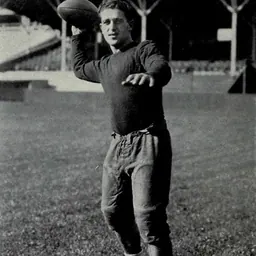



Related people
Same field, nearest in time

Contemporaries
People whose lives overlapped Willie Heston's

Frequently asked questions
Who was Willie Heston?
American football player and coach, lawyer, judge (1878-1963)
When was Willie Heston born?
Willie Heston was born on 9 September 1878 in Galesburg.
When did Willie Heston die?
Willie Heston died on 9 September 1963 in Traverse City.
What was Willie Heston's occupation?
Willie Heston was a lawyer, american football player and judge.
What nationality was Willie Heston?
Willie Heston was American.
Sources & further reading
Cite this page
APA: Biography.guide. (2026). Willie Heston. https://biography.guide/willie-heston/
MLA: "Willie Heston." Biography.guide, https://biography.guide/willie-heston/.
Chicago: "Willie Heston." Biography.guide. https://biography.guide/willie-heston/.
Data last updated: 2026-09-20 · Spot an error? Report a correction.
Page generated 2026-09-27 05:19 UTC