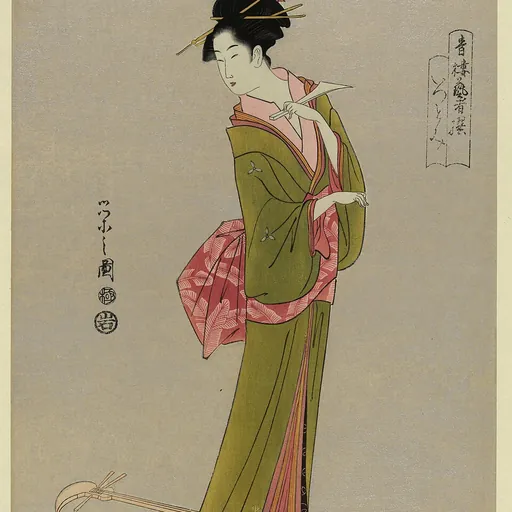
About Hosoda Eishi
Lived 1756 – 1829 (aged 73). Hosoda Eishi was a Japanese painter, ukiyo-e artist and artist.
was a Japanese ukiyo-e artist. His last name was Hosoda (細田). His first name was Tokitomi (時富). His common name was Taminosuke (民之丞) and later Yasaburo (弥三郎). Pupil of Kano Eisen'in Michinobu (狩野 栄川院 典信). Born as the first son of direct vassal of the Shogunate, a well-off samurai family that was part of the Fujiwara clan. Eishi was a vassal of the Shogunate with a generous stipend of 500 'koku' (90,000 litres) of rice. Eishi left his employ with the Shōgun Ieharu to pursue art. His early works were prints, mostly Bijin-ga portraits of tall, thin, graceful beauties in the original style established by himself akin to Kiyonaga and Utamaro. He established his own school and was a rival to Utamaro. He was a prolific painter, and from 1801 gave up print designing to devote himself to painting.
Life and career
Eishi was born Hosoda Tokitomi in 1756 to a well-provided samurai family that was part of the prestigious Fujiwara clan. His grandfather Hosoda Tokitoshi (細田 時敏) had held an influential position in the shogunate as Treasury Minister. In 1772 he came to head his family when his father Hosoda Tokiyuki died. From 1781 he held a position in the palace of the shōgun, Tokugawa Ieharu.
How Eishi took to art is unknown. He appears to have studied under Kanō Michinobu of the Kanō school of painting, from whom he likely was given the art name Eishi—though tradition holds he received the name from Shōgun Ieharu. About 1784 he left the official service of the Shōgun and began to train under Torii Bunryūsai, an ukiyo-e artist about whom almost nothing is known. Eishi's earliest known work dates to the following year. He remained unofficially in the Shōgun's service until 1789, and thereafter left his family in the hands of his adopted son Tokitoyo , thereby giving up his samurai rank; he reasoned that his ill health did not permit him to continue with such duties.
Eishi's earliest works were colour prints. The subjects are such literary fare as The Tale of Genji and are in subdued tones, as required by contemporary laws against ostentation. He went on to specialize in portraits of beautiful women, of which he produced a number of series. His most prominent rival at first was Kiyonaga; later his work competed against that of Utamaro. His manner of depicting women went through stages: the earliest were of courtesans much in the manner of Kiyonaga; then seated women performing daily activities such as reading or writing, set against bright backgrounds; later, slender women standing against minimal, subdued backgrounds. Eishi depicted gradually taller and more slender women until, in the latest prints, their heads were one-twelfth the height of the figures; more so even than Kiyonaga, whose reputation is for tall, slender beauties. Eishi made occasional illustrations for books of erotica. He was a prolific painter of such standing that in 1800 a painting of his entered the collection of the cloistered Empress Go-Sakuramachi and he was granted the honorary title Jibukyō . Eishi abandoned print designing for painting after 1801.
He died in the seventh month of 1829 and was buried at Rengeji Temple. His Buddhist posthumous name is Kōsetsuin Denkaishin Eishi Nichizui Koji . He also used the personal names Min'nojō and Yasaburō . Most of his students are little remembered; the best known are and Eishō.
Collections Modern Collections that feature Eishi's work:
Art Gallery of Greater Victoria Art Gallery of New South Wales Art Institute of Chicago Asian Art Museum (San Francisco) British Museum Cleveland Museum of Art Fine Arts Museums of San Francisco Finnish National Gallery Harvard Art Museums Hermitage Museum Indianapolis Museum of Art Israel Museum, Jerusalem Lauren Rogers Museum of Art Los Angeles County Museum of Art Metropolitan Museum of Art Minneapolis Institute of Art Museum of Fine Arts, Boston Nelson-Atkins Museum of Art the Newark Museum of Art Norton Simon Museum Philadelphia Museum of Art San Diego Museum of Art San Francisco Museum of Modern Art Suntory Museum of Art Tikotin Museum of Japanese Art University of Michigan Museum of Art Victoria and Albert Museum Weatherspoon Art Museum
Don’t just read it —
keep it.
Full-length biographies made to live with: read them, listen on the way to work, watch them tonight.
- E-book
- Audio
- Video
Instant download · yours to keep · every purchase keeps this site free
Important facts
People in Hosoda Eishi's life
Named in this biography and alive at the same time


Related people
Same field, nearest in time




Contemporaries
People whose lives overlapped Hosoda Eishi's




Frequently asked questions
Who was Hosoda Eishi?
Japanese artist (1756-1829)
When was Hosoda Eishi born?
Hosoda Eishi was born on 27 January 1756 in Kyoto.
When did Hosoda Eishi die?
Hosoda Eishi died on 1 August 1829 in Kyoto.
What was Hosoda Eishi's occupation?
Hosoda Eishi was a painter, ukiyo-e artist and artist.
What nationality was Hosoda Eishi?
Hosoda Eishi was Japanese.
Sources & further reading
Cite this page
APA: Biography.guide. (2026). Hosoda Eishi. https://biography.guide/hosoda-eishi/
MLA: "Hosoda Eishi." Biography.guide, https://biography.guide/hosoda-eishi/.
Chicago: "Hosoda Eishi." Biography.guide. https://biography.guide/hosoda-eishi/.
Data last updated: 2026-09-23 · Spot an error? Report a correction.
Portrait: Wikimedia Commons · author & licence
Page generated 2026-09-27 05:05 UTC