
About Henry Gleason
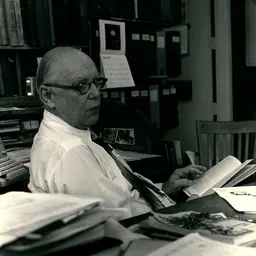
Lived 1882 – 1975 (aged 93). Henry Gleason was an American botanist and ecologist.
Henry Allan Gleason (1882–1975) was an American ecologist, botanist, and taxonomist. He was known for his endorsement of the individualistic or open community concept of ecological succession, and his opposition to Frederic Clements's concept of the climax state of an ecosystem. His ideas were largely dismissed during his working life, leading him to move into plant taxonomy, but found favour late in the twentieth century.
Life and work Gleason was born in Dalton City, Illinois, and after undergraduate and master's work at the University of Illinois earned a PhD from Columbia University in Biology in 1906. He held faculty positions at the University of Illinois, the University of Chicago and the University of Michigan, before returning to the East Coast, to the New York Botanical Garden in the Bronx, New York, where he remained for the rest of his career, until 1950.
In Gleason's early ecological research on the vegetation of Illinois, around 1909–1912, he worked largely within the theoretical structure endorsed by ecologist Frederic Clements, whose work on succession was the most influential during the first decades of the twentieth century. Building on Henry C. Cowles's landmark research at the Indiana Dunes and some of the ideas of his mentor Charles Bessey at the University of Nebraska, Clements had developed a theory of plant succession in which vegetation could be explained by reference to an ideal sequence of development called a sere. Clements sometimes compared the development of seres to the growth of individual organisms, and suggested that under the right circumstances, seres would culminate in the best adapted form of vegetation, which he called the climax state. In his early research, Gleason interpreted the vegetation of Illinois using Clementsian concepts like associations, climax states, pioneer species, and dominant species.
However, in 1918, Gleason began to express significant doubts on the usefulness of some of Clements's widely employed vocabulary, especially the use of the organism metaphor to describe the growth of vegetation, and the treatment of the units of vegetation as including climaxes. (What units should be used in the analysis of vegetation was a widely disputed issue in early twentieth-century ecology.) In 1926, Gleason expressed even stronger objections to Clements's theory. First, he argued that Clements's identification of particular kinds of vegetation assumed too much homogeneity, since areas of vegetation are actually similar to one another only to degrees. Second, he argued that Clements's associating particular vegetation types with particular areas underestimated the real diversity of vegetation. These objections together cast doubt, for Gleason, on the "integrity of the association concept" itself—on identifying any grouping of species as amounting to a nameable association, like "oak-maple association," as botanists and ecologists (including Gleason himself) normally had.
As an alternative to describing vegetation in terms of associations, Gleason offered "the Individualistic concept of ecology," in which "the phenomena of vegetation depend completely upon the phenomena of the individual" species (1917), and plant associations are less structured than he thought Clements's theory maintained. At times, Gleason suggested that the distribution of plants approaches mathematical randomness.
Clements never responded in print to Gleason's objections and alternative models, and they were largely ignored until the 1950s, when research by a number of ecologists (particularly Robert Whittaker and John T. Curtis) supported Gleasonian models. Subsequently, 'species-individualistic' models have become prevalent in community ecology.
Frustration due to dismissal of his ecological ideas without serious consideration may have contributed to Gleason's general abandonment of ecology. From the 1930s onward, he shifted the focus of his work to plant taxonomy, where he became an influential figure, working for many years at the New York Botanical Garden, and authoring with Arthur Cronquist one of the authoritative floras of northeastern North America.
Gleason married Eleanor Theodolinda Mattei, the daughter of the Swiss-American winemaker Andrew Mattei; they met on a steamship, where Gleason was on a botanical expedition, while Mattei was taking a grand tour of the world following her graduation from Mills College. Their elder son, Henry Allan Gleason Jr (1917–2007), was a linguist and Professor Emeritus at the University of Toronto. Their second son, Andrew Gleason, (1921–2008), was a mathematician and Professor Emeritus at Harvard University.
Awards and honors Named Honorary Fellow of the Association for Tropical Biology and Conservation in 1963. The 110 acre Henry Allan Gleason Nature Preserve Area in the Sand Ridge State Forest was dedicated after him in October 1970.
Don’t just read it —
keep it.
Full-length biographies made to live with: read them, listen on the way to work, watch them tonight.
- E-book
- Audio
- Video
Instant download · yours to keep · every purchase keeps this site free
Important facts
Family & relationships
People in Henry Gleason's life
Named in this biography and alive at the same time





Related people
Same field, nearest in time

Contemporaries
People whose lives overlapped Henry Gleason's





Frequently asked questions
Who was Henry Gleason?
American ecologist (1882-1975)
When was Henry Gleason born?
Henry Gleason was born on 2 January 1882 in Dalton City.
When did Henry Gleason die?
Henry Gleason died on 21 April 1975 in New York City.
What was Henry Gleason's occupation?
Henry Gleason was a botanist and ecologist.
What nationality was Henry Gleason?
Henry Gleason was American.
Sources & further reading
Cite this page
APA: Biography.guide. (2026). Henry Gleason. https://biography.guide/henry-gleason/
MLA: "Henry Gleason." Biography.guide, https://biography.guide/henry-gleason/.
Chicago: "Henry Gleason." Biography.guide. https://biography.guide/henry-gleason/.
Data last updated: 2026-09-20 · Spot an error? Report a correction.
Page generated 2026-09-27 05:24 UTC