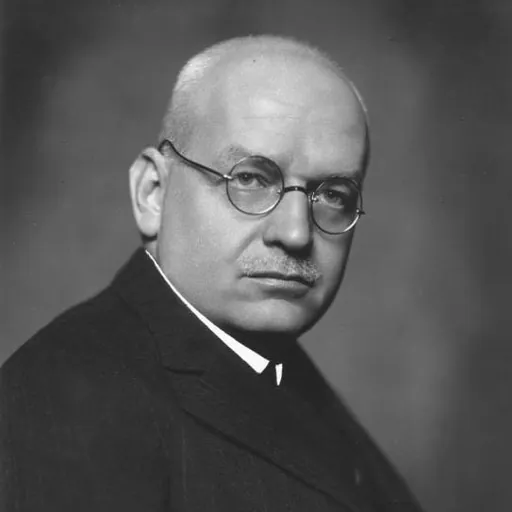
About Hans Luther
Lived 1879 – 1962 (aged 83). Hans Luther was a German politician, banker, diplomat, lawyer, jurist and financier.
Hans Luther (10 March 1879 – 11 May 1962) was a German politician and Chancellor of Germany for 482 days in 1925 to 1926. As Minister of Finance, he helped stabilise the Mark during the hyperinflation of 1923. From 1930 to 1933, Luther was head of the Reichsbank and from 1933 to 1937, he served as German Ambassador to the United States.
Early life Hans Luther was born in Berlin on 10 March 1879 into a Lutheran family as the son of Otto (1848–1912), a well-off merchant, and Wilhelmine Luther (née Hübner).
After attaining the Abitur at the Leibniz-Gymnasium/Berlin, Luther studied law at Geneva, Kiel and Berlin from 1897 to 1901. His teachers included Otto von Gierke, Franz von Liszt, Heinrich Brunner, Gustav von Schmoller and Hugo Preuss. In 1904, Luther was awarded a Dr.jur. for his dissertation Die Zuständigkeit des Bundesrats zur Entscheidung von Thronstreitigkeiten innerhalb des Deutschen Reiches (The Federal Council's jurisdiction to decide throne disputes within the German Reich). He passed the Assessor exam in 1906 and worked in the Prussian administration, in 1906/1907 at the city council of Charlottenburg, now a part of Berlin.
Weimar Republic and Reich politics During the creation of the cabinet of Wilhelm Cuno in November 1922, Luther was offered the Reichswirtschaftsministerium (Economic Affairs) and the Reichsinnenministerium (Interior), but he refused both. However, on 1 December 1922, he took over the Reichsministerium für Ernährung und Landwirtschaft (food and agriculture). His predecessor, Karl Müller, had been forced to resign after only three days in office due to allegations about connections to Rhenish separatists. Luther remained in this office in the cabinet of Gustav Stresemann, focussing on ensuring food supplies for those groups of the population hardest hit by inflation. a law of July 1925 extended workmen's compensation coverage to all accidents from and to places of work, and vocational care was introduced that same month. In addition, a decree of May 1925 established compensation for occupational diseases.
Luther voluntarily decided to resign after a Reichstag majority censured him on 12 May 1926 after he had asked Hindenburg to issue the presidential Flaggen-Verordnung (5 May 1926), which ordered German embassies and consulates to display not just the official black-red-gold Reichsflagge but also the black-white-red Handelsflagge (trade flag). His successor was Wilhelm Marx.
After the Nazis seized power in 1933, Adolf Hitler insisted that the Reichsbank contribute billions of Reichsmarks to finance his rearmament plans. Luther declined and pointed to the legally guaranteed independence of the Reichsbank. Furious, Hitler acknowledged that he could not legally dismiss Luther, but made it clear that he would not hesitate to remove Luther by extralegal means if necessary. Luther took the hint and resigned his post on 16 March 1933; he was replaced by Hitler's ally Schacht the same day. Luther was offered and accepted the post of German ambassador to Washington instead.
In 1937, he retired from active public service (im einstweiligen Ruhestand) (in temporary retirement) and in 1942 retired fully.
Post-World War II, Luther was trustee of Merck Finck & Co., a private bank in Munich, in 1948–1949. He also served as a member of the supervisory board of the Bayerischen Hypotheken und Wechselbank (Bavarian Mortgage and Exchange Bank). In 1952, the Munich Hochschule für politische Wissenschaften (University of Political Sciences) awarded him an honorary professorship. In 1952–1955, Luther was the chairman of the committee of experts on the territorial restructuring of the Federal Republic of Germany (Sachverständigen-Ausschuß für die Neugliederung des Bundesgebiets) (Expert Committee for the Reorganisation of the Federal Territory). In 1958, he became president of the reestablished Verein für das Deutschtum im Ausland (Association for German Culture Abroad).
He died in Düsseldorf on 11 May 1962.
Works Feste Mark - Solide Wirtschaft, 1924; Von Deutschlands eigener Kraft, 1928; Die Stabilisierung der deutschen Währung, in: 10. Jahrbuch deutscher Geschichte, 1928; Nur scheinbar in eigener Sache, in: Mitteilungen der List-Gesellschaft, Fasz. 2, Nr. 2, 1959; Das Wahlrecht dem Wähler, 1959; Im Dienste des Städtetages, 1959; Politiker ohne Partei, 1960; Vor dem Abgrund 1930–1933, 1964.
Don’t just read it —
keep it.
Full-length biographies made to live with: read them, listen on the way to work, watch them tonight.
- E-book
- Audio
- Video
Instant download · yours to keep · every purchase keeps this site free
Important facts
People in Hans Luther's life
Named in this biography and alive at the same time





Related people
Same field, nearest in time





Contemporaries
People whose lives overlapped Hans Luther's


Frequently asked questions
Who was Hans Luther?
German chancellor (1879-1962)
When was Hans Luther born?
Hans Luther was born on 10 March 1879 in Berlin.
When did Hans Luther die?
Hans Luther died on 11 May 1962 in Düsseldorf.
What was Hans Luther's occupation?
Hans Luther was a politician, banker, diplomat, lawyer, jurist and financier.
What nationality was Hans Luther?
Hans Luther was German.
Sources & further reading
Cite this page
APA: Biography.guide. (2026). Hans Luther. https://biography.guide/hans-luther-politician/
MLA: "Hans Luther." Biography.guide, https://biography.guide/hans-luther-politician/.
Chicago: "Hans Luther." Biography.guide. https://biography.guide/hans-luther-politician/.
Data last updated: 2026-09-22 · Spot an error? Report a correction.
Portrait: Wikimedia Commons · author & licence
Page generated 2026-09-27 05:03 UTC