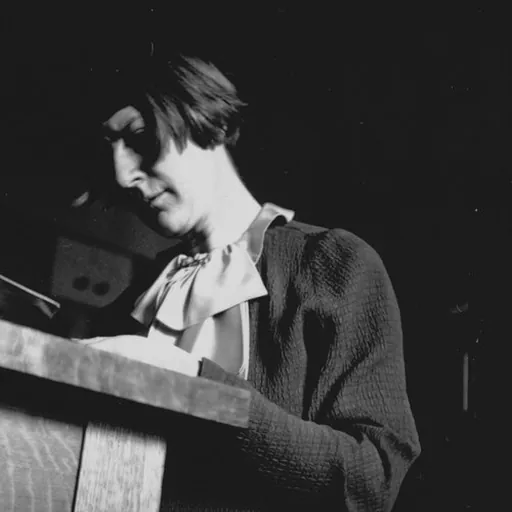
About Gladys Reichard
Lived 1893 – 1955 (aged 62). Gladys Reichard was an American anthropologist and linguist.
Gladys Amanda Reichard (born 17 July 1893 at Bangor, Pennsylvania; died 25 July 1955 at Flagstaff, Arizona) was an American anthropologist and linguist. She is considered one of the most important women to have studied Native American languages and cultures in the first half of the twentieth century. She is best known for her studies of three different Native American languages: Wiyot, Coeur d'Alene and Navajo. Reichard was concerned with understanding language variation, and with connections between linguistic principles and underpinnings of religion, culture and context.
Biography Reichard received her bachelor's degree from Swarthmore College in 1919 and her master's degree from the same institution in 1920. She started fieldwork on Wiyot in 1922 under the supervision of A.L. Kroeber of the University of California-Berkeley. Reichard's fieldwork on Wiyot was undertaken in 1922 to 1923 and resulted in the publication of Wiyot Grammar and Texts in 1925.
In 1923, she took up a position as Instructor in Anthropology at Barnard College. In the same year, she began doing fieldwork on Navajo with Pliny Earle Goddard, and she returned to this work for several summers. After Goddard's death in 1928, Reichard spent her summers living in a Navajo household, learning to weave, tend sheep and participate in the daily life of a Navajo woman. Eventually she became a speaker of Navajo, an accomplishment that is connected to her major works on the language and culture.
Her work on Coeur d'Alene was undertaken during visits to Tekoa, Washington, in 1927 and 1929. She worked with a small group of speakers, three of whom were members of the Nicodemus family – Dorthy Nicodemus, Julia Antelope Nicodemus, and Lawrence Nicodemus, who was Dorthy's grandson. Julia was Reichard's primary translator and interpreter within the group, which also included master storyteller Tom Miyal. Lawrence Nicodemus, who later came to Columbia University to work with Reichard,
She returned to work with Navajo during the middle 1930s and continued until the early 1950s. She started a Navajo school in which she worked with students to develop a practical orthography for the Navajo language. During the 1940s, she undertook a broader analysis of Navajo language, belief system, and religious practice which culminated in the two volume study, Navaho Religion, published in 1950 by the Bollingen Foundation. An extensive collection of her notes on Navajo ethnology and language is held by the Museum of Northern Arizona.
Reichard was made full professor at Barnard in 1951 and remained there until her death in 1955. This was for many years the only Department of Anthropology at an undergraduate women's college, and a number of women anthropologists were trained by her.
Conflicts with Sapir and colleagues As documented by Julia Falk, where she also reflects on the experiences Navajo speakers had with other educational institutions.
Honors and service Reichard received a Guggenheim fellowship in 1926. Over the course of her career, she served as secretary for the American Ethnological Society, the American Folk-Lore Society, the Linguistic Circle of New York, and the American Association for the Advancement of Science.
Major works Reichard published a variety of works relating to anthropology, linguistics, comparative religion and ethnography of art. 1925: Wiyot Grammar and Texts 1932: Melanesian Design (2 volumes) 1932: Spider Woman: A Story of Navajo Weavers and Chanters 1936: Navajo Shepherd and Weaver 1938: "Coeur d'Alene", in Handbook of American Indian Languages 1939: Dezba, Woman of the Desert 1939: Stemlist of the Coeur d'Alene Language 1940: Agentive and Causative Elements in Navajo (co-authored with Adolph Bitanny) 1944: The Story of the Navajo Hail Chant 1945: Composition and Symbolism of the Coeur d'Alene Verb Stem 1945: Linguistic Diversity Among the Navaho Indians. 1947: An Analysis of Coeur d'Alene Indian Myths 1949: The Character of the Navaho Verb Stem 1949: Language and Synesthesia (co-authored with Roman Jakobson and Elizabeth Werth) 1950: Navaho Religion: A Study of Symbolism (2 volumes) 1951: Navaho Grammar 1958–1960: A Comparison of Five Salish Languages (in 6 parts)
Don’t just read it —
keep it.
Full-length biographies made to live with: read them, listen on the way to work, watch them tonight.
- E-book
- Audio
- Video
Instant download · yours to keep · every purchase keeps this site free
Important facts
People in Gladys Reichard's life
Named in this biography and alive at the same time


Related people
Same field, nearest in time


Contemporaries
People whose lives overlapped Gladys Reichard's


Frequently asked questions
Who was Gladys Reichard?
American anthropologist (1893-1955)
When was Gladys Reichard born?
Gladys Reichard was born on 17 July 1893 in Bangor.
When did Gladys Reichard die?
Gladys Reichard died on 25 July 1955 in Flagstaff.
What was Gladys Reichard's occupation?
Gladys Reichard was an anthropologist and linguist.
What nationality was Gladys Reichard?
Gladys Reichard was American.
Sources & further reading
Cite this page
APA: Biography.guide. (2026). Gladys Reichard. https://biography.guide/gladys-reichard/
MLA: "Gladys Reichard." Biography.guide, https://biography.guide/gladys-reichard/.
Chicago: "Gladys Reichard." Biography.guide. https://biography.guide/gladys-reichard/.
Data last updated: 2026-09-22 · Spot an error? Report a correction.
Portrait: Wikimedia Commons · author & licence
Page generated 2026-09-27 05:03 UTC