
About André Parrot
Lived 1901 – 1980 (aged 79). André Parrot was a French anthropologist, archaeologist, lutheran pastor, university teacher, assyriologist and art historian, known for Mari, Syria.
André Charles Ulrich Parrot (15 February 1901 – 24 August 1980) was a French archaeologist, Assyriologist, curator, and Lutheran pastor who served as the first president and director of the Louvre Museum in Paris from 1968 through 1972. A specialist in the ancient Near East, Parrot led excavations in Lebanon, Iraq and Syria, and is best known for his discovery of the city of Mari where he led important excavations from 1933 through 1975.
He was the husband of the composer Marie-Louise Girod.
Biography
Early life and education Parrot was born on 15 February 1901 in Désandans in the French department of Doubs to a Protestant family who professed belief in the Evangelical Lutheran Church in France. His father was Charles Gustave Georges Parrot (21 July 1869 – 9 December 1953) and his mother was Sophie Eugénie Plankenhorn, of German descent (4 April 1880 – 8 February 1938). His younger brother, Jean-Emmanuel Parrot, died ten days old (21 May 1905 – 31 May 1905), scarring the family.
Charles Parrot was a pastor from Montbéliard who preached in Héricourt aside from Désandans, and his son would likewise follow in his footsteps and become a pastor himself upon attaining his theology doctorate from the Protestant Faculty of Theology and Sorbonne University in Paris.
His fascination with Biblical history and theology soon expanded into archæology and studying ancient cultures, especially those in the Near-East. Parrot studied at the École Biblique in Jerusalem from 1926 through 1927, during which he participated in the excavations of Al-Nayrab which were supervised by Augustin Georges-Barrois and Bertrand Carrière.
It was also then he studied art history at the École du Louvre, where he would later be employed from 1937 through 1968.
First major digs
Following successful digs and discoveries at Al-Nayrab and, later in 1928, at Byblos, Parrot was appointed to direct excavations at Baalbek. He was appointed deputy director of excavations at Lagash in 1930; the year later, he became its formal director, serving until 1933, when he resigned to oversee the archæological expedition in Larsa. There he unearthed the Ishtar vase, which dates to the second millennium BC and is displayed at the Louvre's Department of Oriental Antiquities.
Mari
Curation He was appointed chief curator of the National Museums in 1946, and became director of the Louvre from 1958 to 1962. He was a Commander of the Legion of Honour and a member of the Académie des Inscriptions et Belles-Lettres. He married his second wife Marie-Louise Girod in 1960, and died in Paris in 1980.
One of his students at the École du Louvre was Denise Cocquerillat. When he was mobilised in 1940, he was replaced as a teacher at the École du Louvre by Marguerite Rutten.
Personal life His first wife was Henriette Charlotte Antoinette Cazelles (born 11 April 1909), whom he married on 8 July 1929 in the sixteenth arrondissement of Paris; together, they had five children: Jean-Marc, Marion, Marion Françoise (deceased), Christian, and Annick. She died on 3 December 1955.
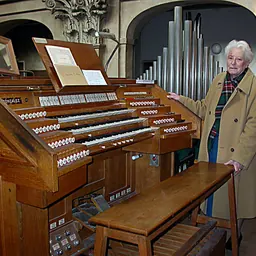
On 30 July 1960, he married the composer Marie-Louise Henriette Girod, who served as titular organist of the Oratoire du Louvre. Girod also shared his Lutheran faith and they practised their faith together.
Death Parrot died at the age of 79 on 24 August 1980 in the fifth arrondissement of Paris, survived by Girod and some of his children.
Don’t just read it —
keep it.
Full-length biographies made to live with: read them, listen on the way to work, watch them tonight.
- E-book
- Audio
- Video
Instant download · yours to keep · every purchase keeps this site free
Important facts
People in André Parrot's life
Named in this biography and alive at the same time




Related people
Same field, nearest in time


Contemporaries
People whose lives overlapped André Parrot's


Frequently asked questions
Who was André Parrot?
French archaeologist (1901-1980)
When was André Parrot born?
André Parrot was born on 15 February 1901 in Désandans.
When did André Parrot die?
André Parrot died on 24 August 1980 in 5th arrondissement of Paris.
What was André Parrot's occupation?
André Parrot was an anthropologist, archaeologist, lutheran pastor, university teacher, assyriologist and art historian.
What was André Parrot known for?
André Parrot was known for Mari, Syria.
What nationality was André Parrot?
André Parrot was French.
Sources & further reading
Cite this page
APA: Biography.guide. (2026). André Parrot. https://biography.guide/andre-parrot/
MLA: "André Parrot." Biography.guide, https://biography.guide/andre-parrot/.
Chicago: "André Parrot." Biography.guide. https://biography.guide/andre-parrot/.
Data last updated: 2026-09-20 · Spot an error? Report a correction.
Page generated 2026-09-27 05:23 UTC