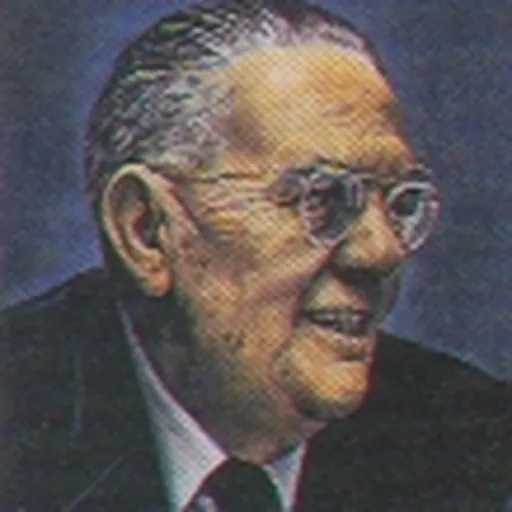
About George W. Taylor
Lived 1901 – 1972 (aged 71). George W. Taylor was an American economist, known for Taylor Law.
George W. Taylor (July 10, 1901 – December 15, 1972) was a professor of industrial relations at the Wharton School at the University of Pennsylvania, and is credited with founding the academic field of study known as industrial relations. He served in several capacities in the federal government, most notably as a mediator and arbitrator. During his career, Taylor settled more than 2,000 strikes.
In 1967, he helped draft the New York state civil service law which legalized collective bargaining in that state but which also banned strikes by public employees—legislation widely known today as the Taylor Law.
Early life Taylor was born in the Kensington industrial neighborhood of Philadelphia, Pennsylvania, on July 10, 1901. His uncle owned a textile mill, and his father, Harry Taylor, was a superintendent at a hosiery mill. He graduated from Frankford High School in 1919. Taylor intended to go into the mills after graduating from high school, but his high school principal persuaded him to attend college instead.
Academic career In 1930, Taylor received an appointment as an assistant professor at his alma mater, the Wharton School. In his first years as a professor at Wharton, Taylor founded the academic field of industrial relations, which covered labor arbitration, mediation, and other forms of alternative dispute resolution. In his lifetime, he became known as the "Father of American Arbitration."
During his lifetime, Taylor was credited with coining a number of common collective bargaining terms, including "tandem," "escalator clause," "productivity improvement," "interplant inequity," and "ability to pay." The board applied the "Little Steel formula" to nearly every American industry during World War II. The decision was severely criticized by organized labor, but Taylor considered it to be one of the most significant, well-written, and well-founded policy decisions he ever made.
President Harry S. Truman named Taylor secretary of the National Labor-Management Conference in 1946. The same year, Truman appointed Taylor chairman of the advisory board of the Office of War Mobilization and Reconversion. Taylor also served as a consultant to the Commission on Reorganization of the Executive Branch from 1948 to 1949.
During the steel strike of 1959, President Dwight Eisenhower appointed Taylor chairman of the Presidential Board of Inquiry created when Eisenhower invoked the cooling-off provisions of the Taft-Hartley Act. Despite Taylor's role in helping Eisenhower win a court injunction stopping the strike for 90s days, Taylor became involved in helping end the strike. He assisted United Steelworkers of America counsel Arthur Goldberg and Kaiser Steel heir Edgar Kaiser negotiate an agreement which later formed the basis for the national collective bargaining agreement which settled the strike.
In 1961, President John F. Kennedy appointed Taylor to the President's Advisory Committee on Labor Management Policy. During his tenure on the committee, Taylor helped craft a long-term contractual solution to a series of wildcat strikes which had plagued the aerospace industry since World War II. Taylor also resolved railroad disputes in 1964 and 1967, and in 1968 settled the long-running copper mining strike.
But Taylor's most famous (and, according to New York state labor leaders, notorious) act as a public official was his role in crafting New York's "Taylor Law." In the wake of the formation of the UFT and (more immediately) a 1966 New York City transit strike, Governor Nelson Rockefeller appointed a Committee on Public Employment Relations to study the state's public employee collective bargaining laws. Taylor led the other five members of the panel in proposing new legislation which gave New York's public employees significantly stronger collective bargaining rights. On April 25, 1967, Gov. Rockefeller signed the Public Employees Fair Employment Act into law. Popularly known as the "Taylor Law," the Act is considered a model for public sector labor legislation. The law established collective bargaining rights for state-employed workers, and set up procedures and mechanisms for county and local public workers to establish unions and bargain collectively.
Two aspects of the law, however, drew harsh criticism from organized labor. Section 210 prohibits public employees from striking, and fines the union double the amount of each striking employee's salary for each day the strike lasts. Section 201, Part 4, of the law prohibits employers from negotiating benefits provided by a public retirement fund or providing income to public sector retirees.
Personal life and honors President Lyndon B. Johnson awarded Taylor the Presidential Medal of Freedom on December 3, 1963.
On January 5, 1995, Taylor was inducted into the U.S. Department of Labor Labor Hall of Fame for his contributions to industrial relations.
During his life, Taylor became close friends with many of the most important labor and government officials of his day: Frances Perkins, Cyrus Ching, George Meany, Philip Murray, Clark Kerr, Walter Heller, Henry J. Kaiser, John L. Lewis, George Shultz, John Dunlop and W. Willard Wirtz.
Taylor retired from the Wharton School in 1971. He died at his home in Philadelphia on the evening of December 15, 1972. He was survived by his wife, the former Edith Ayling; he had no children.
Don’t just read it —
keep it.
Full-length biographies made to live with: read them, listen on the way to work, watch them tonight.
- E-book
- Audio
- Video
Instant download · yours to keep · every purchase keeps this site free
Important facts
People in George W. Taylor's life
Named in this biography and alive at the same time





Related people
Same field, nearest in time

Contemporaries
People whose lives overlapped George W. Taylor's



Frequently asked questions
Who was George W. Taylor?
American professor of industrial relations
When was George W. Taylor born?
George W. Taylor was born on 10 July 1901 in Philadelphia.
When did George W. Taylor die?
George W. Taylor died on 15 December 1972 in Pennsylvania, Philadelphia, U.S..
What was George W. Taylor's occupation?
George W. Taylor was an economist.
What was George W. Taylor known for?
George W. Taylor was known for Taylor Law.
What nationality was George W. Taylor?
George W. Taylor was American.
Sources & further reading
· DBpedia: George W. Taylor (professor)
Cite this page
APA: Biography.guide. (2026). George W. Taylor. https://biography.guide/george-w-taylor-economist/
MLA: "George W. Taylor." Biography.guide, https://biography.guide/george-w-taylor-economist/.
Chicago: "George W. Taylor." Biography.guide. https://biography.guide/george-w-taylor-economist/.
Data last updated: 2026-09-22 · Spot an error? Report a correction.
Page generated 2026-09-27 05:10 UTC