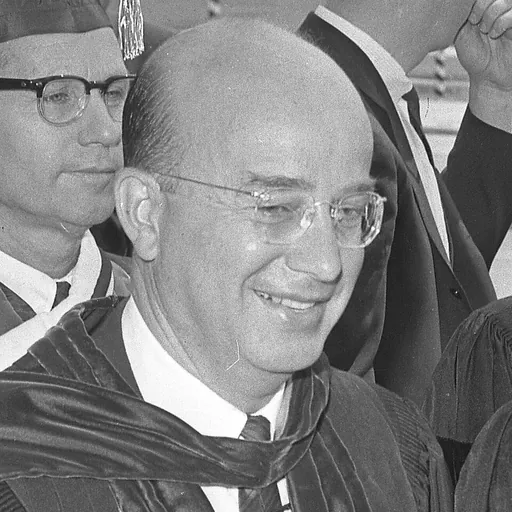
About Clark Kerr
Lived 1911 – 2003 (aged 92). Clark Kerr was an American economist.
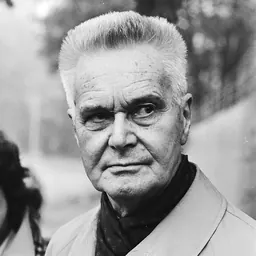
Clark Kerr (May 17, 1911 – December 1, 2003) was an American economist and academic administrator. He was the first chancellor of the University of California, Berkeley, and twelfth president of the University of California.
Early life and education Kerr was born in Stony Creek, Pennsylvania, to Samuel William and Caroline (Clark) Kerr. He was raised on rural farms outside of Reading, Pennsylvania, first in the Stony Creek area and then in the Oley Valley after age 10. Even after Kerr became one of the most prominent academic administrators of his generation, he always regarded himself as a "Pennsylvania farm boy" and expressed frustration with intellectuals who showed condescension towards agriculture.
Kerr was the co-author of the article "Putting the Unemployed at Productive Labor" with economist Paul S Taylor in the Annals of the American Academy of Political and Social Science, 1934, while working with Taylor documenting migrant conditions in 1933-34.
Kerr earned his A.B. from Swarthmore College in 1932, an M.A. in economics from Stanford University in 1933, and a Ph.D. in economics from UC Berkeley in 1939. In 1940 he was a UC Newton Booth Fellow studying at the London School of Economics. In 1945, he became an associate professor of industrial relations and was the founding director of the UC Berkeley Institute of Industrial Relations.
Career UC Berkeley In 1949, soon after the beginning of the McCarthy era, the Regents of the University of California adopted an anti-communist loyalty oath to be signed by all University of California employees. Kerr signed the oath, but fought against the firing of those who refused to sign. Kerr gained respect from his stance and was named University of California, Berkeley's first chancellor when that position was created in 1952. As chancellor, Kerr oversaw the construction of 12 high-rise dormitories. In September 1953, then U.S. president Dwight D. Eisenhower appointed him to the Commission on Intergovernmental Relations.
University of California president
In October 1957, Kerr was the Board of Regents' unanimous choice to lead the entire university system. Raymond B. Allen had been widely expected to succeed Robert Gordon Sproul as systemwide president, but Allen's tenure as UCLA's first chancellor was marred by athletics scandals, poor campus planning, and the perception among the southern regents that he had not put up enough resistance—especially in comparison to Kerr—to Sproul's stubborn refusal to delegate anything to the campus chancellors. Therefore, when Sproul finally announced his retirement in 1957, Allen was passed over in favor of Kerr. Kerr's reforms included delegating to the chancellors the full range of powers, privileges, and responsibilities which Sproul had previously denied them.
In 1959, Kerr along with Chancellor Glenn T. Seaborg helped found the Berkeley Space Sciences Laboratory.
Student protests On March 22, 1961, at the invitation of SLATE, Frank Wilkinson gave a speech at the Berkeley campus, and in response to the ensuing controversy, Kerr defended the importance of freedom of speech: "The University is not engaged in making ideas safe for students. It is engaged in making students safe for ideas." Kerr was criticized both by students, for not agreeing to their demands, and by conservative UC Regent Edwin Pauley and others, for responding too leniently to the student unrest.
Blacklisting In late 1964, President Lyndon Johnson picked Kerr to become secretary of Health, Education and Welfare. He later withdrew the nomination after the FBI background check on Kerr included damaging information the agency knew to be false. Almost 40 years later, in 2002, the FBI released documents used to blacklist Kerr as part of a government campaign to suppress subversive viewpoints at the university. This information had been classified by the FBI and was released only after a fifteen-year legal battle that the FBI repeatedly appealed up to the Supreme Court, but agreed to settle before the Supreme Court decided on hearing the matter.
Edwin Pauley approached John McCone, a Berkeley alum and associate, at the CIA for assistance. McCone in turn met with FBI director J. Edgar Hoover. Hoover agreed to supply Pauley with confidential FBI information on "ultra-liberal" regents, faculty members, and students, and to assist in removing Kerr. Pauley received dozens of briefings from the FBI to this end. The FBI assisted Pauley and Ronald Reagan in painting Kerr as a dangerous "liberal".
Dismissal During his successful campaign in the 1966 California gubernatorial election, Reagan repeatedly promised to "clean up the mess at Berkeley." In 1987, Lyn Nofziger revealed to Kerr that Reagan actually did not know much about UC at the beginning of his campaign, but had tacked right in order to prevail in the Republican primary against George Christopher, and started focusing on the "student revolt at Berkeley" after a poll determined that it was a priority of Republican voters. Kerr knew what was coming and did not actively fight it in the sense of actively lobbying individual regents. At the dedication ceremony Kerr stated that he had left the presidency of the university just as he had entered it: "fired with enthusiasm".
Later career Following his dismissal, Kerr served on the Carnegie Commission on Higher Education until 1973 and was chairman of the Carnegie Council on Policy Studies in Higher Education from 1974 to 1979.
Kerr also served as chair of the 1984 USPS National Agreement Arbitration Panel, after which he joined the USPS panel of national contract arbitrators.
Personal life Kerr was married to Catherine "Kay" Spaulding on Christmas Day, 1934. Kay, along with friends, founded the Save San Francisco Bay Association in 1961, which became Save the Bay. The couple had three children; Clark E., Jr., Alexander, and Caroline Gage.
Kerr died on December 1, 2003, in El Cerrito, California, following complications from a fall.
Legacy and honors There are Kerr Halls on the Davis, Santa Barbara, and Santa Cruz campuses. At UC Berkeley the Clark Kerr Campus is a 50-acre student residence complex.
The Clark Kerr Award is named in his honor. Since 1968, it has been awarded annually by the UC Berkeley Academic Senate to recognize an individual who has made an extraordinary and distinguished contribution to the advancement of higher education. Kerr himself was the first recipient of the award.
Don’t just read it —
keep it.
Full-length biographies made to live with: read them, listen on the way to work, watch them tonight.
- E-book
- Audio
- Video
Instant download · yours to keep · every purchase keeps this site free
Important facts
Family & relationships
People in Clark Kerr's life
Named in this biography and alive at the same time





Related people
Same field, nearest in time


Contemporaries
People whose lives overlapped Clark Kerr's






Frequently asked questions
Who was Clark Kerr?
American academic (1911-2003)
When was Clark Kerr born?
Clark Kerr was born on 17 May 1911 in Stony Creek, Stony Creek.
When did Clark Kerr die?
Clark Kerr died on 1 December 2003 in El Cerrito.
What was Clark Kerr's occupation?
Clark Kerr was an economist.
What nationality was Clark Kerr?
Clark Kerr was American.
Sources & further reading
Cite this page
APA: Biography.guide. (2026). Clark Kerr. https://biography.guide/clark-kerr/
MLA: "Clark Kerr." Biography.guide, https://biography.guide/clark-kerr/.
Chicago: "Clark Kerr." Biography.guide. https://biography.guide/clark-kerr/.
Data last updated: 2026-09-22 · Spot an error? Report a correction.
Portrait: Wikimedia Commons · author & licence
Page generated 2026-09-27 05:02 UTC