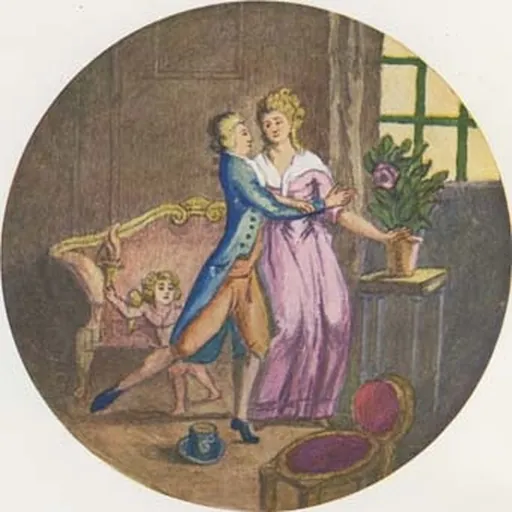
About Etta Palm
Lived 1743 – 1799 (aged 55–56). Etta Palm was a Dutch writer, salonnière, spy, women's rights activist and revolutionary feminist.
Etta Lubina Johanna Palm d'Aelders (April 1743 – 28 March 1799), also known as the Baroness of Aelders, was a Dutch spy and feminist, outspoken during the French Revolution. She gave the address Discourse on the Injustice of the Laws in Favour of Men, at the Expense of Women to the French National Convention on 30 December 1790 and was a founding member of the first female-only organisation in the history of France, Société patriotique et de bienfaisance des Amies de la Vérité. D'Aelders used these political platforms to instruct French citizens on the struggles of women in the public and private spheres, and to show men the harm that was being caused to the lives of women through their relative social inferiority. D'Aelders joined women like Olympe de Gouges and Théroigne de Méricourt in her resolute determination to improve the rights of women and mobilise tangible action to drive female equality forward.
Biography Etta Lubina Johanna d'Aelders was born into a middle-class family in Groningen in April 1743. She was the daughter of Jacob Aelders van Nieuwenhuys, a wallpaper merchant and pawnbroker, and his second wife Agatha Petronella de Sitter. Aelders's father died in 1749 when she was only six years old. Her mother took over the family's business as manager of the pawnshop, a move which was protested by her family, the de Sitters, who did not believe it to be an appropriate occupation as her late husband Jacob had been of a lower social standing than her. The business is recorded to have not been particularly successful, with speculation that widespread anti-semitism resulted in discrimination against d'Aelders's mother due to her Jewish business partner.
D'Aelders was eventually based in The Hague where she now spied on French émigrés like Beaumarchais and Dumouriez. However, later in her life, events in France forced her to change sides again and she imposed on the stadtholder himself, referring to her old services. Then in early 1795 the French revolutionary armies invaded the Netherlands. The Batavian Republic was proclaimed and Etta became suspect, because she tried to persuade the French representatives at the negotiations for the Treaty of The Hague (1795) to use the right of conquest to the detriment of the new Republic. These machinations, in collaboration with her old acquaintance Jan Munniks, brought her to the attention of the Hague Comité van Waakzaamheid (the Dutch equivalent of the French Comité de surveillance révolutionnaire). Munniks was sentenced to banishment, and d'Aelders was put under arrest in the fortress of Woerden together with her old spymaster Van de Spiegel. She was released at the end of 1798, but her health had suffered so much, that she died in the Hague the following March on the 28th 1799, and is thought to have been buried in an unmarked grave in a cemetery in Rijswijk.
Political activity Due to d'Aelders's highly-praised espionage and diplomatic work, the financial income from her missions enabled her to move to a grander house at the Rue Favart in Paris, where she set up a salon, where many politically engaged people met. At this time she was given her affectation of the title of "baroness." Among these meetings were Dutchmen like Gerard Brantsen, who negotiated the peace between the Republic and Austria in Paris in 1784, and Apollonius Jan Cornelis Lampsins, a prominent Patriot, who sought refuge in France in 1787. She also apparently started working for the Dutch Grand Pensionary Laurens Pieter van de Spiegel, to whom she became especially valuable after the events of 14 July 1789, when her salon was frequented by prominent revolutionaries like Jean-Paul Marat, François Chabot and Claude Basire.
During this time she developed a lively correspondence with many political figures including the Dutch Grand Pensionary Van de Spiegel and the French minister Lebrun. Some of her letters have been preserved and they show she was engaged in political discourse. In one letter dated 18 January 1790, de Spiegel is shown to be expounding his views to her regarding the principles of the Dutch constitution.
D'Aelders's political and diplomatic participation and influence should not be understated. She is known as having almost single-handedly averted the 1784 conspiracy against Van Brunswijk, the personal counsellor of the stadtholder. In 1787 revolting patriots arrested Princess Wilhelmina, the wife of the stadholder, and the Prussian army intervened to defeat the patriots, many of whom fled to France. The possibility of a civil war followed, which could have exposed the Netherlands to the threat of foreign powers or threaten its autonomy. D'Aelders mediated on her own initiative and succeeded in stopping France from intervening in the conflict as planned by minister Breteuil in 1787. In 1790 she was able to reassure and calm the French government regarding news about involvement of the Dutch government in a counter revolutionary plot. D'Aelders's speech, titled 'On the injustice of the law in favour of men, at the expense of women' (French: Sur l´injustice des Loix en faveur des Hommes, aux dépens de Femmes), did not question the domestic role nor the subordination of women, but demanded the possibility for women to intervene in political life. Cercle social was a key group for those involved in Paris's political sphere and shaped the intellectual and political debates that occurred in the city. D'Aelders became involved in revolutionary politics and was especially active in feminist circles, like the Société Fraternelle des Patriotes de l'un et l'autre sexe.
D'Aelders then decided to take more concrete action, formulating a plan in February 1791 to create a network of patriotic women's societies across France, much like those already functioning under the leadership of men. The societies would be organised and connected by a central, federal society in Paris. As part of this ambitious agenda, d'Aelders founded a women's equivalent to Cercle social, named Société Patriotique et de Bienfaisance des Amies de la Vérité in March 1791, which became the focal point of her feminist activities in countering prejudice against women.
As the president of Société Patriotique et de Bienfaisance des Amies de la Vérité, d'Aelders's speeches on the social and living conditions of women were read and heard widely, garnering popular support from Parisian women.
Rumours of espionage were most harmful when d'Aelders was linked with the King of Prussia; although these accusations were unfounded. The shadow that was cast over her personal political allegiance stunted her developing political career as popular opinion turned against her. Despite this, the French government retained confidence in d'Aelders's political and oratory ability, sending her on a diplomatic mission to Holland. The newly founded French Republic wished to send an ambassador to the country. However, d'Aelders was seemingly unsuccessful in this attempt as she never returned to France, and did not take up her position on the political scene again.
Call for an end to sexual discrimination, Summer 1791 D'Aelders exhorts the National Assembly to legislate completely the equality of rights for women, but her main concerns are with equality between spouses in laws affecting marriage and equal opportunity for education. She speaks about the most radical feminist thought of the high enlightenment, grounding constitutional propositions in laws and rights of nature.
Works Sur l´injustice des Loix en faveur des Hommes, au dépens de Femmes, in The French Revolution and Human Rights: A Brief Documentary History, translated, edited, and with an introduction by Lynn Hunt (Bedford/St. Martin's: Boston/New York), 1996, 122–123. Appel aux Francoises sur la régénération des moeurs, et nécessité de l'influence des femmes dans un gouvernement libre, L'imprimerie du Cercle Social, (probably) July, 1791. Facsimile in: Les femmes dans la révolution Française, T. 2, Paris, Edhis, 1982 and on Gallica
Don’t just read it —
keep it.
Full-length biographies made to live with: read them, listen on the way to work, watch them tonight.
- E-book
- Audio
- Video
Instant download · yours to keep · every purchase keeps this site free
Important facts
People in Etta Palm's life
Named in this biography and alive at the same time




Related people
Same field, nearest in time



Contemporaries
People whose lives overlapped Etta Palm's





Frequently asked questions
Who was Etta Palm?
Dutch feminist and spy
When was Etta Palm born?
Etta Palm was born in 1743 in Groningen.
When did Etta Palm die?
Etta Palm died on 28 March 1799 in The Hague.
What was Etta Palm's occupation?
Etta Palm was a writer, salonnière, spy, women's rights activist and revolutionary feminist.
What nationality was Etta Palm?
Etta Palm was Dutch.
Sources & further reading
· DBpedia: Etta Palm d'Aelders
Cite this page
APA: Biography.guide. (2026). Etta Palm. https://biography.guide/etta-palm/
MLA: "Etta Palm." Biography.guide, https://biography.guide/etta-palm/.
Chicago: "Etta Palm." Biography.guide. https://biography.guide/etta-palm/.
Data last updated: 2026-09-22 · Spot an error? Report a correction.
Portrait: Wikimedia Commons · author & licence
Page generated 2026-09-27 04:57 UTC