
About Donald Lippincott
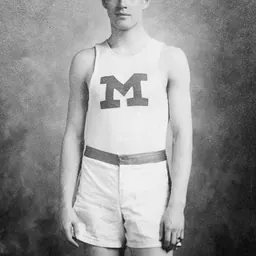
Lived 1893 – 1962 (aged 68). Donald Lippincott was an American athletics competitor and athlete.
Donald Fithian Lippincott (November 16, 1893 – January 9, 1962) was an American Olympic athlete who competed in the 1912 Summer Olympics in Stockholm, Sweden. He won a bronze medal in the 100 metres and a silver medal in the 200 metres.
Lippincott was the first record holder in 100 metres to be recognized by the International Amateur Athletics Federation. He set the world record in a heat of 100 metres at the 1912 Olympics.
Early life and education Lippincott was born November 16, 1893, in Philadelphia into a wealthy banking family. He was a member of the Delta Kappa Epsilon fraternity and the Sphinx Senior Society. He graduated from the Wharton school at Penn with a degree in Economics in 1915. In 1915, he was a member of the Penn 4×440 yard relay team that set a new world record of 3:18.0.
Lippincott also had a time recorded for 440 yard dash of 48.0 seconds although the time is considered suspect.
He was a member of the varsity track team that was the dominant force in college track and field at the time, winning 3 Intercollegiate association of Amateur Athletics of America (IC4A) championships in 4 years in the period 1910–13. The team was coached by Mike Murphy who died in 1913. It is said Lippincott ran the 220 yard dash in world record time to guarantee Murphy his last championship. In 1915, Lippincott was named captain of the track team. She tried to persuade Lippincott's father to write his son a letter stating that the family business was struggling and no money for travel would be forthcoming. In the end he did raise the sponsorship money from Penn alumni and his parents relented.
100 metres Lippincott set the world record in heat 16 of the 100 metres. Richard Rau was considered to have the then unofficial world's best time of 10.5 s but this had not been properly ratified. Lippincott would remain world record holder for eight years without peers (in 1920 Jackson Scholz gained a share of the record, and in 1921 Charlie Paddock recorded a new record of 10.4 seconds. )
In the 100 metres final itself there were seven false starts, one of which led to both Lippincott and the eventual winner Ralph Craig sprinting the whole length of the track.
Later life After graduation in 1915, Lippincott served as a lieutenant in the US Navy during World War I. After the war, he went into banking in Philadelphia and worked as a broker with Bache & Co.
He died January 9, 1962, and was interred at West Laurel Hill Cemetery in Bala Cynwyd, Pennsylvania.
Personal life He was married and had 4 children.
Don’t just read it —
keep it.
Full-length biographies made to live with: read them, listen on the way to work, watch them tonight.
- E-book
- Audio
- Video
Instant download · yours to keep · every purchase keeps this site free
Important facts
People in Donald Lippincott's life
Named in this biography and alive at the same time



Related people
Same field, nearest in time


Contemporaries
People whose lives overlapped Donald Lippincott's





Frequently asked questions
Who was Donald Lippincott?
American sprinter (1893–1962)
When was Donald Lippincott born?
Donald Lippincott was born on 16 November 1893 in Philadelphia.
When did Donald Lippincott die?
Donald Lippincott died on 9 January 1962 in Philadelphia.
What was Donald Lippincott's occupation?
Donald Lippincott was an athletics competitor and athlete.
What nationality was Donald Lippincott?
Donald Lippincott was American.
Sources & further reading
· Wikipedia: Donald Lippincott
Cite this page
APA: Biography.guide. (2026). Donald Lippincott. https://biography.guide/donald-lippincott/
MLA: "Donald Lippincott." Biography.guide, https://biography.guide/donald-lippincott/.
Chicago: "Donald Lippincott." Biography.guide. https://biography.guide/donald-lippincott/.
Data last updated: 2026-09-26 · Spot an error? Report a correction.
Page generated 2026-09-27 05:13 UTC