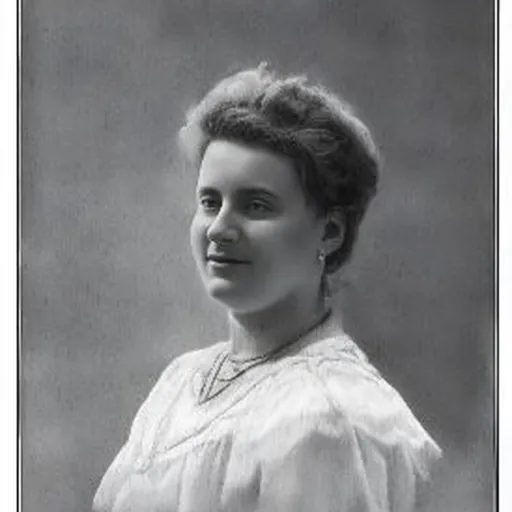
About Clara Winnicki
Lived 1880 – 1941 (aged 60). Clara Winnicki was a Swiss pharmacist, known for Switzerland.
Clara Winnicki (10 November 1880 – 6. May 1941 ) became Switzerland's first qualified female pharmacist in 1905, and went on to open and operate a succession of pharmacies. Commercial success eluded her, however. By 2018 the profession had become highly feminised: more than two thirds of Switzerland's qualified pharmacists were female; but there are indications that during the early decades of the twentieth century her gender placed Clara Winnicki at a professional disadvantage. In 1925 she married a Swiss-based German pharmacist who was not permitted to practice his profession in Switzerland. As a result of marrying a foreign man Clara Winnicki lost her citizen's rights as a Swiss citizen. In 1933 the couple were expelled across the frontier into Germany, having been identified by the authorities as "foreigners without means of support".
Life Provenance and early years Clara Emma Winnicki was born in Bern. Leopold Winnicki, her father, was an engineer who had arrived from Poland as an immigrant, and then acquired Swiss citizenship through the legal process of naturalization. Her mother, born Carolina Emma Elisabeth Sulser, was a secondary school teacher from Bern.
Student years On 18 April 1900 Clara Winnicki enrolled at the University of Bern, becoming the university's first ever female student in Pharmacy. She mastered the study material without difficulty. The problems came with trying to obtain the internship necessary to complete the course, as she later explained in a talk: "The greatest [difficulty], probably, was that none of the pharmacists that you asked wanted to take upon himself the risk of being the first to have a female pharmacist in the shop. The gentlemen were greatly concerned that the public would react with hostility to the intrusion of a female, that a female apprentice would not have the necessary strength to undertake the work and that a lady would have to be treated with too much respect and forbearance". Passing the exam gave her official authorisation to manage a pharmacy, and for eight months, between April and November 1906, Winnicki managed the "Apotheke Masson" (pharmacy) in Langenthal.
It turned out that in order to acquire and manage her own pharmacy business it would be helpful for Winnicki to pursue her student career further. She returned to the University of Bern and worked on a doctorate under the supervision of Prof. Alexander Tschirch. She received her doctorate on 28 February 1907 in return for a "contribution on the developmental history of the flowers of some officially [approved medicinal] plants". The dissertation included a dedication to her parents.
Biel/Bienne pharmacist In April 1907 Clara Winnicki purchased the "Apotheke Bonjour", a pharmacy business on the little town of Biel, a midsized town some 100 km across the hills to the north-west of Bern. The name of the business reflects the bilingual character of Biel, which is set on the language frontier between German speaking and French speaking Switzerland. For Winnicki it was not enough to stand behind the counter and make herself agreeable to the customers. She also used the room at the back of the shop as a little laboratory in which she prepared her own range of pills and potions. "Migrainite" tablets were a headache treatment: "Pilulesroses" was designed to address Anaemia. Later she also developed a sore throat treatment in a pharmacists' bottle, advertised as an "Anticatarrhol".
Activism Over time, Winnicki's pioneering achievements in breaking through into a traditionally all-male profession attracted a growing volume of media coverage: she herself emerged after approximately 1914 as a prominent advocate for women's rights in the profession, using both her pen and the platforms provided by public meetings. On 14 December 1917 she addressed a meeting at the "Casino Bern" concert hall on the theme "Die Frau im Apothekerberuf" ("The Woman in the Pharmacy Profession"). The same title was used at around this time for articles she wrote, notably for the "Schweizerische Apotheker-Zeitung". She told of difficulties she had encountered in her professional career, but also shared her assessment that in her pharmacy there was no persisting "women question", and absolute pay equality had been achieved. She spoke of her pride that professional colleague now took her seriously, and a Swiss Pharmacists' Convention had passed a resolution to encourage young women to study pharmacy. But she also warned audiences that this excellent situation must be defended. Vigilance was necessary: "We now have no 'women question' in our profession. Take care that the relationships stay that way. Any time you accept a new job, forcefully reject any terms that do not place you on an equal footing with male colleagues. Doing anything else will do great harm not just to you, but, to all your female comrades, to whom you are also responsible in these matters". She was also keen to remind her listeners that female pharmacists should always take on both the same duties and the same responsibilities as their male counterparts. That did not mean they should necessarily always make their contributions in precisely the same way. The taking in of heavy deliveries could certainly be left to the boys, while circumstances might easily arise where women would more easily listen with patience and sympathy to customers describing their painful symptoms.
Don’t just read it —
keep it.
Full-length biographies made to live with: read them, listen on the way to work, watch them tonight.
- E-book
- Audio
- Video
Instant download · yours to keep · every purchase keeps this site free
Important facts
People in Clara Winnicki's life
Named in this biography and alive at the same time
Related people
Same field, nearest in time




Contemporaries
People whose lives overlapped Clara Winnicki's




Frequently asked questions
Who was Clara Winnicki?
(1880-1935)
When was Clara Winnicki born?
Clara Winnicki was born on 10 November 1880 in Bern.
When did Clara Winnicki die?
Clara Winnicki died on 6 May 1941 in Göttingen.
What was Clara Winnicki's occupation?
Clara Winnicki was a pharmacist.
What was Clara Winnicki known for?
Clara Winnicki was known for Switzerland.
What nationality was Clara Winnicki?
Clara Winnicki was Swiss.
Sources & further reading
Cite this page
APA: Biography.guide. (2026). Clara Winnicki. https://biography.guide/clara-winnicki/
MLA: "Clara Winnicki." Biography.guide, https://biography.guide/clara-winnicki/.
Chicago: "Clara Winnicki." Biography.guide. https://biography.guide/clara-winnicki/.
Data last updated: 2026-09-23 · Spot an error? Report a correction.
Portrait: Wikimedia Commons · author & licence
Page generated 2026-09-27 05:07 UTC