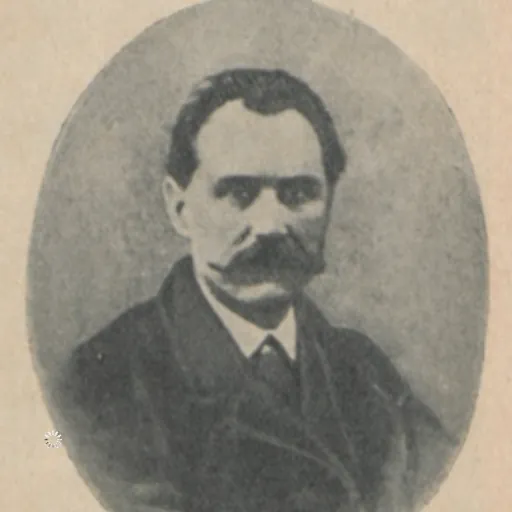
About Bolesław Roman Dłuski
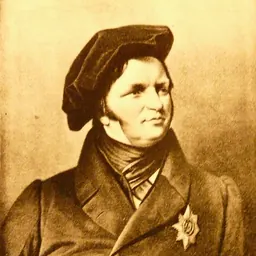
Lived 1829 – 1905 (aged 75). Bolesław Roman Dłuski was an Austrian painter and physician.
Bolesław Roman Dłuski, alias Jabłonowski ( or Balys Dluskis; 19 August 1826 – 10 May 1905) was a Lithuanian physician, painter and military officer, leader of the January Uprising in Samogitia.
Early life He spent his childhood in the family estate of Zamūšė , Ukmergė County. He studied at the Vilnius gymnasium. In 1845, at the age of 14, he and his brother Przemysław were sentenced to prison by the Russian authorities for allegedly participating in an anti-state conspiracy.
Service in the Imperial Russian Army Bolesław was sent to Caucasus, where he was included in a Russian penal military unit engaged in the Murid War against Imam Shamil. He remained in the army until 1856, reaching the rank of a captain in the Imperial Russian Army.
Studies and medical career At his request, he was transferred to the reserve and then studied at St. Petersburg Imperial Academy of Arts. After a year, he moved to Moscow University, where he started medical studies. After graduation, he ran a private medical clinic in Pasvalys in Samogitia.
January Uprising While still a student, he was involved in the Red party, he continued conspirational activity while in Pasvalys. Soon he became a member of the Lithuanian Provincial Committee. He partook in talks with the Central National Committee in Warsaw, mainly about the demarcation of the spheres of activity between Central and Lithuanian Committees and the latter's level of autonomy. When the uprising broke out, Konstanty Kalinowski appointed Dłuski as the military leader of Kaunas Governorate, he went there in February 1863 and took the alias of "Jabłonowski". In the first period, he inspected the governorate's combat readiness and started first preparations. In March, with his own small unit, he went towards Panevėžys, where near the Miegėnai village, he merged with priest Antanas Mackevičius' unit. On March 27, both units victoriously fought against a larger Russian unit. Following the fight, both divisions parted and Dłuski went towards the forests of Krakės, where he joined Major Tomasz Kuszłejko's division. The newly formed group, numbering 1,000 insurgents, fought a battle on April 1 at Lenčiai, which ended with a tactical victory, but led to the group's disintegration.
At the beginning of April , the head of the insurgent government in Lithuania, but unlike Dłuski belonging to the Whites, dismissed Dłuski from the post of the head of the Governorate of Kaunas, appointing in his place Józef Kościałkowski. After that he went once again to the Prussian border, near Tauragė, to pick up smuggled guns. On May 11 and 12 his unit of 150 insurgents fought two victorious battles against the overwhelmingly more numerous Russian unit, near village Stemplės. The Russians, however, made it impossible to intercept the weapons.
In these circumstances, Dłuski went to Telšiai, where at the end of May he established a camp. On the way there, he was joined by the unit of Seweryn Gross "Aleksandrajtis". Jasiński's unit joined the Dłuski near Akmenė. At that moment, Dłuski's group consisted of 400 well-experienced insurgents. The unit set up a camp near the village Papilė. On June 22, the camp was attacked by the Russians, who forced the insurgents to withdraw towards the marshes near . Thanks to a successful counterattack, the Russian troops were forced to flee inertly, as a result of which many soldiers drowned in the swamps. The victory was total, the insurgents lost only 7 killed and 6 wounded.
After the battle, Gross's unit headed towards Telšiai, while the rest of the insurgents, led by Dłuski, avoided the Russian pursuit, and headed towards the Prussian border. On the very border, Dłuski once again avoided breaking up his unit, attacked by the Russians in the vicinity of the village Pajūris. Then, discouraged by the prospects of the uprising itself, mainly due to the Vilnius government's conservative policy, he crossed the Prussian border with some insurgents, leaving the rest under the command of Jan Staniewicz-Pisarski.
Through Prussia, Dłuski went to Paris, where on behalf of the National Government he started organizing the supply of weapons to Lithuania, where the Reds, led by Kalinowski, retook the government. In February 1864, Romuald Traugutt, the National Government's head, appointed Dłuski as the head of the . Dłuski took up vigorous preparations for the resumption of the uprising in Lithuania and Samogitia. However, these efforts were unsuccessful due to the enemy's overwhelming numerical superiority.
From 1864 to 1905 After the fall of the uprising, Dłuski lived in Paris and worked at the Hôpital Saint-Louis, where he married Ernestine Noémie Hazard. After her death, he moved to London, where he worked as a painter, he also married a Polish woman Antonina Lewoniewska, she a had daughter Maria Józefa with her. He died in May 1905.
Don’t just read it —
keep it.
Full-length biographies made to live with: read them, listen on the way to work, watch them tonight.
- E-book
- Audio
- Video
Instant download · yours to keep · every purchase keeps this site free
Important facts
People in Bolesław Roman Dłuski's life
Named in this biography and alive at the same time


Related people
Same field, nearest in time


Contemporaries
People whose lives overlapped Bolesław Roman Dłuski's



Frequently asked questions
Who was Bolesław Roman Dłuski?
Polish physician, January Uprising participant
When was Bolesław Roman Dłuski born?
Bolesław Roman Dłuski was born on 19 August 1829 in Ukmergė County, Vilnius.
When did Bolesław Roman Dłuski die?
Bolesław Roman Dłuski died on 10 May 1905 in Kraków.
What was Bolesław Roman Dłuski's occupation?
Bolesław Roman Dłuski was a painter and physician.
What nationality was Bolesław Roman Dłuski?
Bolesław Roman Dłuski was Austrian.
Sources & further reading
· Wikipedia: Bolesław Roman Dłuski
· DBpedia: Bolesław Roman Dłuski
Cite this page
APA: Biography.guide. (2026). Bolesław Roman Dłuski. https://biography.guide/boleslaw-roman-dluski/
MLA: "Bolesław Roman Dłuski." Biography.guide, https://biography.guide/boleslaw-roman-dluski/.
Chicago: "Bolesław Roman Dłuski." Biography.guide. https://biography.guide/boleslaw-roman-dluski/.
Data last updated: 2026-09-21 · Spot an error? Report a correction.
Portrait: Wikimedia Commons · author & licence
Page generated 2026-09-27 05:00 UTC