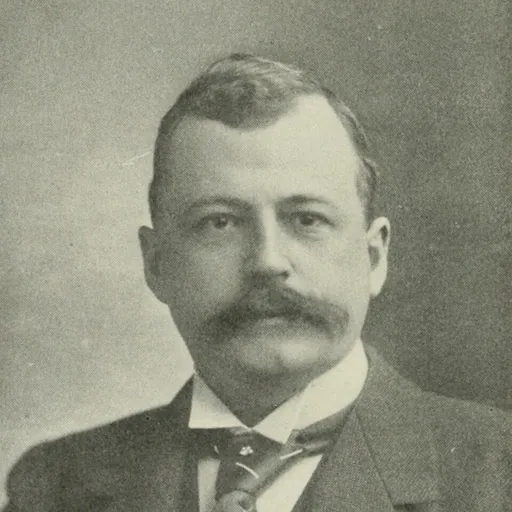
About Boies Penrose
Lived 1860 – 1921 (aged 61). Boies Penrose was an American politician and lawyer.
Boies Penrose (November 1, 1860 – December 31, 1921) was an American politician from Philadelphia, Pennsylvania, who served as a Republican member of the United States Senate for Pennsylvania from 1897 to 1921. He served as a member of the Pennsylvania House of Representatives for the Philadelphia County district in 1885. He served as a member of the Pennsylvania State Senate for the 6th district in 1897 and as President pro tempore of the Pennsylvania Senate from 1889 to 1891.
Penrose was the fourth political boss of the Pennsylvania Republican political machine (known under his bossism as the Penrose machine), following Simon Cameron, Donald Cameron, and Matthew Quay. He was the most powerful political operative in Pennsylvania for 17 years, supported Warren Harding in his nomination for U.S. president, and added the oil depletion allowance into the Revenue Act of 1913 to benefit oil producers. Penrose was the longest-serving U.S. Senator from Pennsylvania until Arlen Specter surpassed his record in 2005.
Early life and education He was born on November 1, 1860, in Philadelphia, one of seven sons, to Dr. Richard Alexander Fullerton Penrose and Sarah Hannah Boies.
Penrose was born into a prominent Old Philadelphian family of Cornish descent. The family traced their American origins to Bartholomew Penrose, a Bristol shipbuilder, who was invited by William Penn to establish a shipyard in the Province of Pennsylvania. He was a grandson of Speaker of the Pennsylvania Senate Charles B. Penrose and brother of gynecologist Charles Bingham Penrose and mining entrepreneurs Richard and Spencer Penrose. He was a descendant of the prominent Biddle family of Philadelphia. He graduated second in his class in 1881. After reading the law with the firm of Wayne MacVeagh and George Tucker Bispham, he was admitted to the Pennsylvania Bar in 1883. and was elected to the Pennsylvania State Senate for the 6th district in 1886. He served as president pro tempore from 1889 to 1891. At the age of 26, he was the youngest state senator and at age 29, the youngest President pro tempore.
Although Penrose wrote two books on political reform, he joined the political machine of Matthew Quay, a Pennsylvania Republican political boss. In 1895, Penrose ran unsuccessfully for mayor of Philadelphia. One of Penrose's most important legislative actions was adding the oil depletion allowance to the Revenue Act of 1913 which benefited oil producers including the Mellons and the Pews. Penrose consistently supported "pro-business" policies, and opposed labor reform and women's rights. A year later, Quay died, and Penrose was appointed to succeed him as the state's Republican National Committeeman. He was the most powerful political operative in Pennsylvania for the next 17 years and enabled figures like Richard Baldwin to advance through loyalty to his organization.
In the 1912 presidential election, Penrose strongly supported incumbent President William Howard Taft over former President Theodore Roosevelt. To discredit Roosevelt in the three-way race that year, Penrose worked with Roosevelt's embittered Progressive rival, Robert M. La Follette, to establish a Senate committee to investigate sources of contributions to Roosevelt's 1904 and 1912 campaigns. After a campaign that consisted of heavy attacks on Penrose, Roosevelt won Pennsylvania in the 1912 election, although Democrat Woodrow Wilson won the national vote. Penrose was also a major supporter of Warren Harding, and helped the Ohio Senator win the 1920 Republican nomination. Penrose did not stand for re-election to his national committee post. However, following Flinn's departure from the party to support Theodore Roosevelt's Progressive Party, Penrose was able to garner enough support to return to his post as national committeeman and would remain in the position until his death.
In 1914, Penrose faced his first direct election (following the passage of the Seventeenth Amendment). He publicly campaigned for the first time in his life and defeated Democrat A. Mitchell Palmer and Progressive Gifford Pinchot. According to his hunting guide, W.G. (Bill) Manson, they had to spend a lot of time to find a horse big enough to carry Penrose and his custom saddle. The horse was called "Senator." After Penrose stopped riding, the horse was retired to pasture because no standard saddle would fit him.
He never married and was known to boast of his love of prostitutes, stating that he didn't "believe in hypocrisy".
In 1903, Penrose, along with his brothers and father, invested in the formation of the Utah Copper Company.
Death
Penrose died on December 31, 1921, in his Wardman Park penthouse suite in Washington, D.C. in the last hour of 1921, after suffering a pulmonary thrombosis.
Mount Penrose in the Dickson Range in southwest-central British Columbia is named after Penrose.
A bronze statue of Penrose by Philadelphia sculptor Samuel Murray was erected in Harrisburg, Pennsylvania's Capitol Park in September 1930.
Publications Philadelphia 1681-1887: A History of Municipal Development, Baltimore: Johns Hopkins University, 1887 The City Government of Philadelphia - Volume 5, Baltimore: Johns Hopkins University, 1887 Ground Rents in Philadelphia, Philadelphia: Porter & Coates, 1888 Revenue Bill of 1918: Speech of Hon. Boies Penrose of Pennsylvania in the United States Senate, Washington, 1918
Don’t just read it —
keep it.
Full-length biographies made to live with: read them, listen on the way to work, watch them tonight.
- E-book
- Audio
- Video
Instant download · yours to keep · every purchase keeps this site free
Important facts
People in Boies Penrose's life
Named in this biography and alive at the same time



Related people
Same field, nearest in time





Contemporaries
People whose lives overlapped Boies Penrose's


Frequently asked questions
Who was Boies Penrose?
United States Senator from Pennsylvania (1860–1921)
When was Boies Penrose born?
Boies Penrose was born on 1 November 1860 in Philadelphia.
When did Boies Penrose die?
Boies Penrose died on 31 December 1921 in Washington, D.C..
What was Boies Penrose's occupation?
Boies Penrose was a politician and lawyer.
What nationality was Boies Penrose?
Boies Penrose was American.
Sources & further reading
Cite this page
APA: Biography.guide. (2026). Boies Penrose. https://biography.guide/boies-penrose/
MLA: "Boies Penrose." Biography.guide, https://biography.guide/boies-penrose/.
Chicago: "Boies Penrose." Biography.guide. https://biography.guide/boies-penrose/.
Data last updated: 2026-09-20 · Spot an error? Report a correction.
Portrait: Wikimedia Commons · author & licence
Page generated 2026-09-27 04:58 UTC