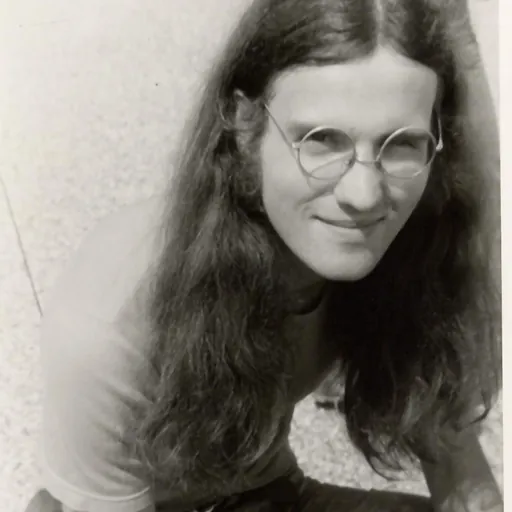
About Andreas Floer
Lived 1956 – 1991 (aged 34). Andreas Floer was a German mathematician, topologist and university teacher, known for Floer homology.
Andreas Floer (; 23 August 1956 – 15 May 1991) was a German mathematician who made seminal contributions to symplectic topology, and mathematical physics, in particular the invention of Floer homology. Floer's first pivotal contribution was a solution to a special case of Arnold's conjecture on fixed points of a symplectomorphism. Because of his work on Arnold's conjecture and his development of instanton homology, he achieved wide recognition and was invited as a plenary speaker for the International Congress of Mathematicians held in Kyoto in August 1990. He received a Sloan Fellowship in 1989.
Life He was an undergraduate student at the Ruhr-Universität Bochum and received a Diplom in mathematics in 1982. He then went to the University of California, Berkeley, living at Barrington Hall of the Berkeley Student Cooperative, and undertook Ph.D. work on monopoles on 3-manifolds, under the supervision of Clifford Taubes; but he did not complete it when interrupted by his obligatory alternative service in Germany. He received his Dr. rer. nat. at Bochum in 1984, under the supervision of Eduard Zehnder.
In 1988 he became an assistant professor at the University of California, Berkeley and was promoted to full professor of mathematics in 1990. From 1990 he was professor of mathematics at the Ruhr-Universität Bochum, until his suicide in 1991 as a result of depression.
Quotes "Andreas Floer's life was tragically interrupted, but his mathematical visions and striking contributions have provided powerful methods which are being applied to problems which seemed to be intractable only a few years ago."
Simon Donaldson wrote: "The concept of Floer homology is one of the most striking developments in differential geometry over the past 20 years. ... The ideas have led to great advances in the areas of low-dimensional topology and symplectic geometry and are intimately related to developments in Quantum Field Theory" and "the full richness of Floer's theory is only beginning to be explored".
"Since its introduction by Andreas Floer in the late nineteen eighties, Floer theory has had a tremendous influence on many branches of mathematics including geometry, topology and dynamical systems. The development of new Floer theoretic tools continues at a remarkable pace and underlies many of the recent breakthroughs in these diverse fields."
Don’t just read it —
keep it.
Full-length biographies made to live with: read them, listen on the way to work, watch them tonight.
- E-book
- Audio
- Video
Instant download · yours to keep · every purchase keeps this site free
Important facts
People in Andreas Floer's life
Named in this biography and alive at the same time


Related people
Same field, nearest in time


Contemporaries
People whose lives overlapped Andreas Floer's



Frequently asked questions
Who was Andreas Floer?
German mathematician (1956–1991)
When was Andreas Floer born?
Andreas Floer was born on 23 August 1956 in Duisburg.
When did Andreas Floer die?
Andreas Floer died on 15 May 1991 in Bochum.
What was Andreas Floer's occupation?
Andreas Floer was a mathematician, topologist and university teacher.
What was Andreas Floer known for?
Andreas Floer was known for Floer homology.
What nationality was Andreas Floer?
Andreas Floer was German.
Sources & further reading
Cite this page
APA: Biography.guide. (2026). Andreas Floer. https://biography.guide/andreas-floer/
MLA: "Andreas Floer." Biography.guide, https://biography.guide/andreas-floer/.
Chicago: "Andreas Floer." Biography.guide. https://biography.guide/andreas-floer/.
Data last updated: 2026-09-22 · Spot an error? Report a correction.
Portrait: Wikimedia Commons · author & licence
Page generated 2026-09-27 05:03 UTC