About Alicia Zubasnabar de De la Cuadra
Lived 1915 – 2008 (aged 92). Alicia Zubasnabar de De la Cuadra was an Argentine human rights defender.
Alicia "Licha" Zubasnabar de De la Cuadra (born Alicia Zubasnubar; 15 July 1915 – 1 June 2008), was an Argentine human rights activist. She was one of the twelve founding members of the Grandmothers of the Plaza de Mayo and served as the first president of the organization. She has been named as a "prominent woman" by the Argentine National Congress and as an "illustrious citizen" by Corrientes Province.
A year later, Alicia received news of the birth of her granddaughter and of the deplorable conditions under which her daughter and son-in-law were suffering:
The judges systematically refused to start any sort of investigative activities. Shortly afterwards, thanks to the negotiations of that Italian Jesuit order, Monseñor Mario Pichi intervened, meeting with Colonel Enrique Rospide to ask him if he could give the child to its grandmother. The Colonel replied:
Grandmothers of the Plaza de Mayo
The coup d'état of March 24, 1976, established a regime of state terrorism based on the forced disappearance of the opposition and the imposition of an atmosphere of terror designed to avoid complaints. At that time, the family members of the disappeared were completely defenceless and powerless, as neither any of the world's democracies, nor the Catholic Church, nor international humanitarian organisations were ready to condemn the atrocities committed by the military regime and on the contrary even cooperated with this illegal repression in some cases. Nor was it possible to call on the judiciary system for help.
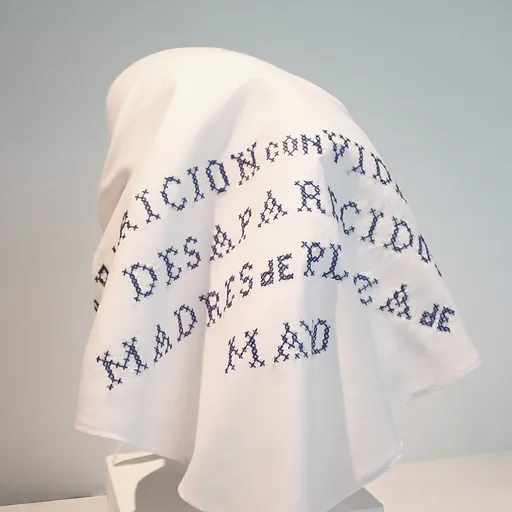
Under these conditions a group of mothers, fathers and other family members of the disappeared started a nonviolent resistance movement which made history. The idea was put forward by Azucena Villaflor, later kidnapped and murdered by the dictatorship: On April 30, 1977, they began marching every Thursday around the Pirámide de Mayo in the square of the same name, located opposite the House of Government. To call attention to themselves, the women decided to cover their heads with white cloth. Amongst these mothers and grandmothers was Alicia Zubasnabar de De la Cuadra, "Licha", who had started to participate in the marches in September 1977 along with her husband and Hebe de Bonafini.
At that time, another mother and grandmother, María Isabel Chorobik de Mariani or "Chicha", had started looking for other mothers of the disappeared who were, like her, looking for their grandchildren. Mariani had been pushed towards joining up with other grandmothers by Lidia Pegenaute, a lawyer working as an advisor to minors in the courts of La Plata, where she had tried without success to find a solution to her case. In the second half of 1977 Mariani went to see De la Cuadra at her house in La Plata:
That same day, Chicha and Licha made the decision to form a group of grandmothers and unite those whom they knew from the Thursday marches in the Plaza de Mayo.
quote|Licha (Alicia de De la Cuadra) looked for the other grandmothers that she already knew from the Plaza de Mayo, we met up and we decided to work together. There were 12 of us at that time. It astonished me to see them so calm; I was a wreck, constantly crying, I saw them all looking so calm and I said "I have to be like them". First of all we were known as the "Argentinian Grandmothers with Disappeared Grandchildren". But as we grew, people came to know us and to call us the "Grandmothers of the Plaza de Mayo". (Chicha Mariani)
During the military dictatorship and despite the risks, the Grandmothers of the Plaza de Mayo began investigations in order to find their grandchildren, without abandoning the search for their children, at the same time as starting a national and international public awareness campaign focusing on their missing grandchildren and the dictatorship's systematic kidnapping of children.
Once democracy was restored on December 10, 1983, the grandmothers promoted the use of the most recent genetic advances to establish a system for identifying their stolen grandchildren, a system unprecedented in the world, and pressured the state into indicting those responsible for the kidnapping of children, considering them to be part of a plan of repression.
In 1984, the Grandmothers became a civil non-profit association, with Alicia stepping down as president and the role passing on to María Isabel de Mariani (Chicha). At that time, her husband had just died. From then on, Alicia continued as the group's spokeswoman. By 2008, the Grandmothers of the Plaza de Mayo had recovered 88 grandchildren. It is estimated that, in total, about five hundred children born between 1975 and 1980 were kidnapped.
Don’t just read it —
keep it.
Full-length biographies made to live with: read them, listen on the way to work, watch them tonight.
- E-book
- Audio
- Video
Instant download · yours to keep · every purchase keeps this site free
Important facts
People in Alicia Zubasnabar de De la Cuadra's life
Named in this biography and alive at the same time



Related people
Same field, nearest in time



Contemporaries
People whose lives overlapped Alicia Zubasnabar de De la Cuadra's



Frequently asked questions
Who was Alicia Zubasnabar de De la Cuadra?
Argentine human right activist
When was Alicia Zubasnabar de De la Cuadra born?
Alicia Zubasnabar de De la Cuadra was born on 15 July 1915 in Sauce.
When did Alicia Zubasnabar de De la Cuadra die?
Alicia Zubasnabar de De la Cuadra died on 1 June 2008 in La Plata.
What was Alicia Zubasnabar de De la Cuadra's occupation?
Alicia Zubasnabar de De la Cuadra was a human rights defender.
What nationality was Alicia Zubasnabar de De la Cuadra?
Alicia Zubasnabar de De la Cuadra was Argentine.
Sources & further reading
· Wikipedia: Alicia Zubasnabar de De la Cuadra
· DBpedia: Alicia Zubasnabar de De la Cuadra
Cite this page
APA: Biography.guide. (2026). Alicia Zubasnabar de De la Cuadra. https://biography.guide/alicia-zubasnabar-de-de-la-cuadra/
MLA: "Alicia Zubasnabar de De la Cuadra." Biography.guide, https://biography.guide/alicia-zubasnabar-de-de-la-cuadra/.
Chicago: "Alicia Zubasnabar de De la Cuadra." Biography.guide. https://biography.guide/alicia-zubasnabar-de-de-la-cuadra/.
Data last updated: 2026-09-24 · Spot an error? Report a correction.
Portrait: Wikimedia Commons · author & licence
Page generated 2026-09-27 05:08 UTC