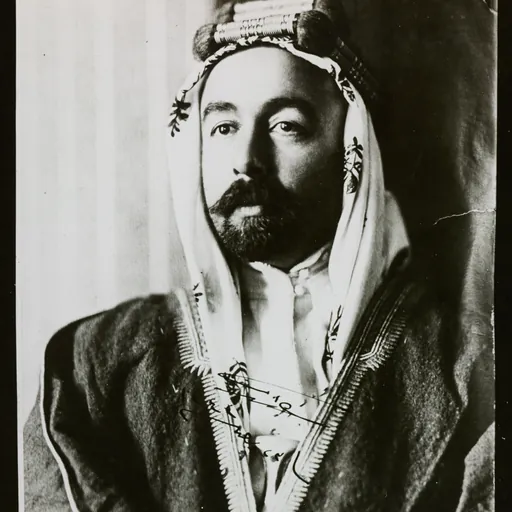
About Abdullah I of Jordan
Lived 1882 – 1951 (aged 69). Abdullah I of Jordan was a Turkish monarch, amir and king.
Abdullah I (Abdullah bin Hussein; 2 February 188220 July 1951) was the ruler of Jordan from 11 April 1921 until his assassination in 1951. He was the Emir of Transjordan, a British protectorate, until 25 May 1946,
Born in Mecca, Hejaz, Ottoman Empire, Abdullah was the second of four sons of Hussein bin Ali, Sharif of Mecca, and his first wife, Abdiyya bint Abdullah. He was educated in Istanbul and Hejaz. From 1909 to 1914, Abdullah sat in the Ottoman legislature, as deputy for Mecca, but allied with Britain during the First World War. During the war, he played a key role in secret negotiations with the United Kingdom that led to the Arab Revolt against Ottoman rule that was led by his father Sharif Hussein. Abdullah personally led guerrilla raids on garrisons.
Abdullah became Emir of Transjordan in April 1921. He upheld his alliance with the British during World War II, and became king after Transjordan gained independence from the United Kingdom in 1946. Abdullah was succeeded by his eldest son Talal.
Early political career
In 1910, Abdullah persuaded his father to stand, successfully, for Grand Sharif of Mecca, a post for which Hussein acquired British support. In the following year, he became deputy for Mecca in the parliament established by the Young Turks, acting as an intermediary between his father and the Ottoman government. In 1914, Abdullah paid a clandestine visit to Cairo to meet Lord Kitchener, the United Kingdom's Secretary of State for War, to seek British support for his father's ambitions in Arabia.
Abdullah maintained contact with the British throughout the First World War and in 1915 encouraged his father to enter into correspondence with Sir Henry McMahon, British high commissioner in Egypt, about Arab independence from Turkish rule (see McMahon–Hussein Correspondence).
The garrison consisted of 3,000 men with ten 75-mm Krupp guns. Abdullah led a force of 5,000 tribesmen, but they did not have the weapons or discipline for a full attack. Instead, he laid siege to town. In July, he received reinforcements from Egypt in the form of howitzer batteries manned by Egyptian personnel. He then joined the siege of Medina commanding a force of 4,000 men based to the east and north-east of the town.
In early 1917, Abdullah ambushed an Ottoman convoy in the desert, and captured £20,000 worth of gold coins that were intended to bribe the Bedouin into loyalty to the Sultan. In August 1917, Abdullah worked closely with the French Captain Muhammand Ould Ali Raho in sabotaging the Hejaz Railway. Abdullah's relations with the British Captain T. E. Lawrence were not good, and as a result, Lawrence spent most of his time in the Hejaz serving with Abdullah's brother, Faisal, who commanded the Arab Northern Army.
Abdullah, alone among the Arab leaders of his generation, was considered a moderate by the West. It is possible that he might have been willing to sign a separate peace agreement with Israel, but for the Arab League's militant opposition. Because of his dream for a Greater Syria within the borders of what was then Transjordan, Syria, Lebanon, and Palestine under a Hashemite dynasty with "a throne in Damascus," many Arab countries distrusted Abdullah and saw him as both "a threat to the independence of their countries and they also suspected him of being in cahoots with the enemy" and in return, Abdullah distrusted the leaders of other Arab countries.
Abdullah supported the Peel Commission in 1937, which proposed that Palestine be split up into a small Jewish state (20 percent of the British Mandate for Palestine) and the remaining land be annexed into Transjordan. The Arabs within Palestine and the surrounding Arab countries objected to the Peel Commission while the Jews accepted it reluctantly. Ultimately, the Peel Commission was not adopted. In 1947, when the UN supported partition of Palestine into one Jewish and one Arab state, Abdullah was the only Arab leader supporting the decision.
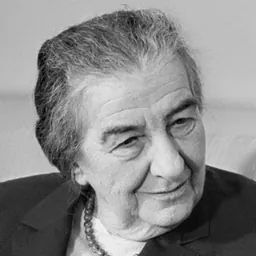
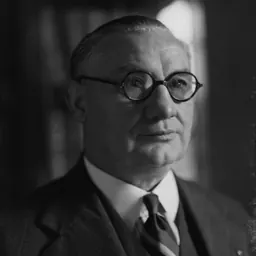
On 17 November 1947, in a secret meeting with Golda Meir, Abdullah stated that he wished to annex all of the Arab parts as a minimum, and would prefer to annex all of Palestine. This partition plan was supported by British Foreign Secretary Ernest Bevin who preferred to see Abdullah's territory increased at the expense of the Palestinians rather than risk the creation of a Palestinian state headed by the Mufti of Jerusalem Mohammad Amin al-Husayni.
Historian Graham Jevon discusses the Shlaim and Karsh interpretations of the critical meeting and accepts that there may not have been a "firm agreement" as posited by Shlaim while claiming it is clear that the parties openly discussed the possibility of a Hashemite-Zionist accommodation and further says it is "indisputable" that the Zionists confirmed that they were willing to accept Abdullah's intention.
On 4 May 1948, Abdullah, as a part of the effort to seize as much of Palestine as possible, sent in the Arab Legion to attack the Israeli settlements in the Etzion Bloc. Abdullah too found the coming war to be unfortunate, in part because he "preferred a Jewish state [as Transjordan's neighbour] to a Palestinian Arab state run by the mufti." Abdullah was especially anxious to take Jerusalem as compensation for the loss of the guardianship of Mecca, which had traditionally been held by the Hashemites until Ibn Saud seized the Hejaz in 1925.
Abdullah's role in this war became substantial. He distrusted the leaders of the other Arab nations and thought they had weak military forces; the other Arabs distrusted Abdullah in return. He saw himself as the "supreme commander of the Arab forces" and "persuaded the Arab League to appoint him" to this position. His forces under their British commander Glubb Pasha did not approach the area set aside for the Jewish state, though they clashed with the Yishuv forces around Jerusalem, intended to be an international zone. According to Abdullah el-Tell it was the King's personal intervention that led to the Arab Legion entering the Old City against Glubb's wishes.
Don’t just read it —
keep it.
Full-length biographies made to live with: read them, listen on the way to work, watch them tonight.
- E-book
- Audio
- Video
Instant download · yours to keep · every purchase keeps this site free
Important facts
Family & relationships
People in Abdullah I of Jordan's life
Named in this biography and alive at the same time




Related people
Same field, nearest in time
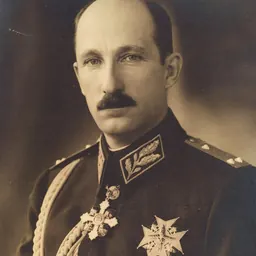
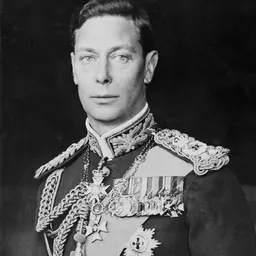
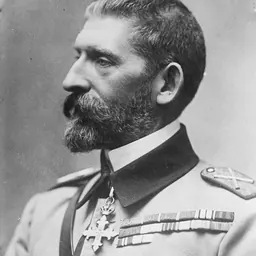
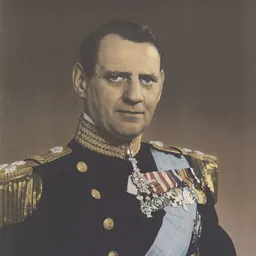
Contemporaries
People whose lives overlapped Abdullah I of Jordan's





Frequently asked questions
Who was Abdullah I of Jordan?
Ruler of Transjordan and Jordan from 1921 to 1951
When was Abdullah I of Jordan born?
Abdullah I of Jordan was born on 2 February 1882 in Mecca.
When did Abdullah I of Jordan die?
Abdullah I of Jordan died on 20 July 1951 in Masjid Al-Aqsa.
What was Abdullah I of Jordan's occupation?
Abdullah I of Jordan was a monarch, amir and king.
What nationality was Abdullah I of Jordan?
Abdullah I of Jordan was Turkish.
Sources & further reading
· Wikipedia: Abdullah I of Jordan
· DBpedia: Abdullah I of Jordan
Cite this page
APA: Biography.guide. (2026). Abdullah I of Jordan. https://biography.guide/abdullah-i-of-jordan/
MLA: "Abdullah I of Jordan." Biography.guide, https://biography.guide/abdullah-i-of-jordan/.
Chicago: "Abdullah I of Jordan." Biography.guide. https://biography.guide/abdullah-i-of-jordan/.
Data last updated: 2026-09-22 · Spot an error? Report a correction.
Portrait: Wikimedia Commons · author & licence
Page generated 2026-09-27 05:04 UTC