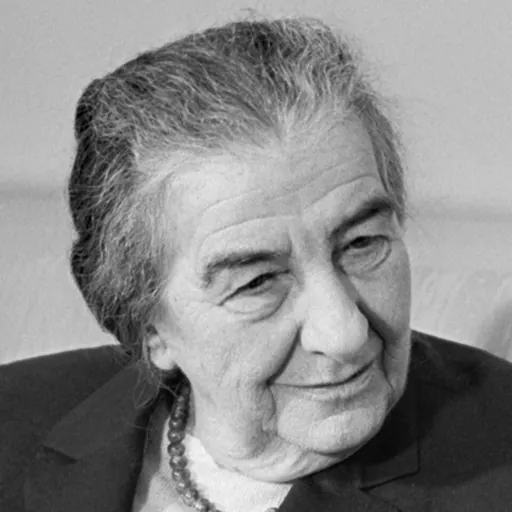
About Golda Meir
Lived 1898 – 1978 (aged 80). Golda Meir was a Russian and Israeli teacher, politician and librarian.
Golda Meirbulleted list|English: ;
Born into a Ukrainian-Jewish family in Kiev , Russian Empire, Meir immigrated with her family to the United States in 1906. She graduated from the Milwaukee State Normal School and found work as a teacher. While in Milwaukee, she embraced the Labor Zionist movement. In 1921, Meir and her husband immigrated to Mandatory Palestine, settling in Merhavia, later becoming the kibbutz's representative to the Histadrut. In 1934, she was elevated to the executive committee of the trade union. Meir held several key roles in the Jewish Agency during and after World War II. She was a signatory of the Israeli Declaration of Independence, in 1948. Meir was elected to the Knesset, in 1949, and served as Labor Minister until 1956, when she was appointed Foreign Minister by Prime Minister David Ben-Gurion. She retired from the ministry in 1966 due to ill health.
In 1969, Meir assumed the role of prime minister following the death of Levi Eshkol. Early in her tenure, she made multiple diplomatic visits to western leaders to promote her vision of peace in the region. The outbreak of the Yom Kippur War in 1973 caught Israel off guard and inflicted severe early losses on the army. The resulting public anger damaged Meir's reputation and led to an inquiry into the failings. Her Alignment coalition was denied a majority in the subsequent legislative election; she resigned the following year and was succeeded as prime minister by Yitzhak Rabin. Meir died in 1978 of lymphoma and was buried on Mount Herzl.
A controversial figure in Israel, Meir has been lionized as a founder of the state and described as the "Iron Lady" of Israeli politics, but also widely blamed for the country being caught by surprise during the war of 1973. In addition, her dismissive statements towards the Palestinians have been described as the most famous example of Israeli denial of Palestinian identity. in downtown Kiev in the Russian Empire. Her parents were Blume Neiditch (1868–1951) and Moshe Yitzhak Mabovitch (1864–1944), a carpenter. Meir wrote in her autobiography that her earliest memories were of Moshe boarding up the front door in response to rumours of an imminent pogrom. She was named after Blume's paternal grandmother, Golde. Meir had two sisters, Sheyna (1889–1972) and Tzipora "Tzipke" (later known as Clara; born 1902–1981), as well as five other siblings who died in infancy.
Moshe left Russia to find work in New York City in 1903. In his absence, the rest of the family moved to Pinsk to join Blume's family. In 1905, Moshe moved to Milwaukee, Wisconsin, in search of higher-paying work and found employment in the workshops of the local railroad yard. The following year, he had saved up enough money to bring his family to the United States. Meir, along with Blume, Sheyna, and Tzipke, landed in Quebec and traveled to Milwaukee by train. Her parents had not wanted her to attend high school.
The following year, Meir took a train to live with her married sister, Sheyna Korngold, in Denver, Colorado. She attended North High School there. The Korngolds held intellectual evenings at their home, where she was exposed to debates on Zionism, literature, women's suffrage, trade unionism, and more. In her autobiography, Meir wrote: "To the extent that my own future convictions were shaped and given form ... those talk-filled nights in Denver played a considerable role." Around 1913, she began dating Morris Meyerson,
Return to Milwaukee, Zionist activism, and teaching
In 1914, after disagreements with her sister, Golda left North High School, moved out of her sister's home, and found work. After reconciling with her parents, she returned to Milwaukee and resumed studies at North Division High, graduating in 1915. While there, she became an active member of Young Poale Zion, which later became Habonim, the Labor Zionist youth movement. She spoke at public meetings and embraced Socialist Zionism.
On 9 July 1917, Golda became a naturalized US citizen, as her father had naturalized, and at that time children of naturalized citizens under the age of 21 received citizenship by descent. She had intended to make aliyah (immigration to Israel) straight away, but her plans were disrupted when all transatlantic passenger services were canceled due to the entry of the United States into the First World War. She then threw her energies into Poale Zion activities. A short time after their wedding, she embarked on a fund-raising campaign for Poale Zion that took her across the United States.
In 1924, the couple left the kibbutz and lived briefly in Tel Aviv before settling in Jerusalem. There, they had two children: a son Menachem in 1924, and a daughter Sarah in 1926. Meir returned to Merhavia for a brief period in 1925.
In July 1938, Meir was the Jewish observer from Palestine at the Évian Conference, called by President Franklin D. Roosevelt of the United States to discuss the question of Jewish refugees' fleeing Nazi persecution. Delegates from the 32 invited countries repeatedly expressed their sorrow for the plight of the European Jews, but refused to admit the refugees. The only exception was the Dominican Republic, which pledged to accept 100,000 refugees on generous terms. Meir was disappointed at the outcome and she remarked to the press, "There is only one thing I hope to see before I die and that is that my people should not need expressions of sympathy anymore."
However, she played a critical role in fundraising. In January 1948, the Jewish Agency needed to raise funds for the continuing war and the coming Israeli state. The treasurer of the Jewish Agency was convinced that they would not be able to raise more than $7 to $8 million from the American Jewish community. Meir raised over $30 million. She toured dozens of cities in the United States and returned to Israel on 18 March. Ben-Gurion wrote that Meir's role as the "Jewish woman who got the money which made the state possible" would go down in history.
On 13 April, she was hospitalized in Tel Aviv due to a suspected heart attack. Ben-Gurion and the political department heads urged her to guard her health and come to Jerusalem as soon as she could. They asked her to be "the mother of this city", and that her "words to 100,000 residents will be a source of blessing and encouragement". She returned to Tel Aviv, and eventually to Jerusalem two weeks before the end of the mandate.
The two met Abdullah in the home of an associate of Danin. According to Meir's account, when asked if Abdullah would break the promise he made to her at Naharayim, he responded by claiming that he had made the promise when he was alone, but now he was "one of five", and that he did not have the capability to fulfill the promise alone. Abdullah asked Meir to let him integrate Jordan into Palestine, with Jews being granted representation in the Jordanian parliament, but Meir refused. She later recalled, "After I signed, I cried. When I studied American history as a schoolgirl and I read about those who signed the U.S. Declaration of Independence, I couldn't imagine these were real people doing something real. And there I was sitting down and signing a declaration of establishment."
A day after independence, the second phase of the war began. Meir also suddenly lost her job and administrative responsibilities, as the Political Department became the provisional Ministry of Foreign Affairs, and her leadership role in Jerusalem was taken over by Dov Yosef.
On 18 May, she embarked on a second and even more successful fundraising tour in which she raised around $50 million. In total, her fundraising efforts raised around $90 million, around a third of the cost of the war ($275 million). Over the ten weeks that she was gone, Israel was battered by the war and changed drastically.
On 25 June, while still in the United States, Meir was appointed by Sharett, then the Minister of Foreign Affairs, as the minister plenipotentiary to the Soviet Union, which recently recognized Israel.
Meir was displeased by the offer. In spite of being born in Russia, she spoke no Russian and feared being lonely in Moscow. She said "At last we have a state. I want to be there. I don't want to go thousands of miles away. Why do I always have to go away?"
She was reportedly impatient with diplomatic niceties and using interpreters. She did not drink or ballroom dance and had little interest in gossip and fashion. According to her interpreter, when asked by a Russian ambassador how she traveled to Moscow, she responded "tell His Excellency the Ambassador that we arrived riding on donkeys". However, Soviet–Israeli relations were complicated by Soviet policies against religious institutions and nationalist movements, made manifest in actions to shut down Jewish religious institutions as well as the ban on Hebrew language study and the prohibition of promoting emigration to Israel.
Just 20 days after her term began, antisemitic crackdowns began in response to an article by Soviet Jewish writer Ilya Ehrenburg. Meir and the other Israeli representatives responded by making a point of visiting Russian Jewish businesses, synagogues, and performances.
To her close friends, she admitted she had little to do in Moscow and felt isolated from Israeli politics.
Labor Minister (1949–1956)
Ben-Gurion initially offered Meir the position of "deputy prime minister", which she rejected. She found the title and responsibilities vague, and disliked the idea of needing to coordinate with so many government departments. and introduced major housing and road construction projects. From 1949 to 1956, 200,000 apartments and 30,000 houses were built, large industrial and agricultural developments were initiated, and new hospitals, schools, and roads were built. Despite the complaints of her colleagues in the Finance Ministry, Meir worked to establish social security, maternity benefits, work-related accident insurance, benefits to widows and orphans, and even burial costs.
In 1954, she sided with Ben-Gurion against Pinhas Lavon in the Lavon Affair. While angered by the sexism she encountered, she was happy to rejoin her colleagues in the cabinet. Meir planned and coordinated with the French government and military prior to the start of the invasion. During United Nations debates about the crisis, Meir took charge of the Israeli delegation. She also devoted much effort to convincing the United States to sell Israel weaponry. One success in this area came in 1962, when the White House quietly agreed to sell Hawk missiles to Israel.
In 1958, shortly after the death of Pope Pius XII, Meir praised the late pope for assisting the Jewish people. The pontiff's legacy as a wartime pope has continued to be controversial into the 21st century.
The same year, during the wave of Jewish migration from Poland to Israel, Meir sought to prevent disabled and sick Polish Jews from immigrating to Israel. In a letter sent to Israel's ambassador in Warsaw, Katriel Katz, she wrote: A proposal was raised in the coordination committee to inform the Polish government that we want to institute selection in aliyah, because we cannot continue accepting sick and handicapped people. Please give your opinion as to whether this can be explained to the Poles without hurting immigration."
In late 1965, 67-year-old Meir was diagnosed with lymphoma.
Premiership (1969–1974)
Prime Minister Levi Eshkol died suddenly on 26 February 1969, leading to the appointment of Yigal Allon as interim prime minister and an election to replace him. Before the vote, most suspected that Meir would be elected. On 7 March 1969, the party's central committee voted Meir as the new party leader. Now age 71, Meir had mixed feelings due to her health concerns, but eventually agreed, saying that she would honor the party's decision just as she had honored all of the party's past decisions.
Meir served as prime minister from 17 March 1969 to 3 June 1974. She maintained the national unity government formed in 1967 after the Six-Day War, in which Mapai merged with two other parties (Rafi and Ahdut HaAvoda) to form the Israeli Labor Party.
In 1969 and the early 1970s, Meir met with many world leaders to promote her peace settlement idea, including Richard Nixon (1969), Nicolae Ceaușescu (1972) and Pope Paul VI (1973). In 1973, she hosted the chancellor of West Germany, Willy Brandt, in Israel.
On February 28, 1973, during a visit in Washington, D.C., Meir agreed with Henry Kissinger's peace proposal based on "security versus sovereignty": Israel would accept Egyptian sovereignty over all Sinai, while Egypt would accept Israeli presence in some of Sinai's strategic positions. This phrase is considered to be the most famous example of Israeli denial of Palestinian identity.
The interview entitled Who can blame Israel was published in The Sunday Times on June 15, 1969, and included the following exchange: Frank Giles: Do you think the emergence of the Palestinian fighting forces, the Fedayeen, is an important new factor in the Middle East? Golda Meir: Important, no. A new factor, yes. There was no such thing as Palestinians. When was there an independent Palestinian people with a Palestinian state? It was either southern Syria before the First World War and then it was a Palestine including Jordan. It was not as though there was a Palestinian people in Palestine considering itself as a Palestinian people and we came and threw them out and took their country from them. They did not exist.
Munich Olympics (1972)
Meir (center) with Pat and President Richard Nixon in Washington, DC, in 1973. In the wake of the Munich massacre at the 1972 Summer Olympics, Meir appealed to the world to "save our citizens and condemn the unspeakable criminal acts committed". Outraged at the perceived lack of global action, she ordered the Mossad to hunt down and assassinate suspected leaders and operatives of Black September and the PFLP.
Dispute with Austria (1973) During the 1970s, about 200,000 Soviet Jewish emigrants were allowed to leave the Soviet Union for Israel by way of Austria. When seven of these emigrants were taken hostage at the Austria–Czechoslovakia border by Palestinian militants in September 1973, the Chancellor of Austria, Bruno Kreisky, closed the Jewish Agency's transit facility in Schönau, Austria. A few days later in Vienna, Meir tried to convince Kreisky to reopen the facility by appealing to his own Jewish origin, and described his position as "succumbing to terrorist blackmail". Kreisky did not change his position, so Meir returned to Israel, infuriated. A few months later, Austria opened a new transition camp.
Yom Kippur War (1973)
US President Richard Nixon and Israeli Prime Minister Golda Meir meeting on March 1, 1973, in the Oval Office. Nixon's National Security Advisor Henry Kissinger is to the right of Nixon. A common criticism of Meir is that she could have avoided the Yom Kippur War in 1973. For months preceding the attack, Egyptian President Anwar Sadat made repeated overtures for peace in exchange for a full Israeli withdrawal from the Sinai, but these gestures were rebuffed by Meir, who had offered previously to discuss ceding "most of the Sinai", but was not willing to restore the pre-1967 borders, and Egypt had no interest in peace talks under Meir's conditions. As the nation's leader during this short war, her main goal was deciding on the timing of preliminary operations, and providing the IDF with the necessary time and munitions to pull off a victory.
In the days leading up to the Yom Kippur War, Israeli intelligence could not conclusively determine that an attack was imminent. However, on 5 October 1973, Meir received information that Syrian forces were massing on the Golan Heights. She was alarmed by the reports, and believed that the situation was similar to what preceded the Six-Day War. However, her advisers counseled her not to worry, saying they would have adequate notice before any war broke out. This made sense at the time; after the Six Day War, most in the Israeli intelligence community considered the Arabs unprepared to launch another attack. Consequently, although the Knesset passed a resolution granting her power to demand a full-scale call-up of the military (instead of the typical cabinet decision), Meir did not mobilize Israel's forces early. Soon, though, the threat of war became very clear. Six hours before the outbreak of hostilities, Meir met with Minister of Defense Moshe Dayan and General David Elazar. While Dayan continued to argue that war was unlikely and favored calling up the air force and only two divisions, Elazar advocated full-scale army mobilization and the launch of a full-scale preemptive strike on Syrian forces.
On October 6, Meir approved full-scale mobilizing but rejected a preemptive strike, citing concerns that Israel might be perceived as initiating hostilities, which would hurt Israel's access to crucial foreign aid and military support, in particular from the United States, in the resulting conflict. She made it a priority to inform Washington of her decision. U.S. Secretary of State Henry Kissinger later confirmed Meir's assessment by stating that if Israel had launched a preemptive strike, Israel would not have received the backing of the United States.
Resignation (1974)
Following the Yom Kippur War, Meir's government was plagued by infighting and questions over Israel's lack of preparation for the war. The Agranat Commission appointed to investigate the war cleared Meir of "direct responsibility". It said about her actions on Yom Kippur morning:
Her party won the elections in December 1973, but the coalition lost seats and was unable to form a majority. Meir resigned as prime minister on 11 April 1974, and gave up her Knesset seat on 7 June 1974. She never held office again. She believed that was the "will of the people" and that she had served enough time as premier. She believed the government needed to form a coalition. She said, "Five years are sufficient ... It is beyond my strength to continue carrying this burden." Yitzhak Rabin succeeded her on June 3, 1974.
After premiership and death (1974–1978) In 1975, Meir published her autobiography, My Life, which became a New York Times Best Seller.
On 21 November 1977, Meir spoke at the Knesset on behalf of the Labor Party to Egyptian President Anwar Sadat during his historic trip as the first Arab leader to visit Israeli-controlled territory. She said his visit was important for the sake of the next generations' avoiding war, praised Sadat for his courage and vision, and expressed the hope that while many differences remained to be resolved, that vision would be achieved in a spirit of mutual understanding. In May 1978 Meir was interviewed live by video link by Barbra Streisand at the finale of the American television special The Stars Salute Israel at 30, broadcast to celebrate the 30th anniversary of the state of Israel.
On 8 December 1978, Meir died of lymphatic cancer (lymphoma) in Jerusalem at the age of 80. She was buried on Mount Herzl in Jerusalem.
Personal life
Meir's husband Morris Meyerson (also "Myerson") was born on 17 December 1893 in Chicago, Illinois. They married on December 24, 1917, and remained married until his death in Jerusalem on 25 May 1951. She never remarried. Despite never divorcing, the couple grew apart over the course of the marriage. Her daughter Sarah was born on 17 May 1926 and died on 30 January 2010 in Revivim.
She had two sisters, Sheyna (1889–1972) and Tzipke (1902–1981), as well as five other siblings who died in childhood.
Morris, Sheyna Korngold and her husband Shamai were buried on Nahalat Yitzhak Cemetery in Givatayim.
In 1956, after becoming Foreign Minister, she changed her surname from "Meyerson" to "Meir", meaning "illuminate", as her predecessor Moshe Sharett had all members of the foreign service take a Hebrew surname.
She was a heavy smoker and coffee drinker, and did not exercise often, which may have contributed to her recurring heart problems.
She strongly identified with Judaism culturally, but was an atheist in religious belief. She is famously reported to have stated: "I believe in the Jewish people, and the Jewish people believe in God." In her later years she widened her religious attitude, especially concerning the State of Israel: "This country exists as the fulfillment of a promise made by God himself. It would be ridiculous to ask it to account for its legitimacy."
Awards and recognition In 1974 Meir was awarded the James Madison Award for Distinguished Public Service by Princeton University's American Whig–Cliosophic Society.
Also in 1974, Meir was awarded the honor of World Mother by American Mothers.
In 1975, Meir was awarded the Israel Prize for her special contribution to society and the State of Israel.
In 1985, Meir was inducted into the Colorado Women's Hall of Fame.
In 2019, Time created 89 new covers to celebrate women of the year starting from 1920; it chose her for 1956.
Legacy
Biographer Meron Medzini argues that a perspective of forty years makes possible an appreciation of her deep nationalism and Zionism. Historians find her main legacy includes effective leadership of the Labor Movement, and building good relationships with Third World nations. Medzini states, "Apart from laying the foundations for Israel’s presence in Africa, she was never taken with the routine and often dull diplomatic work in the Foreign Ministry and abhorred its outer manifestations of ceremonies and rites." Most historians agree she was a success as Secretary of Labor and Housing, but a failure as prime minister.
A controversial figure in Israel, she has been lionized as a founder of the state and described as the "Iron Lady" of Israeli politics, but also widely blamed for the country being caught by surprise during the 1973 Yom Kippur War. She was also criticized for her dismissive statements towards the Palestinians.
In 2003, American Jewish actress Tovah Feldshuh portrayed her on Broadway in Golda's Balcony, Gibson's second play about Meir's life. The play was controversial for implying that Meir considered using nuclear weapons during the Yom Kippur War. Valerie Harper portrayed Meir in the touring company production and in the film version of Golda's Balcony. In 2005, actress Lynn Cohen portrayed Meir in Steven Spielberg's film Munich.
Tovah Feldshuh assumed the role of Meir again in the 2006 English-language French movie O Jerusalem. She was played by the Polish actress Beata Fudalej in the 2009 dramatic film The Hope directed by Márta Mészáros.
English actor Helen Mirren portrayed Meir in the 2023 biopic film Golda, directed by Guy Nattiv and produced by Michael Kuhn. The film centres on the Yom Kippur War.
As of April 2021, a TV miniseries Lioness starring Shira Haas is also currently being produced and will be directed by Barbra Streisand. As of August 2026, IMBd listed it as in development.
Commemoration
Golda Meir House Museum and Education Center, Auraria Campus, 1149 9t Street, Denver CO 80204 Golda Meir School, Milwaukee, Wisconsin Golda Meir School, in Barra da Tijuca, Rio de Janeiro, Brazil Golda Meir Library, University of Wisconsin–Milwaukee, Wisconsin Golda Meir Boulevard, Jerusalem, Israel (and various other streets, neighborhoods and schools in Israel) Golda Meir Center for the Performing Arts – home to the Israeli Opera and the Cameri Theater, Tel Aviv Bust of Golda Meir at Golda Meir Square, New York City Golda Meir Center for Political Leadership at Metropolitan State University of Denver Golda Meir House, Newton, Massachusetts Golda Meir Street in the city of Kyiv
Cultural references In Israel, the term "Golda's shoes" (na'alei Golda) has become a reference to the sturdy orthopedic shoes that Golda favored. These shoes were also supplied to women soldiers in the Israel Defense Forces from its foundation to 1987.
Published works This Is Our Strength (1962) – Golda Meir's collected papers My Father's House (1972) My Life (1975). Putnam.
Don’t just read it —
keep it.
Full-length biographies made to live with: read them, listen on the way to work, watch them tonight.
- E-book
- Audio
- Video
Instant download · yours to keep · every purchase keeps this site free
Important facts
People in Golda Meir's life
Named in this biography and alive at the same time



Related people
Same field, nearest in time


Contemporaries
People whose lives overlapped Golda Meir's




Frequently asked questions
Who was Golda Meir?
Prime Minister of Israel from 1969 to 1974
When was Golda Meir born?
Golda Meir was born on 21 April 1898 in Kyiv, Russian Empire.
When did Golda Meir die?
Golda Meir died on 8 December 1978 in West Jerusalem.
What was Golda Meir's occupation?
Golda Meir was a teacher, politician and librarian.
What nationality was Golda Meir?
Golda Meir was Russian and Israeli.
Sources & further reading
Cite this page
APA: Biography.guide. (2026). Golda Meir. https://biography.guide/golda-meir/
MLA: "Golda Meir." Biography.guide, https://biography.guide/golda-meir/.
Chicago: "Golda Meir." Biography.guide. https://biography.guide/golda-meir/.
Data last updated: 2026-09-20 · Spot an error? Report a correction.
Page generated 2026-09-27 05:10 UTC