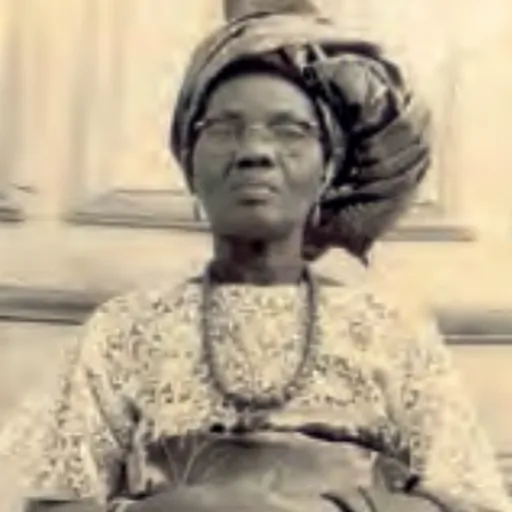
Funmilayo Ransome-Kuti
Nigerian educator, political campaigner, suffragist, and women's rights activist
About Funmilayo Ransome-Kuti
Lived 1900 – 1978 (aged 77). Funmilayo Ransome-Kuti was a Nigerian teacher, politician, activist and suffragette.
Chief Funmilayo Ransome-Kuti (born Frances Abigail Olufunmilayo Olufela Folorunso Thomas; 25 October 190013 April 1978), also known as Funmilayo Aníkúlápó-Kuti, was a Nigerian educator, political organizer, and women's rights advocate who intellectually engaged with anti-imperialist, Pan-Africanist, and feminist ideologies. Ransome-Kuti also identified herself as an African Socialist.
Funmilayo Ransome-Kuti was born in Abeokuta, in Ogun State, and was the first female student to attend the Abeokuta Grammar School. As a young adult, she worked as a teacher, organizing some of the earliest preschool classes in the country and arranging literacy classes for lower-income women, laying important foundations for feminist education scholarship in Africa.
During the 1940s, Ransome-Kuti established the Abeokuta Women's Union and advocated for women’s rights, demanding better representation of women in local governing bodies and an end to unfair taxes on market women. Ransome-Kuti led marches and protests of up to 10,000 women, forcing the ruling Alake of Egbaland to temporarily abdicate in 1949. As Ransome-Kuti’s political influence grew, she took part in the Nigerian independence movement, attending conferences and joining overseas delegations to discuss proposed national constitutions. Spearheading the creation of both the Nigerian Women’s Union and the Federation of Nigerian Women’s Societies, she advocated for Nigerian women’s right to vote and became a noted member of international peace and women's rights movements.
Ransome-Kuti became vice president of the Women's International Democratic Federation (WIDF) in 1953, and would later lead the Nigerian branch of the Women's International League for Peace and Freedom (WILPF) in 1963. While in these roles, Ransome-Kuti helped build connections between Nigeria's independence movement and feminist, anti-colonial networks around the world. Her international work also drew political attention; British colonial authorities refused to renew her passport in 1957 and the United States denied her a visa in 1958, both citing suspected communist ties during the Cold War era.
Ransome-Kuti received the Lenin Peace Prize and was awarded membership in the Order of the Niger for her work. In her later years, she supported her sons' criticism of Nigeria's military governments. She died at the age of 77 after being wounded in a military raid on family property. Ransome-Kuti's children included the musician and activist Fela Kuti (born Olufela Ransome-Kuti), doctor and activist Beko Ransome-Kuti, and health minister Olikoye Ransome-Kuti.
Early life and education Frances Abigail Olufunmilayo Olufela Folorunso Thomas was born on 25 October, 1900, in Abeokuta, Ogun State, Nigeria, which at the time was a part of the Southern Nigeria Protectorate, a Protectorate of the British Empire. She was born to Chief Daniel Olumeyuwa Thomas (1869–1954), a member of the aristocratic Jibolu-Taiwo family, and Lucretia Phyllis Omoyeni Adeosolu (1874–1956).
Frances' paternal lineage was rooted in the Saro community, which consisted of returnees from Sierra Leone, many of whom were formerly enslaved Africans who had been freed and resettled in Freetown prior to returning to Yorubaland in the 19th century.
Her father was born to Ebenezer Sobowale Thomas, who was himself born in Freetown, Sierra Leone, and Abigail Fakemi, who was born in the Yoruba town of Ilesa. Frances' oldest known paternal ancestor was her great-grandmother, Sarah Taiwo (mother of Ebenezer Sobowale Thomas), a Yoruba woman who had been captured by slave traders in the early 19th century before eventually returning home to her family in Abeokuta. Sarah's first husband was Sobowale Thomas. Sarah's descendants through Thomas and her other two husbands – the Jibolu-Taiwos – became some of the first Christians in the area, and had a large influence on the growth of Christianity in Abeokuta.
Frances' mother was born to Isaac Adeosolu, who was from Abeokuta, and Harriet, the daughter of Adeboye, who was from the ancient Yoruba town of Ile-Ife. Her parents married in 1897, and they had two children who died in infancy before Frances was born. The school had initially been open only to male students, but it admitted its first female students in 1914, and Frances was first among the six girls registered for study that year. where she learned elocution, music, dressmaking, French, and various domestic skills. Before she completed her studies and returned to Abeokuta in 1922, she stopped using her Christian names, Frances and Abigail, and chose to go by her Yoruba name of Funmilayo, which means "God has given me joy".
Personal life On 20 January 1925, Funmilayo married Reverend Israel Oludotun Ransome-Kuti, a member of the Ransome-Kuti family. His marriage with Funmilayo would last 30 years – until Israel's death – and was marked by a sense of equality and deep mutual respect between the couple.
In 1946, the club was formally renamed the Abeokuta Women's Union (AWU), now open to all women in Abeokuta. The organization now turned its focus to fighting unfair price controls and taxes imposed on market women, with Ransome-Kuti as the AWU's president. (her husband's niece and the mother of Nobel Laureate Wole Soyinka), In an effort to unify women and avoid class conflict, Ransome-Kuti and other formally educated members spoke Yoruba and wore traditional Yoruba clothing to union meetings and events. There was also coercion involved in the process of collecting taxes, as the agents would sometimes strip women of their clothes under the guise of trying to verify their age, and those who were unable to pay were often jailed. The constitution also maintained a mostly European majority on the Executive Council by a nomination system, instead of representative elections. Ransome-Kuti was the sole woman in the delegation; they departed for London on June 26, 1947.
While she was in London, Ransome-Kuti spoke to groups such as the London Women's Parliamentary Committee and the National Federation of Women's Institutes. She argued that colonial rule forced women out of power, both politically and economically. This perspective places her in the intellectual tradition that scholars such as Cheryl Johnson Odim credit as shaping African feminist and Third World feminist theory.
When a Western Provinces conference was held in Nigeria in 1949 to discuss a new national constitution, Ransome-Kuti represented Abeokuta and was once again the only woman involved in the discussions. She made strong arguments for the inclusion of women's enfranchisement and against the creation of an indirect electoral system.
Within the NCNC, Ransome-Kuti served as treasurer while also leading the party's women's group across the Western region; she was the sole female member serving in a leadership role. She was also the only woman nominated by delegates to speak on behalf of the Abeokuta contingent during key talks at the General Constitutional Conference to help shape Nigeria's constitution from 1948 - 1951. being granted the chieftaincy title of Oloye of the Yoruba people and the subsidiary title of Beere. She was the first woman appointed to the Western House and one of the few women to have a position in any Nigerian House of Chiefs at the time. She also served as a board member for the Nigerian Union of Teachers, which her husband had co-founded. alt=Image of Ransome-Kuti shaking hands with Abubakar Tafawa Balewa, the first Prime Minister of Nigeria In 1959, when Ransome-Kuti was denied a second chance to run as an NCNC candidate, she ran as an independent candidate instead, but her campaign split the vote and helped an opponent of the NCNC win the seat. Afterwards, the party revoked Ransome-Kuti's membership.
In 1969, Ransome-Kuti was appointed chairman of the Advisory Board of Education by the western Nigeria state government, and she served as a consultant to the Federal Ministry of Education on recruitment of teachers from other countries. In November 1974, Nigerian police raided his nightclub in town with axes and tear gas, leaving Fela with injuries. In 1976, Fela released an album called Zombie, in which he compared the army to mindless machines, and many believe that this album acted as a final straw in the conflict between Fela and the government. The invasion, her death, and the movement of the coffin is detailed in his song "Coffin for Head of State".
Ideological framework and political thought Ransome-Kuti described herself as an African socialist, which she defined through her belief that all people, regardless of gender or class, were entitled to freedom, education, healthcare, and housing, and that these rights cannot be secured under colonial rule. She noted that she was "not frightened, or repelled by communism", though she also emphasized that her ideological framework was distinct from Soviet-aligned ideology. Ransome-Kuti's framework was rooted in grassroots organizing, cross-class solidarity, and traditional African values of communalism. This argument challenges Western feminist theory and links Ransome-Kuti to a broader tradition of women from sub-Saharan Africa whose politics link women's liberation to national liberation.
Scholars of African feminist thought frequently regard Ransome-Kuti as being a practitioner of theoretical frameworks that were not formalized until after her career. For example, Chikwenye Okonjo Ogunyemi's article "Womanism: The Dynamics of the Contemporary Black Female Novel in English" first theorized African womanism in 1985, however Ransome-Kuti's legacy reflects the same tenets that prioritize collective empowerment over individual liberation. In a similar vein, Catherine Obianju' Acholonu's 1995 text Motherism: The Afrocentric Alternative to Feminism formalized a framework that centered African women's political power within their roles as community nurturers; Ransome-Kuti embodied this through her advocacy and argument that market women, and others doing essential community labor, should have political representation. Her argument was predicated both on the grounds of feminism and on motherism.
Legacy Biographer Cheryl Johnson-Odim notes that Funmilayo Ransome-Kuti's name remains well known throughout Nigeria and that "no other Nigerian woman of her time ranked as such a national figure or had [such] international exposure and connections". As noted above, Ghanaian politician Kwame Nkrumah (later the first Prime Minister of Ghana) was heavily inspired by Ransome-Kuti in his early organizing of the Ghana Women's Association.
Ransome-Kuti was portrayed in the 2014 film October 1 by actress Deola Sagoe. On 25 October 2019, Ransome-Kuti was posthumously honored with a Google Doodle created by Nigerian-Italian illustrator Diana Ejaita. It features movie stars like Joke Silva, Kehinde Bankole, Ibrahim Suleiman, Jide Kosoko, and Dele Odule.
In 2025, filmmaker Kahlil Joseph premiered BLKNWS: Terms & Conditions, an experimental film which premiered at the Sundance Film Festival. The film had a theatrical release in November 2025 and features a central character named Funmi, who is a sociologist and historian, and explicitly named after Funmilayo Anikulapo-Kuti. Her inclusion in this film is the result of Joseph's discovery that Ransome-Kuti's name was not included in his family's copy of W.E.B. Du Bois' Africana Encyclopedia. Her absence from that text is engaged in the film as part of a larger question of what and who has been erased from the archive of Black history, and Joseph's belief that absence is not an accident, but rather an intentional political condition.
Don’t just read it —
keep it.
Full-length biographies made to live with: read them, listen on the way to work, watch them tonight.
- E-book
- Audio
- Video
Instant download · yours to keep · every purchase keeps this site free
Important facts
more
Lioness of LisabFamily & relationships
People in Funmilayo Ransome-Kuti's life
Named in this biography and alive at the same time




Related people
Same field, nearest in time


Contemporaries
People whose lives overlapped Funmilayo Ransome-Kuti's




Frequently asked questions
Who was Funmilayo Ransome-Kuti?
Nigerian educator, political campaigner, suffragist, and women's rights activist
When was Funmilayo Ransome-Kuti born?
Funmilayo Ransome-Kuti was born on 25 October 1900 in Abeokuta.
When did Funmilayo Ransome-Kuti die?
Funmilayo Ransome-Kuti died on 13 April 1978 in Lagos.
What was Funmilayo Ransome-Kuti's occupation?
Funmilayo Ransome-Kuti was a teacher, politician, activist and suffragette.
What nationality was Funmilayo Ransome-Kuti?
Funmilayo Ransome-Kuti was Nigerian.
Sources & further reading
· Wikipedia: Funmilayo Ransome-Kuti
· DBpedia: Funmilayo Ransome-Kuti
Cite this page
APA: Biography.guide. (2026). Funmilayo Ransome-Kuti. https://biography.guide/funmilayo-ransome-kuti/
MLA: "Funmilayo Ransome-Kuti." Biography.guide, https://biography.guide/funmilayo-ransome-kuti/.
Chicago: "Funmilayo Ransome-Kuti." Biography.guide. https://biography.guide/funmilayo-ransome-kuti/.
Data last updated: 2026-09-22 · Spot an error? Report a correction.
Portrait: Wikimedia Commons · author & licence
Page generated 2026-09-27 05:04 UTC