
About Abdul Haq
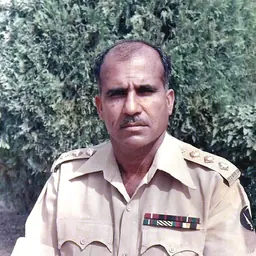
Lived 1912 – 1988 (aged 76). Abdul Haq was an Indian and Pakistani politician, ulema and muhaddith.
Abdul Haq (, ; 11 January 19127 September 1988), also known as Abdul Haq Akorwi, was a Pakistani Deobandi Islamic scholar, who was the founder and Sheikh al-Hadith of the Islamic seminary Darul Uloom Haqqania and had also served as vice-president of Wifaq ul Madaris Al-Arabia, Pakistan.
He was involved in politics as a member of the political party Jamiat Ulema-e-Islam. He served three times in the National Assembly of Pakistan and was an active proponent of the Khatme Nabuwwat movement.
Abdul Haq completed his religious education at Darul Uloom Deoband in Deoband, India. He taught at Deoband for four years until difficulties arose due to the independence of Pakistan.
In 1947, he founded Darul Uloom Haqqania in Akora Khattak, one of the first Islamic seminaries to be established in Pakistan. He taught hadith at the madrasah for the rest of his life and was well known by the title "Shaykh al-Hadith".
Education Abdul Haq was born in the city of Akora Khattak, Peshawar District, North-West Frontier Province (NWFP), British India, the son of Haji Maruf Gul, a local landlord, businessman, and religious scholar. According to family belief, Abdul Haq was born in 1912 or 1914. Muhammad Akbar Shah Bukhari, however, writes in Akabir Ulama-i Deoband that he was born on "7 Muharram al-Haram 1327 AH, Sunday, corresponding to January 1910". This is an error since Sunday 7 Muharram 1327 corresponds to 31 January 1909, not 1910. Another source gives his date of birth as 7 Muharram 1330 AH (c. 29 December 1911). His nasab (patronymic) is given as follows: Shaykhul-Ḥadīs̱ Mawlānā ‘Abdul-Ḥaqq ibn Akhūnzādah al-Ḥājj Mawlānā Muḥammad Ma‘rūf Gul ibn Akhūnzādah al-Ḥājj Mawlānā Mīr Aftāb ibn Akhūnzādah Mawlānā ‘Abdul-Ḥamīd ibn Mawlānā ‘Abdur-Raḥīm Akhūnkhel ibn Mawlānā ‘Abdul-Wāḥid Akhūnkhel.
He completed daurah of hadith, the final stage of the Dars-i Nizami curriculum, under the supervision of Hussain Ahmad Madani, receiving his sanad-i faraghat (graduate degree) in 1352 AH (1933/1934). In 1970, running on the JUI ticket, Abdul Haq was elected to the 5th National Assembly, defeating Ajmal Khattak of the National Awami Party and Nasrullah Khan Khattak of the Pakistan Peoples Party (PPP). In the 1977 general election, he was elected to the 6th National Assembly, running on the ticket of the Pakistan National Alliance, a nine-party alliance including JUI. He again defeated Nasrullah Khan Khattak, then Chief Minister of NWFP and provincial president of the PPP. He was elected to the 7th National Assembly in the 1985 general election, which was held on a non-party basis.
Khatme Nabuwwat movement Abdul Haq was active in the Khatme Nabuwwat movement. In his lectures, he stressed the importance of the concept of finality of prophethood and argued against the interpretations of Quranic verses and hadiths used by Ahmadis to support their beliefs. He was one of the signatories of the resolution moved on 30 June 1974 in the National Assembly in support of declaring Ahmadis as non-Muslims in Pakistan.
Soviet–Afghan War When the Soviets invaded Afghanistan in 1979, Abdul Haq declared the Afghan resistance to be a jihad and an ideological struggle between Islam and communism. The ruling stating this was issued by Darul Uloom Haqqania. Abdul Haq made monetary contributions in support of the Afghan Mujahideen and prayed for their success. On many occasions, he expressed his desire to fight, but he was unable to do so due to his old age and failing health.
Sufism Abdul Haq was a disciple of Haji Sahib Turangzai. He gave bay'ah at the hands of other Sufis including Hussain Ahmad Madani, Khawaja Abdul Malik Siddiqi, and the Faqir of Ipi.
Awards and achievements In October 1978, Abdul Haq was awarded an honorary PhD in Divinity from the University of Peshawar for services rendered in the cause of Islam. Sitara-i-Imtiaz (Star of Distinction) by the President of Pakistan, General Zia-ul-Haq, for his religious, educational, and scholarly achievements.
Death Abdul Haq died on 7 September 1988, at the age of 74 or 76, at Khyber Hospital in Peshawar, North-West Frontier Province, Pakistan.
Don’t just read it —
keep it.
Full-length biographies made to live with: read them, listen on the way to work, watch them tonight.
- E-book
- Audio
- Video
Instant download · yours to keep · every purchase keeps this site free
Important facts
People in Abdul Haq's life
Named in this biography and alive at the same time

Related people
Same field, nearest in time





Contemporaries
People whose lives overlapped Abdul Haq's





Frequently asked questions
Who was Abdul Haq?
Islamic scholar (1912–1988)
When was Abdul Haq born?
Abdul Haq was born on 11 January 1912 in Akora Khattak, Nowshera District.
When did Abdul Haq die?
Abdul Haq died on 7 September 1988 in Peshawar, Pakistan.
What was Abdul Haq's occupation?
Abdul Haq was a politician, ulema and muhaddith.
What nationality was Abdul Haq?
Abdul Haq was Indian and Pakistani.
Sources & further reading
Cite this page
APA: Biography.guide. (2026). Abdul Haq. https://biography.guide/abdul-haq/
MLA: "Abdul Haq." Biography.guide, https://biography.guide/abdul-haq/.
Chicago: "Abdul Haq." Biography.guide. https://biography.guide/abdul-haq/.
Data last updated: 2026-09-20 · Spot an error? Report a correction.
Page generated 2026-09-27 05:30 UTC