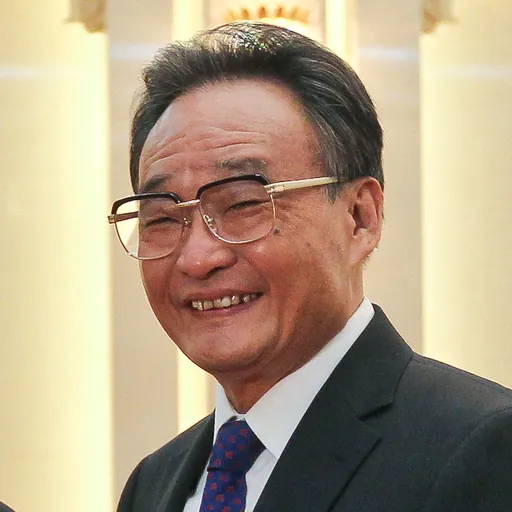
Wu Bangguo
Former Chairman of the Standing Committee of the National People's Congress of China
About Wu Bangguo
Lived 1941 – 2024 (aged 83). Wu Bangguo was a Chinese politician.
Wu Bangguo (22 July 1941 – 8 October 2024) was a Chinese politician who served as the second-ranking member of the Politburo Standing Committee of the Chinese Communist Party from 2002 to 2012, and as Chairman of the Standing Committee of the National People's Congress from 2003 to 2013.
Wu was an electrical engineer by profession, and rose to political prominence during his work in Shanghai. During the early 1980s, he was in charge of science and technology related work in Shanghai, where he worked with Jiang Zemin, then mayor and later Party secretary of the city, leading Wu to be affiliated with Jiang's political faction. He became Shanghai's party secretary in 1991, succeeding Zhu Rongji, leading him to assume a seat in the CCP Politburo in 1992. He became the country's Vice Premier of the State Council in 1995, with a portfolio including state-owned enterprises and the construction of the Three Gorges Dam.
He joined the Politburo Standing Committee in 2002, and was appointed the Chairman of the Standing Committee of the National People's Congress in 2003. Serving as one of the highest-ranking officials under Party general secretary Hu Jintao, Wu is generally regarded to have taken more conservative positions towards political reforms during his tenure. During his efforts, the NPCSC passed numerous administrative, social and economic laws to form a "socialist system of laws with Chinese characteristics". Notable laws passed during his tenure include the 2004 amendment to the Constitution, the Anti-Secession Law, the Oversight Law and the Property Law. He stepped down from the Politburo Standing Committee in 2012, and was succeeded by Zhang Dejiang as Chairman of the Standing Committee of the National People's Congress in 2013.
Early life Wu was born on 22 July 1941, in Pingba, Guizhou, with ancestral roots in Feidong, Anhui. His father Wu Zhongxing was a cartographer working on map projection. He entered Tsinghua University in 1960, majoring in electron tube engineering at the Department of Radio Electronics, where he graduated in 1967. He joined the Chinese Communist Party (CCP) in 1964. After graduation, he was employed as a worker and technician at Shanghai's No. 3 Electronic Tube Factory, and then deputy chief and chief of the technical section from 1976 to 1978. He would eventually go on to lead the factory as its party secretary. In 1978 he was assigned to become the deputy manager of Shanghai Electronic Elements Company, and between 1979 and 1981 the deputy manager of Shanghai Electron Tube Company. Between 1981 and 1983 he worked as the deputy secretary of Shanghai Meters, Instruments and Telecommunications Bureau.
Political career Wu's work in electronics companies earned him a tenure in the city's upper echelons of power. He became part of the Standing Committee of the Shanghai party committee in 1983, effectively becoming part of Shanghai's political inner circle, and was put in charge of work related to science and technology. During his tenure, Wu was generally regarded as a member of the Shanghai clique and an associate of Jiang Zemin, generally taking a conservative approach towards reform. He also stated that the Central Government supported Hong Kong's development of democracy, so long as it is within the boundaries of the Hong Kong Basic Law. Although the remarks were left open to interpretation, they generated significant controversy in Hong Kong, with pro-democracy politicians calling it a challenge on the autonomy of the territory. becoming the first person to serve as the NPCSC Chair for more than two terms since Zhu De. In April 2008, Wu and other legislative leaders decided, as a general rule, to seek public comment on the first draft of each major bill going forward through online methods. In 2011, Wu proposed the "five don'ts by declaring that "e have made a solemn declaration that we will not employ a system of multiple parties holding office in rotation, diversification of guiding ideology, separation of powers and bicameralism, federalism or privatization". Wu retired from the CCP Politburo Standing Committee at the 18th Party Congress in November 2012. On 28 December 2012, in one of Wu's final legislative acts, the NPCSC adopted the Decision on Strengthening Network Information Protection, which introduced important provisions for protecting citizens' "electronic personal information" and established a Internet real-name system. National flags were flown at half-mast at Chinese government buildings, diplomatic missions, and in Hong Kong and Macau.
Don’t just read it —
keep it.
Full-length biographies made to live with: read them, listen on the way to work, watch them tonight.
- E-book
- Audio
- Video
Instant download · yours to keep · every purchase keeps this site free
Important facts
Family & relationships
People in Wu Bangguo's life
Named in this biography and alive at the same time



Related people
Same field, nearest in time





Contemporaries
People whose lives overlapped Wu Bangguo's


Frequently asked questions
Who was Wu Bangguo?
former Chairman of the Standing Committee of the National People's Congress of China (1941–2024)
When was Wu Bangguo born?
Wu Bangguo was born on 22 July 1941 in Pingba District.
When did Wu Bangguo die?
Wu Bangguo died on 8 October 2024 in Beijing.
What was Wu Bangguo's occupation?
Wu Bangguo was a politician.
What nationality was Wu Bangguo?
Wu Bangguo was Chinese.
Sources & further reading
Cite this page
APA: Biography.guide. (2026). Wu Bangguo. https://biography.guide/wu-bangguo/
MLA: "Wu Bangguo." Biography.guide, https://biography.guide/wu-bangguo/.
Chicago: "Wu Bangguo." Biography.guide. https://biography.guide/wu-bangguo/.
Data last updated: 2026-09-22 · Spot an error? Report a correction.
Portrait: Wikimedia Commons · author & licence
Page generated 2026-09-27 05:04 UTC