
About William Bell Scott
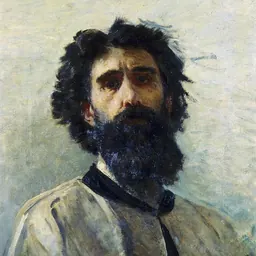
Lived 1811 – 1890 (aged 79). William Bell Scott was a British painter, writer, poet, graphic artist, art historian and exlibrist.
William Bell Scott (12 September 1811 – 22 November 1890) was a Scottish artist in oils and watercolour and occasionally printmaking. He was also a poet and art teacher, and his posthumously published reminiscences give a chatty and often vivid picture of life in the circle of the Pre-Raphaelites; he was especially close to Dante Gabriel Rossetti. After growing up in Edinburgh, he moved to London, and from 1843 to 1864 was principal of the government School of Art in Newcastle upon Tyne, where he added industrial subjects to his repertoire of landscapes and history painting. He was one of the first British artists to extensively depict the processes of the Industrial Revolution. He returned to London, working for the Science and Art Department until 1885.
He painted a cycle of historical subjects mixed with scenes from modern industry for Wallington Hall in Northumberland (now National Trust), his best known works, and a purely historical cycle for Penkill Castle in Ayrshire in Scotland.
He did not paint many portraits, but his striking portrait of his friend Algernon Charles Swinburne is the iconic image of the poet. His etchings were mostly designed to illustrate his books.
Life
The son of Robert Scott (1777–1841), the engraver, and brother of David Scott, the painter, he was born in Edinburgh. While a young man he studied art and assisted his father, and he published verses in the Scottish magazines.
In 1837, Scott went to London. There he became sufficiently well known as an artist to be appointed in 1844 master of the government school of design at Newcastle-on-Tyne. He held the post for twenty years, and did work in organizing art-teaching and examining under the Science and Art Department.
He resigned his appointment under the Science and Art Department in 1885, and from then until his death he was mainly occupied in writing his reminiscences, Autobiographical Notes, which were published posthumously in 1892, with a memoir by Professor Minto. It is for his connection with Rossetti's circle that Bell Scott will be chiefly remembered. He produced eight large pictures illustrating Northumbrian history, with life-size figures, supplemented by eighteen pictures on The Ballad of Chevy Chase in the spandrels of the arches of the hall. For Penkill Castle he executed a similar series, illustrating James I's poem The Kingis Quair.
Don’t just read it —
keep it.
Full-length biographies made to live with: read them, listen on the way to work, watch them tonight.
- E-book
- Audio
- Video
Instant download · yours to keep · every purchase keeps this site free
Important facts
People in William Bell Scott's life
Named in this biography and alive at the same time



Related people
Same field, nearest in time


Contemporaries
People whose lives overlapped William Bell Scott's




Frequently asked questions
Who was William Bell Scott?
British artist (1811-1890)
When was William Bell Scott born?
William Bell Scott was born on 12 September 1811 in Edinburgh.
When did William Bell Scott die?
William Bell Scott died on 22 November 1890 in South Ayrshire.
What was William Bell Scott's occupation?
William Bell Scott was a painter, writer, poet, graphic artist, art historian and exlibrist.
What nationality was William Bell Scott?
William Bell Scott was British.
Sources & further reading
· Wikipedia: William Bell Scott
Cite this page
APA: Biography.guide. (2026). William Bell Scott. https://biography.guide/william-bell-scott/
MLA: "William Bell Scott." Biography.guide, https://biography.guide/william-bell-scott/.
Chicago: "William Bell Scott." Biography.guide. https://biography.guide/william-bell-scott/.
Data last updated: 2026-09-20 · Spot an error? Report a correction.
Page generated 2026-09-27 05:22 UTC