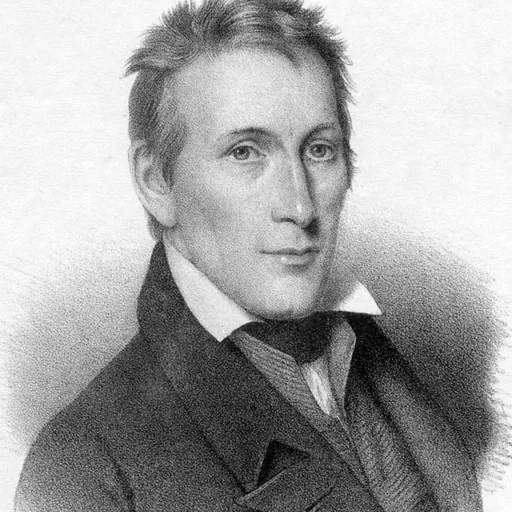
About William Baldwin
Lived 1779 – 1819 (aged 40). William Baldwin was an American botanist, physician, explorer, botanical collector and scientific collector.
William Baldwin (March 29, 1779 – September 1, 1819) was an American physician and botanist who is today remembered for his significant contributions to botanical studies, especially Cyperaceae. He lived in Pennsylvania, Delaware, and Georgia, and served as a ship's surgeon on two voyages overseas. He published only two scientific papers, but his major contributions were in the knowledge that he imparted to other botanists in his letters to them and in the thousands of specimens that he provided for their herbaria. He wrote letters to Henry Muhlenberg, Stephen Elliott, William Darlington, Zaccheus Collins, and others. His most important collections were from Georgia, Florida, and eastern South America. When he died, he left a large herbarium that proved to be of great value, especially to Lewis David von Schweinitz, John Torrey, and Asa Gray. He had a special interest in the plant family Cyperaceae and his incomplete, unpublished manuscripts were a major source for monographs by John Torrey and Asa Gray. The historian Joseph Ewan has said that "Baldwin's treatment of a number of genera, especially in the Cyperaceae, showed penetrating observation, understanding, and diagnosis".
Pennsylvania William Baldwin was born in Newlin Township, Pennsylvania, a small township about one kilometer southeast of Embreeville in Chester County. He was the son of Elizabeth Baldwin (nee Garretson) and Thomas Baldwin, a Quaker minister. At the time, his condition was called hereditary tuberculosis, but it is now known that tuberculosis is an infectious disease.
William Baldwin had little formal education, but he had a thirst for knowledge and became a school teacher at a young age. When he was not teaching class, he was in Downingtown, Chester County, studying medicine under Dr. William A. Todd. It was here that he met Moses Marshall, the nephew of botanist Humphry Marshall.
Baldwin and his wife considered themselves to be devout Quakers, but they were thrown out of meeting for getting married by a Presbyterian minister whom the Quakers called a mere "hireling". Baldwin apologized for this and was reinstated. Because of his reputation as a botanist, Baldwin was selected to sail on the frigate USS Congress as a botanical investigator as well as the ship's surgeon. Thus ended the ill-fated venture which claimed the life of one of America's greatest botanists.
Baldwin was 40 years and 5 months of age at the time of his death. He was buried on the banks of the Missouri River. At the end of his biographical sketch of Baldwin, Darlington, in 1843, wrote:
In January 1844, Lowry wrote to Darlington to tell him that the grave of his friend had been washed away by the floodwaters of the Missouri. It was published in the year of his death. His only other paper was read before a meeting of the American Philosophical Society on April 16, 1819 as he made his way down the Ohio River,
Collections One of the concerns of botany in the early 21st century is the location of type specimens, the material that formed the basis of the description that was given when the plant was named. The whereabouts of this material is sometimes discovered unexpectedly. For example, a set of 18 specimens that Baldwin gave to the American Philosophical Society in March 1819 was neglected, probably because of its small size, and was not studied until 1978. At that time, it was found to contain the type specimens of some species of Rhynchospora.
William Baldwin donated generously to the collections of others, often exchanging some of his plants for plants that he desired. He contributed much to the herbaria if Muhlenberg, Elliott, Collins, and Darlington. He also sent specimens to Aylmer Bourke Lambert and Aime Bonpland, and in 1817, he sent some to James Edward Smith. Smith published several new species based on material that Baldwin had sent him. In 1811, he sent moss and lichen specimens to Olof Swartz and Erik Acharius. In 1815, he sent more of the same to Christian Friedrich Schwägrichen. but this orthographical variant was not generally accepted. Balduina is now a conserved name.
Balduina is a genus of three species native to the Atlantic and Gulf coastal plain. Not all authors have put them in one genus and they have had various names, but a revision of Asteraceae in 2007 placed all three of these species together in Balduina.
Several species of plants have been named for William Baldwin. Among those names that are still in use are the following names: Eleocharis baldwinii (John Torrey) Alvan Wentworth Chapman, Rhynchospora baldwinii Asa Gray, Saccharum baldwinii Curt Sprengel, Clematis baldwinii John Torrey and Asa Gray, Paronychia baldwinii (Torrey and Gray) Eduard Fenzl and Wilhelm Walpers, Eryngium baldwinii Curt Sprengel, Vernonia baldwinii John Torrey, Xyris baldwiniana Josef Schultes, and Matelea baldwyniana (Robert Sweet) Robert Woodson.
At least six other plants, including Fimbristylis annua, Dichanthelium ensifolium, Ptelea trifoliata, Silene catesbaei, Symphyotrichum undulatum, and Viguiera (Rhysolepis) anchusifolia have had names that honored Baldwin, but these are no longer in use.
Don’t just read it —
keep it.
Full-length biographies made to live with: read them, listen on the way to work, watch them tonight.
- E-book
- Audio
- Video
Instant download · yours to keep · every purchase keeps this site free
Important facts
People in William Baldwin's life
Named in this biography and alive at the same time





Related people
Same field, nearest in time



Contemporaries
People whose lives overlapped William Baldwin's


Frequently asked questions
Who was William Baldwin?
U.S. physician and botanist (1779–1819)
When was William Baldwin born?
William Baldwin was born on 29 March 1779 in Newlin Township.
When did William Baldwin die?
William Baldwin died on 1 September 1819 in Franklin.
What was William Baldwin's occupation?
William Baldwin was a botanist, physician, explorer, botanical collector and scientific collector.
What nationality was William Baldwin?
William Baldwin was American.
Sources & further reading
· DBpedia: William Baldwin (botanist)
Cite this page
APA: Biography.guide. (2026). William Baldwin. https://biography.guide/william-baldwin-botanist/
MLA: "William Baldwin." Biography.guide, https://biography.guide/william-baldwin-botanist/.
Chicago: "William Baldwin." Biography.guide. https://biography.guide/william-baldwin-botanist/.
Data last updated: 2026-09-22 · Spot an error? Report a correction.
Portrait: Wikimedia Commons · author & licence
Page generated 2026-09-27 05:03 UTC