
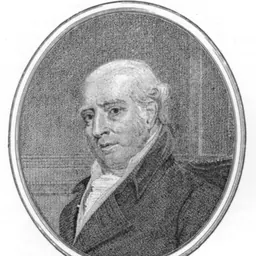
James Edward Smith
English botanist, founder of the Linnean Society of London
About James Edward Smith
Lived 1759 – 1828 (aged 68). James Edward Smith was a British botanist, pteridologist, bryologist, entomologist, lepidopterist and mycologist.
Sir James Edward Smith (2 December 1759 – 17 March 1828) was an English botanist and founder of the Linnean Society.
Early life and education
Smith was born in Norwich in 1759, the son of a wealthy wool merchant. He started studying botanical science when he was eighteen. In 1781 he enrolled in the medical course at the University of Edinburgh,
Smith spent the remaining thirty years of his life writing books and articles on botany. His books included Flora Britannica and The English Flora (4 volumes, 1824–1828). He contributed 3,348 botanical articles to Rees's Cyclopædia between 1808 and 1819, following the death of Rev. William Wood, who had started the work. In addition, he contributed 57 biographies of botanists.
He contributed seven volumes to the major botanical publication of the eighteenth century, Flora Graeca, the publications begun by John Sibthorp. A fruitful collaboration was found through descriptions Smith supplied to publisher and illustrator, James Sowerby with whom he subsequently developed as passionate interest in mosses and lichens. Depiction of flora in England had previously only found patronage for aesthetic concerns, but an interest in gardening and natural history saw illustrated publications, such as the exotic A Specimen of the Botany of New Holland and James Sowerby's 36-volume English Botany, reach new audiences.
In 1797, Smith published The Natural History of the Rarer Lepidopterous Insects of Georgia, the earliest book on North American insects. It included the illustrations and notes of John Abbot, with descriptions of new species by Smith based on Abbot's drawings.
Smith's friendship with William Roscoe (after whom he named the genus Roscoea) saw him contribute 5000 plants, between 1806 and 1817, to supplement the Roylean Herbarium. This was to become the Smith Herbarium held by the Liverpool Botanical Garden.
Personal life and death Smith died at his Norwich home in Surrey Street on March 17, 1828, aged 68. After his death the Linnean Collection, together with Smith's own collections, were bought by the Linnean Society for £3,000.
He was married in 1796 to Pleasance Reeve, who survived him by 49 years and edited his memoirs and correspondence. They are buried together at St Margaret's, Lowestoft. His niece, Frances Catherine Barnard (1796–1869), was an author.
Eponymy The leguminous genus Smithia and the Himalayan spruce, Picea smithiana, are named for him.
Works Icones pictae plantarum rariorum descriptionibus et observationibus illustratae. London, 1790–93 Linnaeus, Carl von, Disquisitio de sexu plantarum. (1786) – (English) A dissertation on the sexes of plants translated from the Latin of Linnaeus by James Edward Smith. London : Printed for the author, and sold by George Nicol ..., (book details: xv, , 62, p.; 22 cm. (8vo)) "Tentamen Botanicum de Filicum Generibus Dorsiferarum", Mém. Acad. Roy. Sci. Turin, vol. 5 (1793) 401–422; one of the earliest scientific papers on fern taxonomy Available online on Project Gutenberg. English Botany: Or, Coloured Figures of British Plants, with their Essential Characters, Synonyms and Places of Growth, descriptions supplied by Smith, was issued as a part work over 23 years until its completion in 1813. This work was issued in 36 volumes with 2,592 hand-coloured plates of British plants. Published and illustrated by James Sowerby. Linné, Carl von, Lachesis Lapponica or A Tour in Lapland, Translated by James Edward Smith (1811). London: White and Cochrane In two volumes (Volume 1; Volume 2). Tracts Relating to Natural History: published in London in 1798. A collection of essays concerning Linnaeus and botany.
Don’t just read it —
keep it.
Full-length biographies made to live with: read them, listen on the way to work, watch them tonight.
- E-book
- Audio
- Video
Instant download · yours to keep · every purchase keeps this site free
Important facts
People in James Edward Smith's life
Named in this biography and alive at the same time


Related people
Same field, nearest in time




Contemporaries
People whose lives overlapped James Edward Smith's




Frequently asked questions
Who was James Edward Smith?
English botanist, founder of the Linnean Society of London (1759–1828)
When was James Edward Smith born?
James Edward Smith was born on 2 December 1759 in Norwich.
When did James Edward Smith die?
James Edward Smith died on 17 March 1828 in Norwich.
What was James Edward Smith's occupation?
James Edward Smith was a botanist, pteridologist, bryologist, entomologist, lepidopterist and mycologist.
What nationality was James Edward Smith?
James Edward Smith was British.
Sources & further reading
· Wikipedia: James Edward Smith
· DBpedia: James Edward Smith (botanist)
Cite this page
APA: Biography.guide. (2026). James Edward Smith. https://biography.guide/james-edward-smith-botanist/
MLA: "James Edward Smith." Biography.guide, https://biography.guide/james-edward-smith-botanist/.
Chicago: "James Edward Smith." Biography.guide. https://biography.guide/james-edward-smith-botanist/.
Data last updated: 2026-09-20 · Spot an error? Report a correction.
Page generated 2026-09-27 05:21 UTC