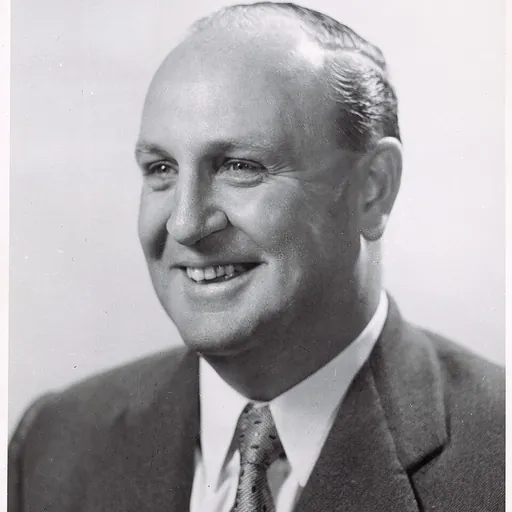
About William Aston
Lived 1916 – 1997 (aged 80). William Aston was an Australian politician, accountant and business executive.
Sir William John Aston, KCMG (19 September 1916 – 21 May 1997) was an Australian politician. Born in Sydney, he attended state schools before becoming an accountant and company director. He served in World War II from 1942 to 1944, and was involved in local politics as a member of Waverley Council. In 1955, he was elected to the Australian House of Representatives as the Liberal member for Phillip. He held the seat until 1961, when he was defeated by Syd Einfeld of the Labor Party. Aston returned to the House in 1963, defeating Einfeld. On 21 February 1967 Aston was elected Speaker. He held this position until the Liberal Government's defeat at the hands of Gough Whitlam in 1972, when Aston lost his seat. He died in 1997.
Early life Aston was born on 19 September 1916 in Mascot, New South Wales. He was the son of Annie (née McKeown) and Harold John Aston; his father worked as a barber.
Aston's family struggled financially during the Great Depression. His mother worked as a washerwoman and he was sent to live with his aunt Ethel George – his father's sister – for a period. He later recalled that "she had a greater influence on me than any other person". He helped convince foreign minister William McMahon to make more explicitly pro-Israel statements, following concerns expressed by Israeli contacts. Aston made an official visit to Israel in 1969 and 1971, after which he was described by the Jerusalem Post as "one of Israel's most faithful and devoted friends in Australia". He was an honorary commander in Betar, a Zionist youth movement, while his wife was a life governor of the Women's International Zionist Organization. In 1971 he officially opened the first annual conference of the Executive Council of Australian Jewry at the new National Jewish Memorial Centre in Canberra.
Speaker of the House Aston was elected speaker of the House of Representatives on 21 February 1967, replacing John McLeay who had retired after the 1966 election. Prior to his election he had defeated eight other contestants for the Liberal Party's nomination. He remained in office until his defeat at the 1972 election, after which he retired from politics.
As speaker, Aston was an advocate for the extension of question time and for the expansion of the House's committee system along the lines of the Senate committees. In his advocacy for the latter he came into conflict with Prime Minister John Gorton. Aston's proposed procedural reforms were included in a report of the House Standing Orders Committee which he delivered as ex officio chairman in September 1970. The House did not accept some of the major changes proposed, but did adopt recommendations for shorter speaking times and reduced quorums.
Aston came into conflict with the ALP opposition on a number of occasions. Following his re-election as speaker in 1969, ALP frontbenchers Kim Beazley and Clyde Cameron accused him as being a "lackey of the prime minister [Gorton]". In April 1970, Aston named ALP MP Gordon Bryant for insulting him, following which Bryant's ALP colleagues crowded around him to prevent his removal by the serjeant-at-arms. The situation was resolved the following day after intervention from ALP leader Gough Whitlam. In April 1971, Aston was the subject of a no-confidence motion from the opposition, with ALP deputy leader Lance Barnard describing him as "arbitrary, capricious, inconsistent and undeniably partisan". The motion was defeated on party lines.
One of the most significant incidents involving Aston occurred in March 1971, when journalist Alan Ramsey shouted "you liar!" at Gorton from the press gallery of the House of Representatives. Whitlam subsequently moved that Ramsey be imprisoned for contempt of parliament, but this was avoided when Aston assisted Ramsey in drafting an apology.
Personal life In 1941, Aston married Betty Burrett, a milliner. The couple had three children, including Ray Aston who served in the New South Wales Legislative Assembly from 1986 until his death in 1988.
Aston suffered from dementia in later life. He died of heart failure in Vaucluse, New South Wales, on 21 May 1997, aged 80.
Don’t just read it —
keep it.
Full-length biographies made to live with: read them, listen on the way to work, watch them tonight.
- E-book
- Audio
- Video
Instant download · yours to keep · every purchase keeps this site free
Important facts
Family & relationships
People in William Aston's life
Named in this biography and alive at the same time





Related people
Same field, nearest in time





Contemporaries
People whose lives overlapped William Aston's



Frequently asked questions
Who was William Aston?
Australian politician (1916-1997)
When was William Aston born?
William Aston was born on 19 September 1916 in Sydney.
When did William Aston die?
William Aston died on 21 May 1997.
What was William Aston's occupation?
William Aston was a politician, accountant and business executive.
What nationality was William Aston?
William Aston was Australian.
Sources & further reading
Cite this page
APA: Biography.guide. (2026). William Aston. https://biography.guide/william-aston-politician/
MLA: "William Aston." Biography.guide, https://biography.guide/william-aston-politician/.
Chicago: "William Aston." Biography.guide. https://biography.guide/william-aston-politician/.
Data last updated: 2026-09-20 · Spot an error? Report a correction.
Portrait: Wikimedia Commons · author & licence
Page generated 2026-09-27 04:58 UTC