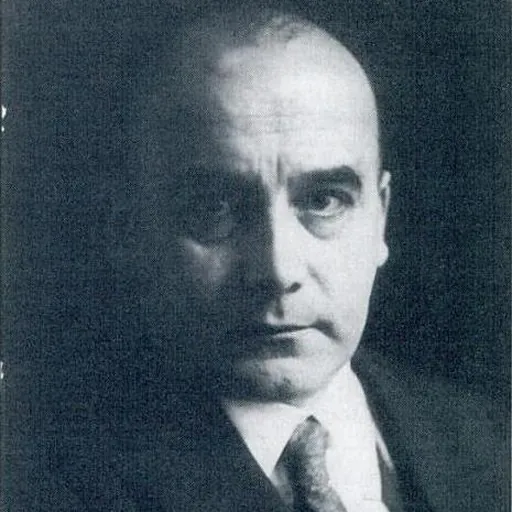
About Will Vesper
Lived 1882 – 1962 (aged 79). Will Vesper was a German writer, literary critic, farmer, editor, translator and librettist.
Will Vesper (11 October 1882 – 14 March 1962) was a German author and literary critic who was involved in the Nazi book burnings.
Life and work Born into a Protestant farmer family in Barmen, he read History and Germanic philology (Germanistik) in Munich. From 1906, he was active as literary adviser and translator at the C. H. Beck publishing house. In 1913–1914, he was in Florence, Italy. He rose to early fame as the editor of several anthologies of German poetry of a spiritual kind, including Der deutsche Psalter and two volumes of Die Ernte aus acht Jahrhunderten deutscher Lyrik, and for his retelling of the Tristan and Isolde and Parzifal legends, all of which sold in tens of thousands before 1914. Vesper took part in World War I from 1915 to 1918, first as an infantryman, and towards the end of the war as scientific or intelligence assistant in the military staff.
After a two-year period as manager of the cultural section of the Deutsche Allgemeine Zeitung from 1918 to 1920, Vesper was employed from 1923 until 1943 as editor of the periodical Die schöne Literatur (Beautiful Literature), later under the title Die Neue Literatur (New Literature), which was to become the leading national socialist literature magazine. At the same time he published his own novels, stories and poems. His works mainly dealt with German history, and above all with proto-Germanic times. In these he displayed a decidedly nationalistic perception, which together with his glorification and exalting of the love of the native soil, of motherhood and war, made it inevitable that he would become a representative of Nazi ideology. His best-known work Das harte Geschlecht, about the Christian conversion of Iceland, appeared in 1931, and in May 1933 was praised in the Völkischer Beobachter as a "thoroughly bloodthirsty Northland novel".
In 1931, Vesper, whom Thomas Mann described as "already one of the worst of the nationalist buffoons", joined the NSDAP. After the exclusion of the disapproved authors from the Poetry department of the Academy of Prussian Arts like Thomas Mann, Leonhard Frank, Alfred Döblin, and others, Vesper installed among others Hans Friedrich Blunck, Hans Carossa, and Hans Grimm in the Poets Academy around 1933. In the May 1933 public book-burning in Dresden, Vesper gave the ceremonial speech. He was one of the 88 authors who in October 1933 signed the Vow of the Loyal Followers (Gelöbnis treuester Gefolgschaft) for Adolf Hitler published in the Vossische Zeitung and Frankfurter Zeitung.
Already, at the beginning of the thirties, Vesper was becoming known as an author of the Bertelsmann editions. In his literary Journal Die Neue Literatur Vesper carried out a kind of private censorship or revisionism, regularly embarking upon defamatory campaigns against authors and publishers who did not agree with his personal views. When he also did not hold back from attacking the State Directives in regard to writing, he lost the advantage of his position. By 1936, he withdrew from his duties to the estate of his wife Rose (Rimpau) Vesper at Triangel bei Gifhorn, where he occupied himself as a farmer but also continued to issue his literary newsletters until the year 1943.
After the war, Vesper was an editor in the Bertelsmann-Verlag and was active in right-wing circles through readings and Writers' Congresses for Hans Grimm in Lippoldsberg, also where he worked. He died in Gut Triangel, near Gifhorn, on 14 March 1962. Vesper's son, the author Bernward Vesper (1938–1971), also became well known when his autobiographic novel Die Reise (Journey, or, Trip) was posthumously published in 1977. As a student of German studies and sociology, he had been the partner of Gudrun Ensslin, who later became founder of the Red Army Faction. Die Reise is considered an important document of the spirit of the German student movement and German society of the 1960s.
Writings Novels, stories, and fables Der Segen, 1905 Tristan und Isolde (Nacherzählung), 1911 Parzifal (Nacherzählung), 1911 Martin Luthers Jugendjahre, 1918 Der Balte, 1919 Annemarie, 1920 Traumgewalten, 1920 Gute Geister, 1921 Die Nibelungensage (Nacherzählung), 1921 Daniel Defoe. Leben und Abenteuer des Robinson Crusoe (Bearbeitung), 1922 Die Gudrunsage (Nacherzählung), 1922 Fröhliche Märchen (Neuerzählung), 1922 Porzellan, 1922 Die Wanderung des Herrn Ulrich von Hutten, 1922 Die ewige Wiederkehr, 1922 Der arme Konrad, 1924 Der Pfeifer von Niclashausen, 1924 (Erzählung über den fränkischen Prediger Hans Böhm) Der Bundschuh zu Lehen, 1925 Jonathan Swift: Lemuel Gullivers vier Reisen (Nacherzählung), 1927 Der Heilige und der Papst, 1928 Die Historie von Reinecke dem Fuchs (Nacherzählung), 1928 Das Mutterbüchlein, 1928 Tiermärchen aus aller Welt (Nacherzählung), 1928 Das harte Geschlecht, 1931 Sam in Schnabelweide, 1931 Drei Erzählungen, 1933 Ein Tag aus dem Leben Goethes, 1933 Der entfesselte Säugling, 1935 Geschichten von Liebe, Traum und Tod, 1937 Kämpfer Gottes, 1938 Im Flug nach Spanien, 1943 Der unzufriedene Igel, 1943 Seltsame Flöte, 1958 Zauber der Heide, 1960 Letzte Ernte, 1962
Dramas and farces Spiele der Liebe, 1913 Die Liebesmesse, 1913 Wer? Wen?, 1927 Eine deutsche Feier, 1936
Poems Die Liebesmesse und andere Gedichte, 1913 Vom großen Krieg 1914, 1915 Der blühende Baum, 1916 Briefe zweier Liebender, 1916 Schön ist der Sommer, 1918 Das Buch vom lieben Weihnachtsmann, 1920 Mutter und Kind, 1920 Des Wiesenmännchen Brautfahrt, 1920 Inschriften und Gedichte, 1928 Kranz des Lebens. Gesamtausgabe meiner Gedichte, 1934 Rufe in die Zeit. Sprüche und Gedichte, 1937 Das Neue Reich, 1939 Bild des Führers, 1942 Dennoch!, 1944 Kleiner Kranz des Lebens. Auswahl, 1960
Essays and editions Friedrich Hölderlin: Hyperion (Nachwort), 1921 Lob der Armut, 1921 Die Jugendbibel (Bearbeitung), 1927 Das Recht der Lebenden, 1927 In den Bergen, auf dem Wasser (Einführung), 1928 Die Weltenuhr, 1932 (Ed.) Die Ernte aus acht Jahrhunderten deutsche Lyrik, 1906 (2 vols) (Ed.) Der deutsche Psalter – ein Jahrtausend geistlicher Dichtung, 1914 (Ed.) Deutsche Lyrik von Heute: Ernte der Gegenwart und Ernte der Zeit, 1940
Don’t just read it —
keep it.
Full-length biographies made to live with: read them, listen on the way to work, watch them tonight.
- E-book
- Audio
- Video
Instant download · yours to keep · every purchase keeps this site free
Important facts
People in Will Vesper's life
Named in this biography and alive at the same time



Related people
Same field, nearest in time

Contemporaries
People whose lives overlapped Will Vesper's




Frequently asked questions
Who was Will Vesper?
German writer (1882–1962)
When was Will Vesper born?
Will Vesper was born on 11 October 1882 in Barmen.
When did Will Vesper die?
Will Vesper died on 11 March 1962 in Sassenburg-Triangel.
What was Will Vesper's occupation?
Will Vesper was a writer, literary critic, farmer, editor, translator and librettist.
What nationality was Will Vesper?
Will Vesper was German.
Sources & further reading
Cite this page
APA: Biography.guide. (2026). Will Vesper. https://biography.guide/will-vesper/
MLA: "Will Vesper." Biography.guide, https://biography.guide/will-vesper/.
Chicago: "Will Vesper." Biography.guide. https://biography.guide/will-vesper/.
Data last updated: 2026-09-22 · Spot an error? Report a correction.
Portrait: Wikimedia Commons · author & licence
Page generated 2026-09-27 05:04 UTC