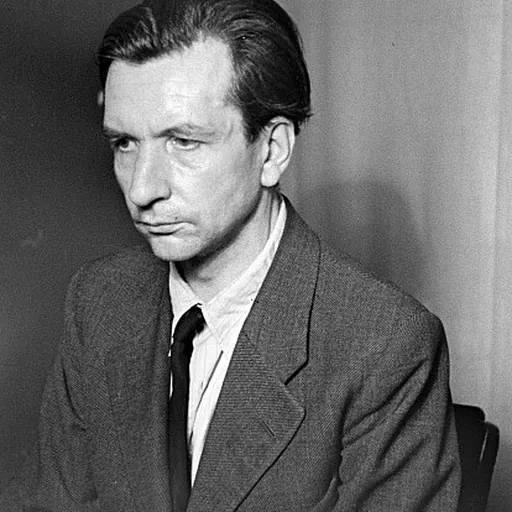
Werner Krauss
German resistance fighter, romanist, politician and literary historian
About Werner Krauss
Lived 1900 – 1976 (aged 76). Werner Krauss was a German resistance fighter, romanist, politician, literary historian, university teacher and literary critic.
Werner Krauss (7 June 1900 – 28 August 1976) was a German university professor (Romance studies).
During the 1940s he became a political activist and resistance fighter against the Nazi regime. In 1943 he was found guilty of preparing to commit high treason and condemned to death. Following the intervention of influential fellow-intellectuals the sentence was commuted to a five-year prison term in 1944.
Life
Provenance and early years Werner Krauss was the son of the archivist-scholar and his wife, born Ottilie Schüle. Werner's mother's sister was the mother of Eberhard Koebel. In June 1918 Werner Krauss successfully completed his schooling at the Eberhard-Ludwigs-Gymnasium in Stuttgart, after which he was conscripted into the wartime army.
Between 1922 and 1926 he lived in Spain, studying at the Complutense University of Madrid. For his doctorate he was supervised by Karl Vossler (who had also taught Victor Klemperer) at the Ludwig-Maximilians-Universität München
He moved to Marburg in April 1931, taking a post as an assistant at Marburg University, and received his habilitation qualification a year later, this time for a piece of work entitled "The development of the bucolic in Spanish Literature",
War returned in 1939, and in August 1940 Krauss was conscripted into the army, ending up in a special company of simultaneous translators: this involved relocating to Berlin, although the work also included front-line assignments.
In Berlin, through his friendship with the psychiatrist John Rittmeister Krauss came into contact with the resistance activist Harro Schulze-Boysen. Krauss and his girlfriend, Ursula Goetze, now participated in a "sticker campaign" against a high-profile exhibition being held in the Lustgarten park in May/June 1942, which carried the ironic title "The Soviet Paradise". This led to their identification as what the Gestapo termed Red Orchestra ("Rote Kapelle") members
On 18 January 1943 they were both found guilty as accessories to High treason by the National War Court and condemned to death. As well as the incident involving the "sticker campaign", Krauss was condemned under the Law on extraordinary broadcast actions ("Verordnung über außerordentliche Rundfunkmaßnahmen") for having listened to, read and given publicity to "inflammatory articles" from abroad.
In the end the death sentence was never carried out. Supported by "psychiatric assessments" and the advocacy of influential academics including Karl Vossler, Ernst Robert Curtius and Hans-Georg Gadamer, By the time his sentence was commuted Krauss had spent twenty months awaiting execution, including a stretch in a death cell in Plötzensee Prison where he shared a cell with chemical engineer Hansheinrich Kummerow, another German resistance fighter. During his time in Plötzensee Werner Krauss was able to write, clandestinely, a satirical Roman à clef entitled "Die Passionen der halkyonischen Seele" ("The Passions of a Halcyon Soul"), with an air-force officer (Harro Schulze-Boysen) as its principal protagonist. The book was published after the war, in 1946, characterised as an anti-fascist novel: it was reissued in 1983.
After the war On his release Krauss made his way back to Marburg, where in 1945 He also sat on the committee responsible for denazification of his fellow professors at Marburg.
Post-war Germany to the west of its new frontier with Poland had been divided in 1945 into four military zones of occupation, and the relocation from Marburg to Leipzig involved a move from the US occupation zone to the Soviet occupation zone, a distinction which gained significance during the later 1940s as the Soviet zone became increasingly separated politically from the other three.
Shortly after the war Krauss also joined the Communist Party. In a letter dated 19 February 1946 he was appointed the party's representative on the newly launched Consultative Regional Committee (Greater Hessen), intended by the occupiers as a precursor to the Landtag of Hesse (regional legislative assembly) which would accompany the re-establishment of a democratic political structure. However, on 15 May 1946 he resigned his seat on the committee in favour of Jo Mihaly.
The territory administered as the Soviet occupation zone was relaunched in October 1949 as the Soviet sponsored German Democratic Republic (East Germany), a one-party state governed by the Socialist Unity Party ("Sozialistische Einheitspartei Deutschlands" / SED) which had been created for the purpose in April 1946. Krauss switched his own party membership to the SED in 1947. In February 1948 Werner Krauss was one of four people identified as "intellectuals" and inducted into the new party's steering committee, precursor to its powerful Central Committee, of which he remained a member till 1951. The focus of his career nevertheless remained firmly in the academic world. He became a member of the Saxony Academy of Sciences ("Sächsische Akademie der Wissenschaften") in 1949, and in 1951 took a professorship with a teaching chair at the Humboldt University of Berlin. In 1955, under the auspices of the German Academy of Sciences, he set up a working group on the history of the French and German Enlightenments, and research on these themes would be at the centre of his working life even after he moved permanently to Berlin in 1961, till his retirement in 1965. 1956 Patriotic Order of Merit in bronze 1959 Friedrich Engels Prize from the (East) German Academy of Sciences and Humanities 1965 Outstanding peoples' scholar 1970 Patriotic Order of Merit in silver 1975 Patriotic Order of Merit in gold
Don’t just read it —
keep it.
Full-length biographies made to live with: read them, listen on the way to work, watch them tonight.
- E-book
- Audio
- Video
Instant download · yours to keep · every purchase keeps this site free
Important facts
People in Werner Krauss's life
Named in this biography and alive at the same time




Related people
Same field, nearest in time


Contemporaries
People whose lives overlapped Werner Krauss's


Frequently asked questions
Who was Werner Krauss?
German resistance fighter, romanist, politician and literary historian (1900-1976)
When was Werner Krauss born?
Werner Krauss was born on 7 June 1900 in Stuttgart.
When did Werner Krauss die?
Werner Krauss died on 28 August 1976 in Berlin.
What was Werner Krauss's occupation?
Werner Krauss was a resistance fighter, romanist, politician, literary historian, university teacher and literary critic.
What nationality was Werner Krauss?
Werner Krauss was German.
Sources & further reading
· DBpedia: Werner Krauss (academic)
Cite this page
APA: Biography.guide. (2026). Werner Krauss. https://biography.guide/werner-krauss/
MLA: "Werner Krauss." Biography.guide, https://biography.guide/werner-krauss/.
Chicago: "Werner Krauss." Biography.guide. https://biography.guide/werner-krauss/.
Data last updated: 2026-09-24 · Spot an error? Report a correction.
Portrait: Wikimedia Commons · author & licence
Page generated 2026-09-27 05:08 UTC