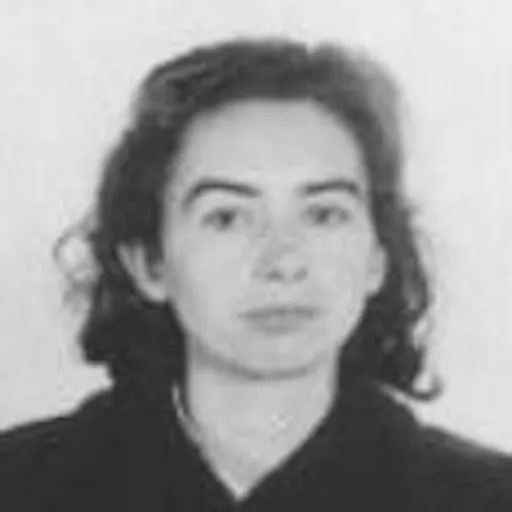
About Ursula Goetze
Lived 1916 – 1943 (aged 27). Ursula Goetze was a spy and resistance fighter.
Ursula Goetze (29 March 1916 – 5 August 1943) was a Berlin student and resistance fighter, who participated in political opposition to the Nazi government in Germany. In May 1942, following involvement in a leafleting campaign, she was arrested and, some time later, sentenced to death. She died by decapitation with a guillotine.
Life Provenance and early years Ursula Goetze was her parents' third recorded child, born into a middle-class family. Her father, Otto Goetze, ran a wallpaper factory. Later, her parents became hoteliers when Otto and Margarete Goetze took over the "Thüringer Hof" (hotel) in Berlin's Hedemannstraße (Hedemann Street). which they had till this point shared with their children.
Ursula stayed on in the former family home at Hornstraße 3 (3 Horn Street) in Berlin-Kreuzberg, which was becoming a meeting point where friends gathered together to listen illicitly to "enemy radio propaganda programmes": these became important as sources of information. Her fluency in French also meant she was able to translate anti-fascist leaflets into that language.
It is not clear how much the Gestapo had been aware of Goetze's resistance activities up to this point, but if it had not happened before, by the end of August 1942 she and Krauss had been identified as members of the "Red Orchestra". They both faced the court on 18 January 1943 and were sentenced to death.
In prison during the final months of her life, Goetze developed strong feelings of guilt, believing she had said more than was necessary and thereby unnecessarily incriminating Werner Krauss, who had had strong doubts about the sticker campaign. In order to save her friend, she tried to take full responsibility onto her own shoulders, which meant disputing statements extracted from Fritz Thiel (who had already been executed). Thiel, under torture, had strongly implicated both Goetze and Krauss. In the end, the death sentence handed out to Krauss was replaced, on 14 September 1944, by a five-year prison sentence.
Ursula Goetze was one of sixteen people executed during a 45-minute period at the Plötzensee prison during the early evening of 5 August 1943.
Don’t just read it —
keep it.
Full-length biographies made to live with: read them, listen on the way to work, watch them tonight.
- E-book
- Audio
- Video
Instant download · yours to keep · every purchase keeps this site free
Important facts
People in Ursula Goetze's life
Named in this biography and alive at the same time

Related people
Same field, nearest in time




Contemporaries
People whose lives overlapped Ursula Goetze's




Frequently asked questions
Who was Ursula Goetze?
resistance fighter against the national socialism (1916–1943)
When was Ursula Goetze born?
Ursula Goetze was born on 29 March 1916 in Berlin.
When did Ursula Goetze die?
Ursula Goetze died on 5 August 1943 in Plötzensee Prison.
What was Ursula Goetze's occupation?
Ursula Goetze was a spy and resistance fighter.
What nationality was Ursula Goetze?
Ursula Goetze's recorded nationality: German Reich, Nazi Germany.
Sources & further reading
Cite this page
APA: Biography.guide. (2026). Ursula Goetze. https://biography.guide/ursula-goetze/
MLA: "Ursula Goetze." Biography.guide, https://biography.guide/ursula-goetze/.
Chicago: "Ursula Goetze." Biography.guide. https://biography.guide/ursula-goetze/.
Data last updated: 2026-09-22 · Spot an error? Report a correction.
Portrait: Wikimedia Commons · author & licence
Page generated 2026-09-27 05:01 UTC