About Elvire De Greef
Lived 1897 – 1991 (aged 94). Elvire De Greef was a Belgian resistance fighter.
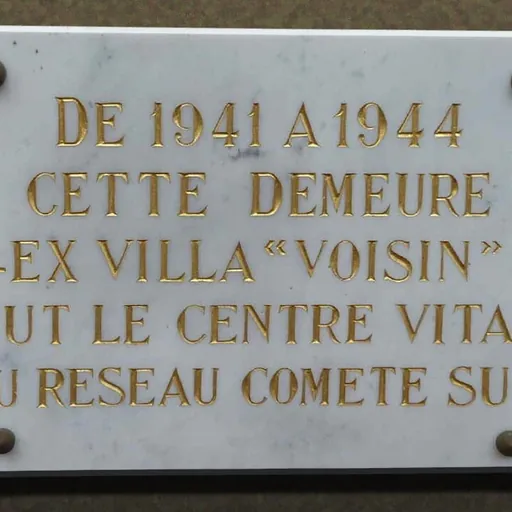
Elvire De Greef, (born June 29, 1897, Ixelles, Belgium, d. August 20, 1991, Brussels), code name Tante Go or Auntie Go, was a member of the Comet Escape Line in World War II. From her house in Anglet in southwestern France, near the border with Spain, she led efforts by the Comet Line in the Basque country to exfiltrate people from occupied Belgium through France to Spain, especially Allied airmen whose aircraft had been shot down by Nazi Germany. Once across the border in neutral Spain the escapees were transported to the United Kingdom. De Greef's husband and two teenage children also worked with the Comet line.
De Greef was a recipient of the George Medal from the United Kingdom and the Medal of Freedom from the United States. Unlike many of the leaders of the Comet Line, De Greef was never captured by the Germans. Authors Nichol and Rennell regarded De Greef as the most important person of the Comet Line, except for founder Andrée de Jongh.
Background Born Elvire Ghislaine Berlemont, she married Fernand De Greef (born November 11, 1902) in 1922. The couple had two children: Frederick, born in 1923, and Janine (born September 29, 1925). In May 1940, when the German army invaded and occupied Belgium, the De Greef family and an Englishman named Albert Edward Johnson fled in an attempt to transit Spain and take refuge in the United Kingdom. Finding the border with Spain closed, they moved into a vacant house in Anglet, a town in the Basque Country of southwestern France about from the border with Spain. Johnson, code named "B", formerly a chauffeur in Belgium, lived with the De Greefs, aiding them as a handyman. Johnson and the De Greef children would later serve as couriers and guides for airmen attempting to escape to Spain. Their house, the "Villa Voisin", was less than from the house where the German military commander lived.
When the Germans occupied the area in June 1940, Fernand got a job with the city government. As a translator and interpreter for the French with the German army, he had the opportunity to gather intelligence and steal and falsify documents, stamps, and identification cards and was assisted by his son, Frederick. Elvire became involved in the black market and smuggling, a time-honored occupation of people on the Franco-Spanish border. The German occupiers were among her customers, relationships which she would rely on later. Her well-known black marketing activities gave her an excuse to be seen at odd times and odd places. Before leaving Brussels, Elvire had let it be known to a banker named Appert (or Apper) that she wanted to be involved in the resistance to the Germans. They agreed that a person sent by Appert to seek help from the De Greef's would present him or herself with the password of "Is Go dead?" Gogo was the name of a deceased pet dog of the De Greef's. Her husband Fernand's code name was "Uncle."
Andree de Jongh and Arnold Deppé, assisted by the De Greefs, attempted their first crossing of the Spanish border in July 1941 with 10 Belgians and "Miss Richards", supposedly an English woman but actually a Belgian secret agent named Frederique Dupuich. After they successfully crossed the border, de Jongh and Deppé left their charges to fend for themselves, and returned to Belgium. The 10 Belgians and "Miss Richards" were arrested by Spanish police. Three Belgian soldiers among them were turned over to the Germans in France. The others were jailed briefly and fined. From this experience, de Jongh realized that in future exfiltrations they must accompany their charges secretly all the way to the British Consulate in Bilbao.
In August, Deppé and de Jongh escorted another group of people, de Jongh taking a longer, more rural, and safer route with three men, including a British soldier, and Deppé a shorter, more dangerous route with six men. An informer betrayed Deppé and his party and they were arrested by the Germans. Deppé was imprisoned for the remainder of the war. De Jongh arrived safely at the De Greef house in Anglet and crossed into Spain with a Basque smuggler, Thomas Anabitarte, as a guide. Anabitarte had been hired by Elvire for his knowledge of the mountainous border region. De Jongh and her charges arrived safely at the British Consulate in Bilbao. She persuaded the British government to pay the Comet Line's expenses for transporting allied soldiers and airmen from Belgium to Spain, but declined all other assistance and guidance offered by the British.
Leader of the southern Comet Line Elvire De Greef was the leader of the southern section of the Comet Line. Her helpers included the three members of her family, about a dozen other key people who lived in neighboring cities and towns plus a number of sympathizers, and several Basque guides who were paid for leading escapees over the mountains into Spain. She also had helpers inside Spain who received the escapees and assisted their onward journey to San Sebastián and Bilbao. In three years of activity de Greef aided 101 exfiltration missions which successfully exfiltrated 288 airmen, mainly British and American, and 84 other persons, mostly Belgians, needing to escape occupied Europe. The allies put a high priority on recovering airmen shot down in Europe and returning them to service as it was time-consuming and expensive to train replacement aircrew. De Greef also supervised the finances of the southern section, accounting for the expenditure of 17 million French Francs (equivalent to 5 million in 2017 U.S. dollars). Most of the money came from the United Kingdom.
One of De Greefs most important helpers was a Basque widow, Kattalin Aguirre, who along with her 14-year-old daughter, Josephine ("Fifine"), provided a safe house for airmen after they got off the train in Saint-Jean-de-Luz and set them on their way toward the nearby border. The Euskalduna Hotel where Aguirre worked was a meeting place for smugglers and Comet Line helpers. Elvire De Greef's daughter, Janine (often spelled Jeanine), was the youngest guide of the Comet Line, first accompanying aviators by train from Paris to Bayonne when she was only 16.
The usual practice of the Comet Line was for airmen and other evacuees to travel by train from Brussels or Paris with an escort, often Andree de Jongh, to either Bayonne or Saint-Jean-de-Luz. Both cities were near the De Greef's home and the border with Spain. The airmen and their escort were met and conducted to a safe house where they would await favorable conditions for the walk to Spain over the Pyrenees mountains which reached elevations of only about in this region. During the first year of operation, the De Greef's home usually hosted the evacuees, but later a network of safe houses was established. From the safe houses, the evacuees were escorted to country homes and inns near Urrugne, usually traveling by bicycle. From Urrugne it was a one to three night hike of about with a Basque guide, usually one who had been a smuggler and knew the mountains intimately, across the Franco-Spanish border to Oiartzun, near San Sebastián. There, the evacuees were met by a driver and automobile belonging to British diplomats which took them to Madrid. From Madrid, the evacuees were escorted by British diplomats to Gibraltar from where they would be flown to the United Kingdom.
The most dangerous part of the walk across the mountains was the crossing of the Bidassoa river near Endarlatsa. The Bidassoa River was the border of France and Spain. Border guards were on both sides of the river and high water often made the crossing of the river difficult or impossible. In December 1943, Comet Line leader Antoine d'Ursel and American pilot James F. Burch were drowned while attempting to cross the river. Her daughter Janine, only 16 years old, made four visits to Paris in 1942 to assist Andrée de Jongh in escorting evacuees from Paris by train to the border of Spain. Jean-François Nothomb guided many evaders from Paris to Spain from October 1942 to January 1944. Several Basque guides worked with the Comet Line, the most competent being Florentino Goikoetxea, a smuggler and a fugitive from Franco's Fascist government, who could find his way across the Pyrenees at night without difficulty.
The end of the Comet Line As the demand for expatriation of flyers increased in 1943, the Comet Line added additional routes to Spain in addition to the one supervised by Elvire De Greef. On June 6, 1944 with the German Gestapo closing in on the De Greefs and their organization, Elvire and her son and daughter crossed the border into Spain. The children were evacuated to England. Elvire returned to France shortly.
The De Greef family returned to Belgium after the country was liberated from the Nazis.
Don’t just read it —
keep it.
Full-length biographies made to live with: read them, listen on the way to work, watch them tonight.
- E-book
- Audio
- Video
Instant download · yours to keep · every purchase keeps this site free
Important facts
People in Elvire De Greef's life
Named in this biography and alive at the same time


Related people
Same field, nearest in time


Contemporaries
People whose lives overlapped Elvire De Greef's


Frequently asked questions
Who was Elvire De Greef?
Belgian member of the Comet line in World War II
When was Elvire De Greef born?
Elvire De Greef was born on 29 June 1897 in Etterbeek.
When did Elvire De Greef die?
Elvire De Greef died on 20 August 1991 in Brussels-Capital Region.
What was Elvire De Greef's occupation?
Elvire De Greef was a resistance fighter.
What nationality was Elvire De Greef?
Elvire De Greef was Belgian.
Sources & further reading
Cite this page
APA: Biography.guide. (2026). Elvire De Greef. https://biography.guide/elvire-de-greef/
MLA: "Elvire De Greef." Biography.guide, https://biography.guide/elvire-de-greef/.
Chicago: "Elvire De Greef." Biography.guide. https://biography.guide/elvire-de-greef/.
Data last updated: 2026-09-22 · Spot an error? Report a correction.
Portrait: Wikimedia Commons · author & licence
Page generated 2026-09-27 05:03 UTC