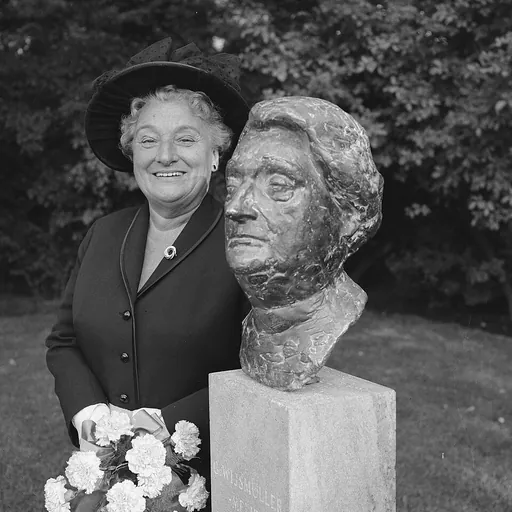
About Gertruida Wijsmuller-Meier
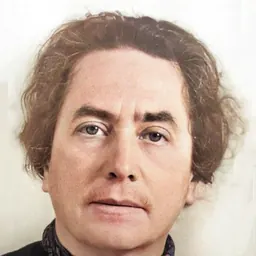
Lived 1896 – 1978 (aged 82). Gertruida Wijsmuller-Meier was a Dutch resistance fighter.
Geertruida Wijsmuller-Meijer (21 April 1896, Alkmaar – 30 August 1978, Amsterdam) was a Dutch resistance fighter who brought Jewish children and adults into safety before and during World War II. Together with other people involved in the pre-war Kindertransport, she saved the lives of more than 10,000 Jewish children, fleeing antisemitism. She was honored as Righteous among the Nations by Yad Vashem. After the war she served on the Amsterdam city council.
Early life Geertruida Wijsmuller-Meijer, known as "Truus" to her family, was born in the city of Alkmaar. She was the firstborn child of Jacob Meijer, who worked in a drug store, and Hendrika Boer, a self-employed dressmaker. Truus came from a reformed liberal family. For two years she attended the School of Commerce. Her teachers described her as a "desperate case", "even though she is diligent". But gradually things got better, In 1913, the family moved to Amsterdam. Her parents taught her to stand up for people who deserve and need it. In 1919 after World War I, they set an example of helping the needy by taking into their home an Austrian boy who needed to recuperate.
A year later, she got her first job at a bank, where she met her future husband, the banker J. F. (Joop) Wijsmuller. They married in 1922 and lived on the Nassaukade in an apartment on the third floor. Wijsmuller stopped working, as was legally required.at the time. When it became clear that they were not having children, Wijsmuller became involved in social work. Through her social work she met Jewish women. Her husband supported her in all her activities. From 1933, they could always count on their live-in assistant, Cietje Hackmann, who did administration work and took care of children, if they stayed with them, when Wijsmuller was away from home.
Social and political work
Wijsmuller took on several unpaid jobs as a social worker, including as a coordinator for an association for homecare, and administrator for a daycare center for children of working women. From 1939 on, she was a board member of Beatrix-Oord, a sanatorium in Amsterdam. After the war she had it converted into a general hospital, where abortion was offered. She joined the Vereeniging voor Vrouwenbelangen en Gelijk Staatsburgerschap ("Association for Women's Interests and for Equal Citizenship"). There she met chairman Mies Boissevain-van Lennep, who would later become a resistance fighter.
In addition to this work, Wijsmuller was nominated as number 6 on the list of Liberal candidates for the Amsterdam city council elections in 1935. Because of the threat of war she founded the Korps Vrouwelijke Vrijwilligers (KVV; "Corps for Female Volunteers") in 1938, which she managed from her home. Soon she had an extensive network of people.
Work with Jewish children and refugees (1933 onward) From 1933 onward, when Hitler came to power in Germany, Wijsmuller traveled to Germany to fetch family members of Jewish acquaintances and bring them safely to the Netherlands. She did so for many years.
After Kristallnacht in 1938, rumours reached her that Jewish children were wandering unattended in the woods, so she went to the Dutch–German border to investigate. She smuggled a Yiddish-speaking Polish boy across the border under her skirts, and took him to Amsterdam.
On 17 November 1938, she took her first group of six Jewish children from the crowded waiting room of the Dutch consulate in Hamburg to the train. Customs attempted to remove them from the train, but Wijsmuller noticed that the Dutch Princess Juliana was on the coupe next to her. She threatened customs that she would involve the princess if there escalated matter, after which customs backed down.
In November 1938, the British Government decided to let Jewish children under the age of 17 from Nazi countries enter the United Kingdom for a temporary stay. Various organisations started working together in the Refugee Children's Movement (RCM) to take care of these children.
A visit to Eichmann On December 2, Wijsmuller received a request to come to the newly established Dutch Children's Committee in Amsterdam. During this visit, Norman Bentwich from England was also present. He asked her to travel to Vienna to meet a certain Dr. Eichner, which they believed was the name of Adolf Eichmann. She left to Vienna the same day.
Eichmann then was the Nazi official handling the forced "emigration" of Jews. It was thought that Wijsmuller, as a non-Jewish woman, might be able to get permission from the Nazis for the children to travel to Britain. Eichmann snarled at her, but Wijsmuller was imperturbable and fearless. She told him why she came. "Unbelievable, so rein-arisch und dann so verrückt!" ("so purely Aryan and then so crazy"), Eichmann concluded. He responded by giving her permission to travel with 600 children, but it had to happen by the upcoming Saturday, on Shabbat, a deadline he seemed to assume she would not be able to make.
She reserved trains at the station, and, with the help of the parents and Jewish organisations, succeeded in evacuating 600 children from Vienna on 10 December. The journey from Vienna to Hook of Holland took around 30 hours. One hundred of the children received shelter in the Netherlands, while 500 traveled on to Britain. In England, Wijsmuller had contact with Lola Hahn-Warburg (a chairwoman from the RCM, who asked in astonishment: "but you were only sent to talk?" when Wijsmuller arrived with 600 children. In the Netherlands, she cooperated with the social worker Gertrude van Tijn from the , belonging to the Committee for Jewish Refugees), Mies Boissevain-van Lennep and many others.
Wijsmullers' vigour was fuelled by the degrading way she had seen Jewish inhabitants treated in Vienna. In the Netherlands, however, nobody believed what she had seen.
December 1938 till September 1939 Kindertransport
From then until the outbreak of World War II on September 1, 1939, Wijsmuller organised children's transports with children up to 17 years old from Nazi Germany and the annexed territories, mainly to Great Britain, but also to the Netherlands, Belgium and France. The trains from the south-east arrived via Emmerich on Tuesdays and Wednesdays; the trains from the north-east passed Bentheim on Thursdays.
After the first large transport, the work involved became more structured and a maximum of 150 children per transport was agreed upon. Several times a week, Wijsmuller traveled to Germany and Nazi-occupied territories to pick up children and arrange things on site with the organisers involved.
The children were allowed to take one suitcase, 10 German Marks and no photos or valuables. Mostly - but it was not always allowed- Jewish companions traveled with the children to the UK border, provided they all returned. Otherwise the transports would have ended. Once a group of weakened women and children of Sudeten Germans traveled with them.
This operation carried out under pressure required the cooperation of parents, guardians and various committees with volunteers in multiple cities and countries. Women took primary responsibility for the travel and accommodation of the children.
Wijsmuller was convinced of the urgency of these transports and gave momentum to the "Kindertransporte", as the evacuations came to be called. She maintained contacts with all of the parties involved in several countries, including the main committees in Vienna, Hamburg, Frankfurt and Berlin (from March 1939 in Prague and Dantzig ) and also the train and boat companies.
She always carried in her handbag a toothbrush, a bar of soap and a towel, as she could be asked at any time to travel. Wijsmuller took responsibility for the travel documents when traveling.. She arranged, that the border police and customs controls were carried out as much as possible on the way before the border. And under her guidance (or under that of one of the other Dutch women). That prevented delays.
On August 24, 1939, Wijsmuller was met at the border by a delegation from the Gestapo with a brass band. She was forced to celebrate with them that she had crossed the border at Bentheim for the 50th time.
Wijsmuller was later quoted saying that the success of the operation was mainly due to the Jewish committees in Vienna, Frankfurt, Hamburg, Berlin and Breslau (and later in Prague, Dantzig and Riga). A miracle of self-control in her eyes, because she realized how afraid people must have been to send their children into the world.Nearly 10.000 children from Nazi-occupied territory reached the safety of England. In the Netherlands approximately 1800 children from the Third Reich remained.
Other people organised evacuation transports too, for example Nicholas Winton and Recha Freier. Ultimately, 10,000 children up to 17 years old were saved from a certain death by being transported on a route via the Netherlands into Great Britain. Approximately 1800 refugee children from nazi-countries remained in the Netherlands.
The outbreak of the war between Great Britain and Germany in September 1939 put a stop to these transports, as from then on the borders to the UK were closed.
Children in the Burgerweeshuis From March 1939 onwards Wijsmuller was on the board of the Amsterdam orphanage Burgerweeshuis (now the Amsterdam Museum), which started to accommodate the refugee children. Wijsmuller and her husband were very involved with the children. The children came in small groups to stay overnight at the Wijsmullers'. Joop Wijsmuller took them on outings, for example to Artis, the Amsterdam zoo. The children called Wijsmuller "Tante Truus" (Auntie Truus).
June and July 1939 Refugee ships In June 1939, international negotiations took place in Antwerp among European countries about the distribution of nearly one thousand Jewish refugees on the MS St. Louis. Wijsmuller was part of the Dutch delegation, who boarded the ship and welcomed the 181 refugees on their arrival in the Netherlands. In July 1939 Wijsmuller was involved in the departure of children on the cargoship the Dora which eventually landed with 450 refugees in the then-British Mandatory Palestine.
September–December 1939 Last journeys from the German border The mobilisation disrupted train traffic and the border at Bentheim in Germany was closed. On 31 August Wijsmuller was told that a group of children from the Youth Aliyah was stuck in Kleve. She arranged travel documents, picked the children up in buses and took them to the boat in Hoek van Holland.
On 1 September, she received a telephone call from Germany that Orthodox boys were stranded at the station of Kleve. The Dutch Railways put together a train for her, consisting of dining cars. At the station at Kleve she also found a group of 300 Orthodox men from Galicia. She told the Germans that "after all, these are also boys", and got permission for them to leave. It was the last group to leave Nazi territory via Vlissingen to England.
In November and December 1939, she regularly collected Jewish refugees stranded in Bentheim (from Vienna and other places) who had papers for America. They left with the Holland America Line from Rotterdam.
September 1939 - May 1940 journeys to England and the south of France From September 1939 till May 1940, Wijsmuller helped Jewish children and adults stranded in the Netherlands, Belgium, Denmark and Sweden. She traveled with them to England, Spain, and the unoccupied parts of France. In Denmark she arranged an airplane and gasoline for the refugees. On these journeys (by plane to Amsterdam and from Amsterdam by plane to England, and by train to Marseille) she accompanied the refugees. She also arranged the necessary but hard-to-get travel documents.
Wijsmuller was described as a born tour conductor, being able to reassure the refugees and to identify the talented children aboard for songs, recitations and performances during the long train journey. From Marseille, people traveled on by boat to try to reach Mandatory Palestine.
In November 1939, Wijsmuller was arrested and mistreated by the French in Marseille, suspecting she was the much-wanted German spy "Erika". Due to a lack of evidence she was released.
May 1940 Children from the Burgerweeshuis to England On 10 May 1940, Wijsmuller was in Paris to take a child away when she heard of the German invasion of the Netherlands.She knew when the invasion would take place and had warned about it in The Hague. However, she was laughed at. Within three days she traveled back to Amsterdam, where she immediately was arrested and questioned by the Dutch police, on suspicion of espionage. After her release she went to the orphanage Burgerweeshuis to see the children. The local garrison commander passed a request on to her from London to arrange for the Jewish children at the orphanage to travel as fast as possible to the coastal town of IJmuiden so they could catch a boat to England on time.
Wijsmuller brought along as many children as possible on the way, bringing a total of 74 children to the very last boat, the SS Bodegraven", that left the harbor. Minutes later the Dutch government surrendered. The Bodegraven sailed for England, but due to the German nationality of the children, at first they were not allowed to disembark. Eventually the ship moored on 19 May at Liverpool.
The children spent the war with foster families and in various institutions in England. Wijsmuller decided to stay in the Netherlands. She wanted to be with her husband and besides she found there was more work for her to do.
May 1940-1943 Help for Jewish children in wartime After the capitulation of the Netherlands, Wijsmuller traveled to Brussels. There, she consulted with the Belgian Red Cross and the Belgian Children's Committee. In Paris she had also contact with the French Red Cross and with the OSE (Oeuvre Secours aux Enfants, a Jewish aid organisation for children). During this period Wijsmuller devoted herself to uniting families. She took children to their parents who had escaped to Belgium and France. On her way back she brought children with her whose parents remained in the Netherlands. Sometimes she brought children to their parents in Germany. She placed children of Jewish women with other, safe families shortly after birth. In Brussels she made contact with Benno M. Nijkerk, (1906-1944 Neuengamme) a Dutch-Belgian businessman. They agreed to bring as many children as possible to the south, legally or illegally.
Nijkerk had false identity cards forged in Brussels. He was the treasurer of the "Comité de Défense des Juifs", a Belgian Jewish resistance group. Later he became a member of "Dutch-Paris", an underground network of the Dutch, Belgian and French resistance. Wijsmuller smuggled the false identity cards with information about the escape route to Holland. This work continued until at least 1943.
In June 1943, she traveled for the last time with Jewish children in the direction of the Spanish border. People also brought food to her house to distribute. An egg merchant from Landsmeer brought her about 1000 duck eggs every week. Wijsmuller then delivered them to elderly homes and hospitals in the city. She called this work the "foodbusiness".
September 1944 Children from Westerbork In September 1944, Wijsmuller discovered that 50 "orphans" (Jewish children taken up without their parents) from Westerbork would be deported. She regularly had brought food to a number of these children in the Amsterdam Huis van Bewaring (house of detention). Alarmed by this news, she went to the Nazis. She claimed that she knew these children were not Jewish, but born out of Dutch non-Jewish mothers and German soldiers. According to the law these children were Dutch. To prove her point she showed a Dutch bill which she had manufactured herself. She insisted on "special treatment" for the children. The children traveled on to Theresienstadt, stayed together as a group and returned after the war.
Contacts with nazis With the Nazis, Wijsmuller had contacts from high to low. She used it when she wanted something done from them. For example, she received travel documents for Jewish children to leave the country from a Gestapo employee who believed that children belonged with their parents. Before that, she had accepted his invitation to have a drink with him on an Amsterdam terrace. He saw her walking in the street and recognized her. Previously he was a border official during the "Kindertransport".
In May 1941, SS member Rajakowitsch called her to The Hague. He demanded her to write down what she was doing and stop her help. Wijsmuller pretended ignorance, acting as if she did not understand how serious the situation was.
Wijsmuller later praised German officers for helping her in dire situations.
Hunger winter 1944-1945 Hunger became a serious issue in the Dutch cities. When it was no longer possible to send food parcels to the camps, Wijsmuller, as a member of an interconfessional group, organized the evacuation of 6,649 famished children From 1945 until 1966, she was a member of the Amsterdam city council for the liberal party (VVD). She was involved in social work and many social projects in the Netherlands and abroad.
Soon, she was on about 12 boards and committees. She was involved in the creation of workplaces for the disabled in Amsterdam and the founding of a hospital in Suriname. In 1957, she was a founder and board member of the Anne Frank House. She remained a board member until 1975. As a director and board member she had the Amsterdam sanatorium "Beatrix" converted into a general hospital. Abortion were offered there.
Most of the Jewish children found that their parents did not survive the Shoah, but some were reunited with their families. Until her death Wijsmuller kept in touch with children she saved, from Enkhuizen to England and Israel.
Joop Wijsmuller died on December 31, 1964. Cietje Hackman lived with Wijsmuller until her death on August 30, 1978. Wijsmuller left her body for scientific research.
In an advertisement after her death, she was described as the "Mother of 1001 children, who made her job of saving Jewish children".
Memories of Wijsmuller Wijsmuller has been described and remembered as having an impressive personality and a powerful voice. She was energetic and practical. Cheeky but never rude. She could improvise and negotiate. It was her preference to work on her own, as she considered that safer. Wijsmuller never accepted money for her work.
In the months and years following the outbreak of the war she never ceased to go wherever work needs to be done.
In the postwar years she was also characterized as a headstrong and dominant woman, Asteroid number 15296 is named "Tante Truus" ("Auntie Truus") after her. On March 8, 2020 "Truus' Children" was released, a documentary by Pamela Sturhoofd and Jessica van Tijn from "Special Eyes". It is an ode to Wijsmuller, with interviews with more than 20 children whom she saved. Hoek van Holland, Monument KindertransportenA statue of Truus Wijsmuller and the "1001 children" she helped saving was unveiled on 1 July 2020 in her hometown of Alkmaar. The tribute was an initiative of the Historical Society of Alkmaar. The statue was made by Annet Terberg-Pompe and Lea Wijnhoven.
Distinctions Knight in the order of Orange Nassau, 21-04-1955 for social work in Amsterdam, Medal of French Gratitude (Reconnaissance Francaise), silver medal for help to French soldiers Medals from the Dutch and German Red Cross in 1962, for assistance for Jewish children Righteous among the Nations in 1966 Truus Wijsmuller tree in Yad Vashem in 1966 Officer in the order of Orange Nassau 19-04-1971 as a treasurer of the Koningin Wilhelmina Fonds Honorary Citizen of Amsterdam (Silver Medal) April 1971, for her work for the city
Don’t just read it —
keep it.
Full-length biographies made to live with: read them, listen on the way to work, watch them tonight.
- E-book
- Audio
- Video
Instant download · yours to keep · every purchase keeps this site free
Important facts
People in Gertruida Wijsmuller-Meier's life
Named in this biography and alive at the same time



Related people
Same field, nearest in time


Contemporaries
People whose lives overlapped Gertruida Wijsmuller-Meier's

Frequently asked questions
Who was Gertruida Wijsmuller-Meier?
Dutch Righteous Among the Nations (1896-1978)
When was Gertruida Wijsmuller-Meier born?
Gertruida Wijsmuller-Meier was born on 21 April 1896 in Alkmaar.
When did Gertruida Wijsmuller-Meier die?
Gertruida Wijsmuller-Meier died on 30 August 1978 in Amsterdam.
What was Gertruida Wijsmuller-Meier's occupation?
Gertruida Wijsmuller-Meier was a resistance fighter.
What nationality was Gertruida Wijsmuller-Meier?
Gertruida Wijsmuller-Meier was Dutch.
Sources & further reading
· Wikipedia: Gertruida Wijsmuller-Meier
· DBpedia: Geertruida Wijsmuller-Meijer
Cite this page
APA: Biography.guide. (2026). Gertruida Wijsmuller-Meier. https://biography.guide/gertruida-wijsmuller-meier/
MLA: "Gertruida Wijsmuller-Meier." Biography.guide, https://biography.guide/gertruida-wijsmuller-meier/.
Chicago: "Gertruida Wijsmuller-Meier." Biography.guide. https://biography.guide/gertruida-wijsmuller-meier/.
Data last updated: 2026-09-22 · Spot an error? Report a correction.
Portrait: Wikimedia Commons · author & licence
Page generated 2026-09-27 05:04 UTC