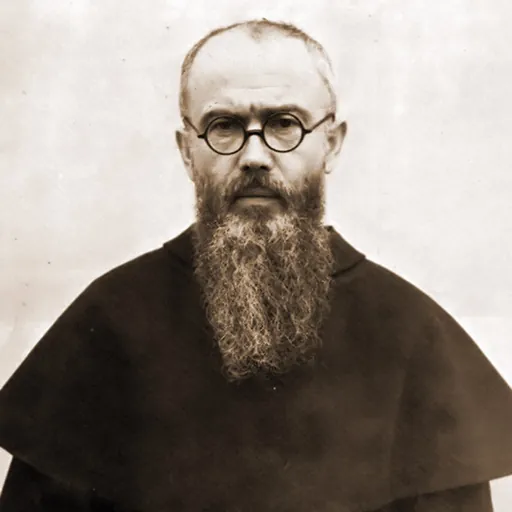
Maximilian Kolbe
Polish Conventual Franciscan friar, martyr and saint of the Roman Catholic Church
About Maximilian Kolbe
Lived 1894 – 1941 (aged 47). Maximilian Kolbe was a Russian and Polish resistance fighter, regular priest, amateur radio operator, preacher, confessor and theologian.
Maximilian Maria Kolbe, OFM Conv. (born Raymund Kolbe; ; 8 January 1894 – 14 August 1941) was a Polish Conventual Franciscan friar, priest, missionary, and martyr. He volunteered to die in place of a man named Franciszek Gajowniczek in the German death camp of Auschwitz, located in German-occupied Poland during World War II. He had been active in promoting the veneration of the Immaculate Virgin Mary, founding and supervising the monastery of Niepokalanów near Warsaw, operating an amateur-radio station (SP3RN), and founding or running several other organizations and publications.
On 10 October 1982, Pope John Paul II canonized Kolbe and declared him a martyr of charity. The Catholic Church venerates him as the patron saint of amateur radio operators, drug addicts, political prisoners, families, journalists, and prisoners. He later described this incident:
That night I asked the Mother of God what was to become of me. Then she came to me holding two crowns, one white, the other red. She asked me if I was willing to accept either of these crowns. The white one meant that I should persevere in purity and the red that I should become a martyr. I said that I would accept them both. adopting the additional name of Maria (Mary).
Kolbe earned a Doctor of Philosophy from the Gregorian in 1915. Kolbe then continued his studies at the Pontifical University of St. Bonaventure in Rome, where he earned a doctorate in theology in either 1919
Priesthood In 1918, Kolbe was ordained a priest. The monastery soon began publishing a Japanese edition of the Knight of the Immaculata. Kolbe returned to Japan and remained there until called back to attend the Provincial Chapter in Poland in 1936. There he was appointed guardian of Niepokalanów, thus precluding his return to Japan. In 1938, he started a radio station at Niepokalanów, Radio Niepokalanów. Impatient to empty the bunker, the guards gave the four remaining prisoners lethal injections of carbolic acid. Kolbe is said to have raised his left arm and calmly waited for it. On 12 May 1955, Kolbe was recognized by Pope Pius XII as a servant of God.
The feast of Saint Maximilian Kolbe was added to the General Roman Calendar. He is one of 10 20th-century martyrs depicted in statues above the Great West Door of the Anglican Westminster Abbey in London.
Controversies Kolbe's recognition as a martyr generated some controversy within the Catholic Church. In a 1924 column, he cited the Protocols of the Elders of Zion as an "important proof" that "the founders of Zionism intended, in fact, the subjugation of the entire world", but that "not even all Jews know this". In a calendar that the publishing house of his organization, the Militia of the Immaculate, published in an edition of a million in 1939, Kolbe wrote, Atheistic Communism seems to rage ever more wildly. Its origin can easily be located in that criminal mafia that calls itself Freemasonry, and the hand that is guiding all that toward a clear goal is international Zionism. Which should not be taken to mean that even among Jews one cannot find good people. In his periodicals, Kolbe published articles about topics such as a Zionist plot for world domination.
According to the anti-racist "Never Again" Association: In 1938, in 'Maly Dziennik', Kolbe argued, 'Jewry has harmed and continues to harm us all the time, it is eating into the body of the nation like a cancer.
During World War II, Kolbe's monastery at Niepokalanów sheltered Jewish refugees. The 2025 film Triumph of the Heart tells the story of Kolbe's final weeks in the Block 11 starvation chamber. The film was written and directed by Anthony D'Ambrosio and stars Marcin Kwasny.
Immaculata prayer Kolbe composed the Immaculata prayer as a prayer of consecration to the Immaculata.
Don’t just read it —
keep it.
Full-length biographies made to live with: read them, listen on the way to work, watch them tonight.
- E-book
- Audio
- Video
Instant download · yours to keep · every purchase keeps this site free
Important facts
more
Maksymilian, Saint Maximilian Kolbe, Maximilian Kolbe OFMConv.People in Maximilian Kolbe's life
Named in this biography and alive at the same time


Related people
Same field, nearest in time


Contemporaries
People whose lives overlapped Maximilian Kolbe's


Frequently asked questions
Who was Maximilian Kolbe?
Polish Conventual Franciscan friar, martyr and saint of the Roman Catholic Church (1894–1941)
When was Maximilian Kolbe born?
Maximilian Kolbe was born on 8 January 1894 in Zduńska Wola.
When did Maximilian Kolbe die?
Maximilian Kolbe died on 14 August 1941 in Auschwitz.
What was Maximilian Kolbe's occupation?
Maximilian Kolbe was a resistance fighter, regular priest, amateur radio operator, preacher, confessor and theologian.
What nationality was Maximilian Kolbe?
Maximilian Kolbe was Russian and Polish.
Sources & further reading
Cite this page
APA: Biography.guide. (2026). Maximilian Kolbe. https://biography.guide/maximilian-kolbe/
MLA: "Maximilian Kolbe." Biography.guide, https://biography.guide/maximilian-kolbe/.
Chicago: "Maximilian Kolbe." Biography.guide. https://biography.guide/maximilian-kolbe/.
Data last updated: 2026-09-20 · Spot an error? Report a correction.
Portrait: Wikimedia Commons · author & licence
Page generated 2026-09-27 04:57 UTC