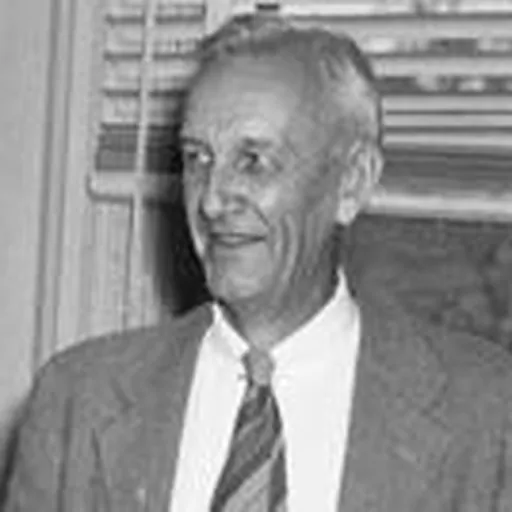
About Walter Richard Miles
Lived 1885 – 1978 (aged 93). Walter Richard Miles was an American psychologist and university teacher.
Walter Richard Miles (March 29, 1885 – May 15, 1978) was an American psychologist and a president of the American Psychological Association (APA). He best known for his development of the two-story rat maze, his research on low dose alcohol, the preservation and study of early Muybridge works, the development of red night vision goggles for aviation pilots, and the reduction of performance in aging individuals. The theme of his academic career was his fascination with apparatuses to measure behavior. C. James Goodwin noted that Miles "never became a leading figure in any particular area of research in psychology... but drifted from one area to another, with the direction of the drift determined often by the presence of a particular type of apparatus or an apparatus-related problem that intrigued him".
Early life Born into a Quaker family on March 29, 1885, in Silverleaf, North Dakota. Richard Walter Miles was the son of Thomas Elwood Miles, a farmer and country store owner, and Sarah Caroline Miles. His grandfather, Richard White, was a prosperous farmer in Indiana, but lost everything in the depression of the late 1870s.
Career
Wesleyan College/Carnegie Institution (1914–1922) Miles began working as a research scientist at Wesleyan College after receiving his PhD. He was recruited by Raymond Dodge to fill a one-year position here while Dodge left to work with F.G. Benedict at the Carnegie Nutrition Institute. When his year was up, he replaced Dodge at the Carnegie Nutrition Laboratory in Washington, D.C., where he remained until 1922. During his time here, much of his research focused on combined psychological and physiological measurements. In line with Miles' love of apparatuses, the two constructed an apparatus to measure the effects of variations in signal calling on the speed at which the lineman moved in reaction to the signal for snapping the ball. to measure eye motion and response times of intoxicated subjects. Psychologist C. James Goodwin reviewed Miles' work on alcohol research in a 2014 publication in the History of Psychology journal. He first examined the effects of moderate doses of alcohol (i.e., 14%–22% by weight) on behavior and demonstrated that this impairs motor skills. Specifically, he gave five male participants moderate doses of alcohol and demonstrated that alcohol reduces typing efficiency, finger movement speed, and horizontal eye movement speed. Miles came up with a novel method of disguising placebo beverages in this study that is still used today: wiping the rim of the glass with alcohol. In the second study, Miles used similar methodology as the first study with the exception of giving participants alcohol after eating a full meal to see if food diluted the effects of alcohol. It reduced adverse effects, but still impair performance. In the third study, Miles collaborated with T. M. Carpenter to examine the effects of alcohol administered via rectal injection during sleep. Rectal injection of either alcohol or a saline solution was used to ensure the participant did not know if he was being administered alcohol or a placebo, and because it was believed that alcohol would be absorbed more quickly into the bloodstream than by oral administration. In the fourth study, Miles examined the effects of low dose alcohol on behavior by conducting a series of studies of two years with a 36-year-old male. This study lead to the fifth set of studies that further examined low dose alcohol using 8 subjects between the ages of 22 and 52.
Miles' research on the effects of alcohol in the 1920s was fitting given the debate about alcohol that led to National Prohibition. However, the war had severed many relations Carnegie Laboratory had with researchers in Europe. As such, physiologist/chemist Francis Benedict chose Miles to reestablish important connections across Europe. This report was made available to the Archives of the History of American Psychology at the University of Akron and in September 2010 C. James Goodwin and Lizette Royer made this work available in print.
Stanford University (1922–1932) Although Walter R. Miles was satisfied with his work at the Carnegie Institute of Technology, he missed the teaching and academic atmosphere he had experienced during his earlier time at Wesleyan University. When Lewis Terman offered him a position at Stanford University in Palo Alto, he accepted. After Miles left Stanford to accept a faculty position at Yale University, Ernest Hilgard who succeeded him, remarked that the laboratory Miles left behind was "literally packed with devices ready to be operated, reminding me of a modern science museum".
Recognizing the historical and scientific value of Muybridge's work, Miles organized efforts to restore and preserve the surviving materials. He saw practical applications for Muybridge’s sequential photography in the study of human perception, particularly regarding how people perceive continuous motion from discrete images, a topic that would later become foundational in motion picture theory and cognitive psychology. Miles used these materials for teaching and research, thereby helping to integrate Muybridge's visual experiments into formal experimental psychology. His work ensured that Muybridge’s contributions extended beyond photography and art into the scientific understanding of motion and vision. Additionally, the Stanford University Libraries maintain documentation of the Muybridge Collection and acknowledge early preservation efforts initiated by faculty like Miles. Thanks to these interventions, Muybridge’s work remained accessible for later generations of researchers, historians, and artists.
Yale University (1932–1952) Miles first came to Yale in 1930 before returning to Stanford in 1931. He came to Yale at the request of Dodge who asked Miles is there was "any possibility of inducing you to come here in a position parallel with mine with the expectation that within a few years you will take my place". Dodge was suffering from Parkinson's disease and wanted Miles to take over. His work published from data collected at Yale were minor and highly specialized. Miles received the Howard Crosby Warren Medal from the Society of Experimental Psychologists in 1949, and American Psychological Foundation Gold Medal in 1962, and was elected to the National Academy of Science in 1933 and the America Philosophical Society in 1944. Kirk died in 1925, leaving Miles widowed with three teenage children. Two years later, he married psychologist Catharine Cox Miles, who was best known in the field of gifted education. He had one child with Catharine named Anna and a son, Charles, who died at birth. Miles and Catharine collaborated throughout their careers and were together until Miles' death on May 15, 1978, in Sandy Springs, Maryland. Catharine died less than a decade later.
Don’t just read it —
keep it.
Full-length biographies made to live with: read them, listen on the way to work, watch them tonight.
- E-book
- Audio
- Video
Instant download · yours to keep · every purchase keeps this site free
Important facts
Family & relationships
People in Walter Richard Miles's life
Named in this biography and alive at the same time




Related people
Same field, nearest in time


Contemporaries
People whose lives overlapped Walter Richard Miles's


Frequently asked questions
Who was Walter Richard Miles?
American psychologist (1885–1978)
When was Walter Richard Miles born?
Walter Richard Miles was born on 29 March 1885 in North Dakota.
When did Walter Richard Miles die?
Walter Richard Miles died on 15 May 1978 in Sandy Spring.
What was Walter Richard Miles's occupation?
Walter Richard Miles was a psychologist and university teacher.
What nationality was Walter Richard Miles?
Walter Richard Miles was American.
Sources & further reading
· Wikipedia: Walter Richard Miles
· DBpedia: Walter Richard Miles
Cite this page
APA: Biography.guide. (2026). Walter Richard Miles. https://biography.guide/walter-richard-miles/
MLA: "Walter Richard Miles." Biography.guide, https://biography.guide/walter-richard-miles/.
Chicago: "Walter Richard Miles." Biography.guide. https://biography.guide/walter-richard-miles/.
Data last updated: 2026-09-22 · Spot an error? Report a correction.
Portrait: Wikimedia Commons · author & licence
Page generated 2026-09-27 05:04 UTC